Himalaya Niti Abhiyan urges ban on highly hazardous pesticides
Source:new-indian-express ↗
Why It Matters
The regulation of highly hazardous pesticides is crucial for environmental sustainability, food safety, and public health. For HPAS aspirants, it touches upon key themes in GS3 (Agriculture and Environment) and highlights the role of civil society in governance, the application of central environmental legislation (Insecticides Act, 1968) at the state level, and state-specific agricultural practices like apple horticulture.
Summary
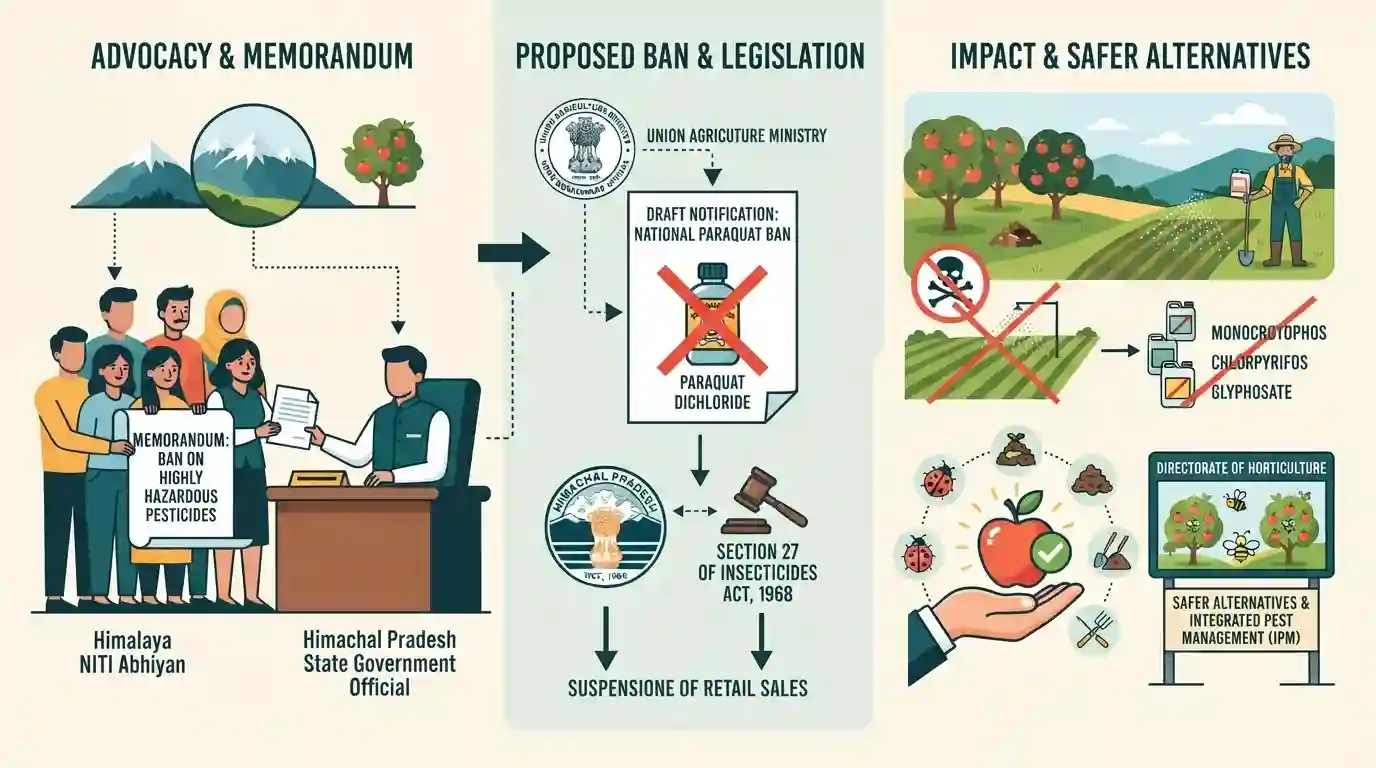
Himalaya NITI Abhiyan has submitted a memorandum to the Himachal Pradesh government advocating for an immediate ban on highly hazardous pesticides (HHPs), particularly the highly toxic herbicide paraquat dichloride. Citing a recent draft notification by the Union Agriculture Ministry that proposes a complete national ban on paraquat, the NGO urged the state to invoke Section 27 of the Insecticides Act, 1968, to suspend its retail sale. The memorandum also calls for the phased elimination of other toxic chemicals such as monocrotophos, chlorpyrifos, and glyphosate, noting that the state's Directorate of Horticulture already supports safer alternatives for apple growers.
Key Points
- The NGO Himalaya NITI Abhiyan has urged Himachal Pradesh CM Sukhvinder Singh Sukhu to halt the sale and use of highly hazardous pesticides (HHPs) like paraquat dichloride.
- The Union Ministry of Agriculture and Farmers Welfare issued a draft notification on July 10 to completely ban the import, manufacture, sale, and use of paraquat due to its severe toxicity.
- The NGO suggested invoking Section 27 of the Insecticides Act, 1968, to immediately suspend the retail sale of paraquat at the state level.
- Other HHPs like monocrotophos, chlorpyrifos, glyphosate, zinc phosphide, and carbofuran are also recommended for a phase-out.
- The state's Directorate of Horticulture already promotes alternative agro-ecological practices in its Apple Spray Schedule, making these toxic chemicals unnecessary for farmers.
Important Terms
Paraquat dichloride

A highly toxic, broad-spectrum herbicide used for weed control. With no known antidote, it causes severe organ failure. India recently issued a draft notification proposing a complete nationwide ban on its use.
UPSC context
GS Paper 3 (Agriculture/Environment). Essential for Prelims regarding hazardous agrochemicals and environmental health policies.
Insecticides Act, 1968
A central legislation regulating the import, manufacture, sale, and use of insecticides to prevent health risks. Section 27 empowers both Central and State governments to temporarily prohibit hazardous chemicals like paraquat.
UPSC context
GS Paper 2 & 3 (Governance/Agriculture). Tests understanding of statutory frameworks governing agrochemical regulation and Centre-State powers.
Highly Hazardous Pesticides (HHPs)
Pesticides presenting extremely high acute or chronic risks to human health or the environment. Chemicals like paraquat and monocrotophos fall into this category and face increasing regulatory scrutiny for fatal poisonings.
UPSC context
GS Paper 3 (Environment/Agriculture). Relevant for questions on sustainable farming, public health, and ecological pollution.
Glyphosate
A popular broad-spectrum systemic herbicide used to control weeds. Due to severe health and ecological hazards, the Indian government has heavily restricted its use, largely limiting it to tea plantations.
UPSC context
GS Paper 3 (Agriculture). Frequently tested in Prelims concerning restricted agricultural chemicals and herbicide-tolerant GM crops.
Himalaya NITI Abhiyan
A grassroots civil society collective in Himachal Pradesh advocating for a sustainable, mountain-specific development model. It campaigns against hazardous pesticides, mega-infrastructure projects, and pushes for community-centric conservation policies.
UPSC context
GS Paper 3 (Environment/Disaster Management). Highlights the role of NGOs advocating for sustainable Himalayan ecology and public health.
Prelims Trap
State Governments possess the exclusive power to permanently ban and deregister any hazardous pesticide within their territories.
Under Section 27, states can only temporarily suspend/prohibit the sale or use of an insecticide (typically for up to 60-90 days) pending a central inquiry. Permanent deregistration or a national ban is the exclusive power of the Central Government.
Static Concepts Connected
What is the regulatory mechanism for pesticides in India?
- Central Role: The Central Insecticides Board and Registration Committee (CIB&RC) registers pesticides and regulates their import and manufacture.
- State Role: State governments enforce licensing, quality control, and can temporarily suspend pesticide sales under Section 27 of the Insecticides Act, 1968.
How do Bioaccumulation and Biomagnification differ?
- Bioaccumulation: Refers to the accumulation of a toxic substance in a single organism's body over time from all environmental sources.
- Biomagnification: Occurs when toxic concentrations increase progressively as chemicals move up to higher trophic levels of a food chain.
Cross-Topic Patterns
Federalism vs. Environmental Health
Demonstrates the constitutional friction between state-level public health duties (State List) and central regulation of toxic chemicals (Union/Concurrent lists) under the Insecticides Act.
Agroecology and Export Barriers
High chemical residues lead to export rejections in the West. Transitioning to organic spray schedules protects domestic biodiversity and secures international market access.

2026 Prelims will likely link the states' powers to ban pesticides under the 1968 Act with organic-farming alternatives.
Linked PYQs · 3
Linked PYQs · 3
- 2020HPAS_PRELIMSGS1
'National Mission for Sustainable Agriculture' has been launched to:
- 2025HPAS_PRELIMSGS1
Mountain Soil Zone in Himachal Pradesh is found between :
- 2017HPAS_PRELIMSGS1
Match the items given in column I and II : | Column-I | Column-II | |---|---| | (P) Biological Diversity Act | (i) 2000 | | (Q) E-Waste (Management and Handling) Rules | (ii) 2008 | | (R) Hazardous Wastes (Management, Handling and Transboundary) Rules | (iii) 2011 | | (S) Municipal Solid Wastes (Management and Handling) Rules | (iv) 2002 | Code:
