Himachal Mineral Extraction Revenue Surges by Seventy Percent
Source:The Hindu ↗
Why It Matters
It highlights the economic contribution of mining to Himachal Pradesh's exchequer, the challenges posed by unrevised royalty rates, interstate taxation issues, and the imperative to adopt sustainable mining practices in an ecologically sensitive Himalayan region.
Summary
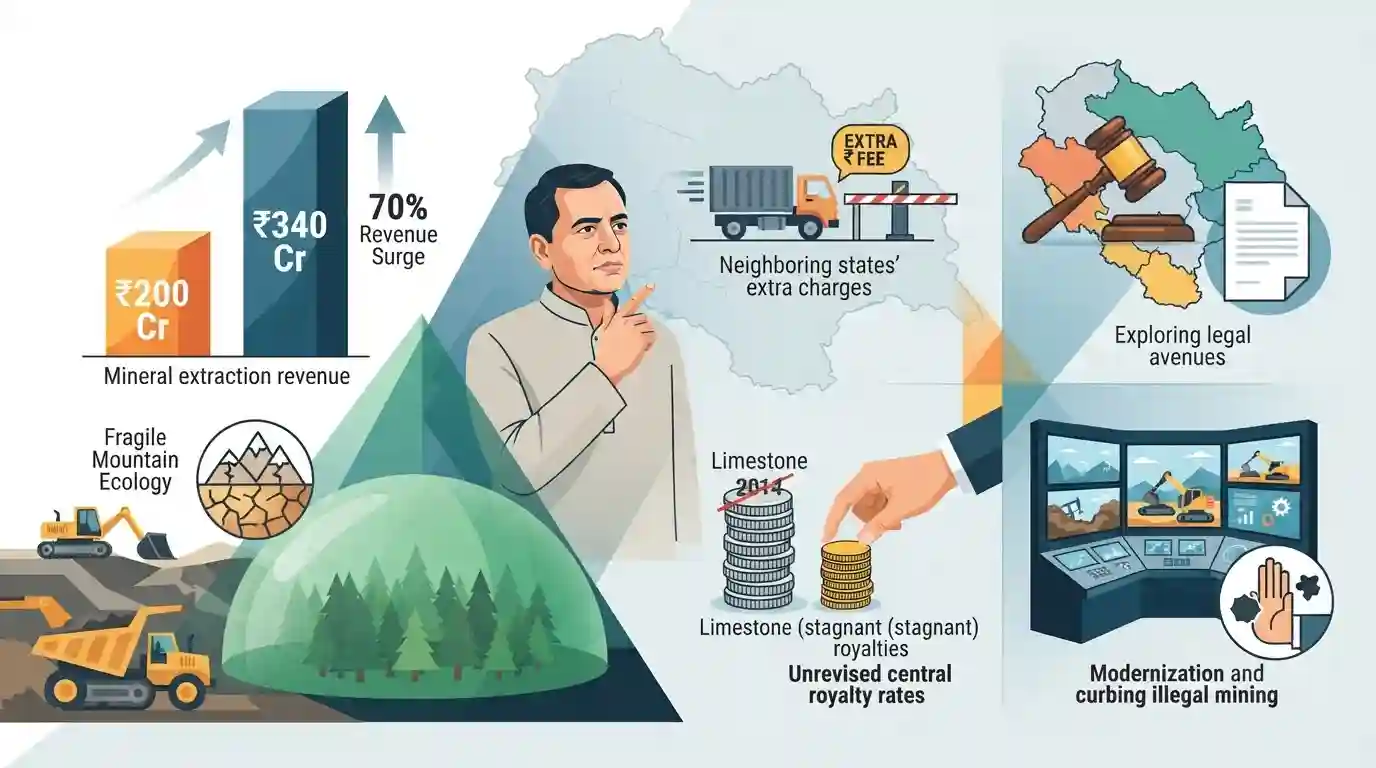
Himachal Pradesh's mineral extraction revenue has surged by 70% over the last three years, increasing from ₹200 crore to ₹340 crore. Chief Minister Sukhvinder Singh Sukhu highlighted this growth while stressing the critical need to balance mineral exploitation with environmental conservation, given the state's fragile mountain ecology. He also raised concerns about neighboring states imposing extra transportation charges on minor minerals and the Central Government's failure to revise limestone royalty rates since 2014, both of which are restricting the state's potential revenue generation. The state is exploring legal avenues against the extra transportation charges and pushing for modernization to curb illegal mining.
Key Points
- Revenue from mineral extraction in Himachal Pradesh grew by 70%, increasing from ₹200 crore to ₹340 crore over the last three years.
- The State Government is emphasizing sustainable and responsible mining to protect Himachal Pradesh's ecologically fragile environment.
- Neighboring states like Punjab, Haryana, and Uttarakhand have imposed additional transportation charges on minor minerals from Himachal, prompting the state to consider legal remedies.
- Himachal Pradesh's revenue has been adversely impacted by the Central Government's delay in revising limestone royalty rates, which have remained unchanged since 2014.
- The Mining Department is focusing on digitalization and robust monitoring to increase revenue and curb illegal mining activities.
Important Terms
Minor Minerals

Minerals like building stones and sand used for local construction. Under the MMDR Act, 1957, State Governments possess the exclusive authority to regulate their extraction, grant concessions, and levy royalties.
UPSC context
GS-1 & GS-2; frequently tested in Prelims regarding the distinct regulatory powers of Centre vs. States.
Major Minerals
Minerals not explicitly classified as minor, such as limestone, iron ore, and coal. The Central Government regulates their extraction frameworks and sets their royalty rates under the MMDR Act, 1957.
UPSC context
GS-1 & GS-2; crucial for understanding central jurisdiction over vital national resources and industrial inputs.
Royalty on Minerals
A statutory fee paid by mining leaseholders to state governments for mineral extraction. The Central Government fixes rates for major minerals; delays in revisions often cause Centre-State fiscal friction.
UPSC context
GS-2 (Fiscal Federalism) & GS-3; highlights state revenue challenges and financial dependency on the Union.
MMDR Act, 1957
The primary legislation regulating India's mining sector. It classifies minerals into major and minor categories, delineating the Central Government's policy-making powers and the States' administrative authorities over natural resources.
UPSC context
GS-2 (Governance) & GS-3 (Economy); the foundational law for all mining policies, resource allocation, and dispute resolution.
Central Government (Mineral Regulation)
The Union authority empowered to regulate major minerals, formulate overarching mining policies, and fix royalty rates. Its administrative decisions directly impact state exchequers and the environmental sustainability of mining.
UPSC context
GS-2 (Polity); relates to the Union's legislative domain and its direct impact on Centre-State financial relations.
Prelims Trap
State governments possess the statutory power to notify and revise royalty rates for all minerals, including limestone, extracted within their borders.
False. Under the MMDR Act, states only frame rules and set royalty rates for minor minerals. The Central government exclusively revises major mineral royalties.
Static Concepts Connected
How is regulatory power over minerals divided between the Centre and States?
- Minor Minerals: States hold exclusive power under Section 15 of the MMDR Act to frame rules and prescribe royalty rates for minerals like sand and gravel.
- Major Minerals: Only the Central Government has the statutory authority to notify and revise royalty rates for these, which include limestone, iron ore, and coal.
- Reclassification: The Ministry of Mines periodically reclassifies minerals (e.g., Barytes, Quartz) from minor to major to facilitate targeted strategic exploration.
What does Article 301 say about restricting inter-state mineral transport?
- Freedom of Trade: Article 301 mandates freedom of trade, commerce, and intercourse throughout India, limiting arbitrary state-level economic barriers.
- Discriminatory Levies: Judicial precedents establish that states cannot levy discriminatory entry fees or transport charges on legally excavated minor minerals moving across borders.
Cross-Topic Patterns
Fiscal federalism and resource royalties
The Centre's failure to revise limestone royalties since 2014 exemplifies the growing fiscal friction between the Union and States, mirroring debates over divisible pools, cesses, and GST compensation.
Himalayan ecology vs mining revenue
The drive to boost state revenues through mineral extraction often clashes with the fragile carrying capacity of the Himalayas, tying into disaster management themes like the Joshimath subsidence and flash floods.

Centre/State jurisdiction over major vs. minor minerals under the MMDR Act, paired with Article 301, is a high-probability Prelims area.
Linked PYQs · 3
Linked PYQs · 3
- 2023HPAS_PRELIMSGS1
Consider the following statements : (1) In Himachal Pradesh, Grant from the Centre is the highest percentage of revenue receipts. (2) In Himachal Pradesh, non-tax revenue is likely to increase to Rs. 3,769 crore in FY 2022-23 (BE). (3) In Himachal Pradesh, the tax revenue growth rate is estimated at 10.84 per cent in FY 2022-23 (BE). (4) In Himachal Pradesh, growth of subsidy expenditure is estimated to be 4.44 per cent in FY 2022-23 (BE). Choose the correct answer from the options given below :
- 2024HPAS_PRELIMSGS1
For the year 2022-23, match the Industry sub-sector in Himachal Pradesh with the percentage of workers employed in them : | List I (Industry Sub-sector) | List II (Percentage of workers employed) | |---|---| | (a) Mining and Quarrying | (i) 2 | | (b) Manufacturing | (ii) 41 | | (c) Electricity and Other Utilities | (iii) 50 | | (d) Construction | (iv) 7 | Choose the correct option : Code: (a) (b) (c) (d)
- 2025HPAS_PRELIMSGS1
Consider the following statements regarding public finance of Himachal Pradesh : (1) According to Budget Estimate for the year 2024-25, share of revenue expenditure out of total expenditure is around 80 percent. (2) Debt as a percentage of GSDP reached 75.33 during the year 2022-23. (3) State's own tax revenue as a percentage of total revenue for the year 2024-25 (BE) increased to 27.4. (4) During FY 2024-25 (BE) education and health sector were allocated Rs. 9995 and Rs. 8575 crores respectively. Choose the correct answer from the options given below :
