Himachal Pradesh Fiscal Consolidation and Development Vision
Source:The Hindu ↗
Why It Matters
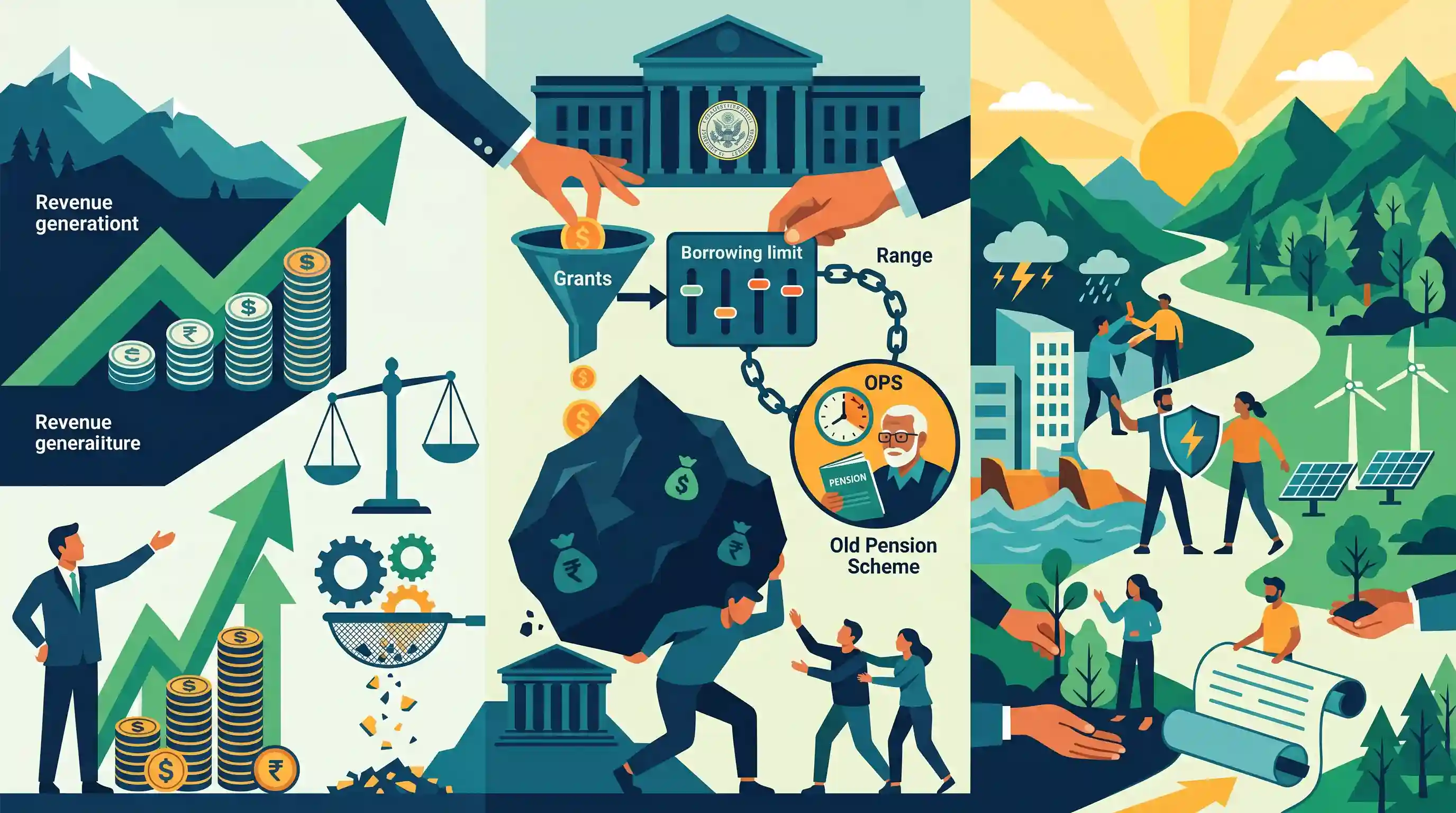
The article illustrates the practical challenges of state-level fiscal management, highlighting tensions in fiscal federalism such as central conditions on state borrowing limits (e.g., linked to OPS restoration) and declining Revenue Deficit Grants. It also emphasizes the critical need for disaster-resilient infrastructure and sustainable development models in ecologically fragile Himalayan states.
Summary
Himachal Pradesh Chief Minister Sukhvinder Singh Sukhu reported a 20% improvement in the state's finances over the past year, achieved through increased revenue generation and expenditure rationalization. During a meeting with NITI Aayog, he highlighted significant fiscal challenges, including an inherited debt of ₹85,000 crore, a reduction in the Revenue Deficit Grant, and a ₹1,774 crore cut in the state's borrowing limit imposed by the Centre due to the restoration of the Old Pension Scheme (OPS). Additionally, the state unveiled the 'Samriddh Himachal Vision,' a strategic roadmap focusing on sustainable, disaster-resilient, and inclusive development tailored to the ecologically sensitive Himalayan region.
Key Points
- Himachal Pradesh's financial condition improved by over 20% in one year due to increased revenue generation and expenditure cuts.
- The restoration of the Old Pension Scheme (OPS) for state employees led to a ₹1,774 crore reduction in the state's borrowing limit by the Union government.
- The state is managing inherited financial burdens, including a debt of ₹85,000 crore and employee liabilities of ₹10,000 crore, alongside a tapering Revenue Deficit Grant.
- The state presented the 'Samriddh Himachal Vision' document to NITI Aayog, emphasizing sustainable, disaster-resilient, and inclusive development for the Himalayan region.
Important Terms
Old Pension Scheme (OPS)

A traditional 'Defined Benefit' pension system providing 50% of the last-drawn salary to retired government employees without mandatory employee contributions, funded directly from the state exchequer.
UPSC context
GS Paper III (Economy); tests understanding of fiscal sustainability, committed liabilities, and the debate over state-led populism versus long-term financial health.
New Pension Scheme (NPS)
A 'Defined Contribution' pension system introduced in 2004 where both employees and government contribute to a market-linked corpus, shifting financial risk from the state to the individual.
UPSC context
GS Paper III (Economy); concerns pension reforms, financial market integration, and the transition from unfunded to funded social security models.
Samriddh Himachal Vision
A strategic roadmap for Himachal Pradesh targeting sustainable, disaster-resilient, and inclusive development, incorporating global models like Gross National Happiness and Alpine infrastructure to ensure ecological sensitivity.
UPSC context
GS Paper III (Environment/Disaster Management); illustrates regional planning for fragile ecosystems and sustainable development goals (SDGs) at the sub-national level.
Revenue Deficit Grant (RDG)
Article 275 grants recommended by the Finance Commission to bridge the gap between a state's revenue expenditure and its receipts after tax devolution from the Centre.
UPSC context
GS Paper II (Polity/Fiscal Federalism); vital for understanding Centre-State financial relations and the role of the Finance Commission in balancing regional disparities.
Fiscal Federalism
The constitutional division of financial powers between the Union and States, involving tax sharing, grants, and regulatory oversight of state borrowings to ensure national economic stability.
UPSC context
GS Paper II (Governance); core to the federal structure, testing knowledge of NITI Aayog's role, Finance Commission recommendations, and state fiscal autonomy.
Borrowing Limit
The ceiling on a state's debt acquisition, regulated by the Centre under Article 293(3), often adjusted based on a state's adherence to fiscal reforms and pension liabilities.
UPSC context
GS Paper III (Economy/Budgeting); relates to the FRBM Act and the Centre's power to enforce fiscal discipline on states through 'net borrowing ceilings'.
Prelims Trap
States have independent constitutional authority to raise domestic loans without needing the Union Government's consent.
Under Article 293(3), a State cannot raise loans without the Centre's consent if it owes outstanding liabilities to the Union. Currently, this applies to all states.
Static Concepts Connected
What are the Constitutional limits on State borrowing?
- Domestic scope: States can only borrow within the territory of India upon the security of their Consolidated Fund (Article 293).
- Mandatory consent: Consent from the Centre is mandatory under Article 293(3) if any part of a previous loan from the Union Government remains outstanding.
- External borrowing: States cannot borrow directly from foreign entities or governments; all external loans must be routed through the Union Government.
What are Post-Devolution Revenue Deficit (PDRD) Grants?
- Article 275 base: PDRD grants are statutory grants provided under Article 275 of the Constitution to States in need of assistance.
- Finance Commission role: They are released based on the recommendations of the Finance Commission to cover gaps in the state revenue accounts post-tax devolution.
- Tapering nature: These grants are generally designed to taper off over the Commission's award period, nudging states toward fiscal self-reliance.
Cross-Topic Patterns
OPS Reversion vs. Capital Expenditure
Reverting to unfunded defined-benefit pensions (OPS) shifts finances to committed expenditures, squeezing out long-term capital expenditure necessary for infrastructure and employment generation.
Climate vulnerability in FC devolution
Himalayan disaster resilience ('Samriddh Himachal') ties into demands by ecologically fragile states to give higher weightage to forest cover and disaster risk in the 16th Finance Commission's tax devolution formula.

Article 293 borrowing limits tied to state fiscal profligacy (like OPS reversions) are a prime candidate for a 2026 Prelims Polity MCQ.
Linked PYQs · 5
Linked PYQs · 5
- 2025MainsGS3
Explain how the Fiscal Health Index (FHI) can be used as a tool for assessing the fiscal performance of states in India. In what way would it encourage the states to adopt prudent and sustainable fiscal policies?
- 2021MainsGS3
Distinguish between Capital Budget and Revenue Budget. Explain the components of both these Budgets.
- 2019MainsGS3
The public expenditure management is a challenge to the Government of India in the context of budget making during the post-liberalization period. Clarify it.
- 2025MainsGS2
Examine the evolving pattern of Centre-State financial relations in the context of planned development in India. How far have the recent reforms impacted the fiscal federalism in India?
- 2021MainsGS2
How have the recommendations of the 14th Finance Commission of India enabled the States to improve their fiscal position?
