Himachal BJP submits assembly privilege notice against chief minister
Source:tribuneindia ↗
Why It Matters
The incident highlights the practical application of parliamentary privilege mechanisms in state legislatures and intersects with constitutional duties (Article 51A regarding the National Anthem), making it a relevant case study for state polity and governance questions.
Summary
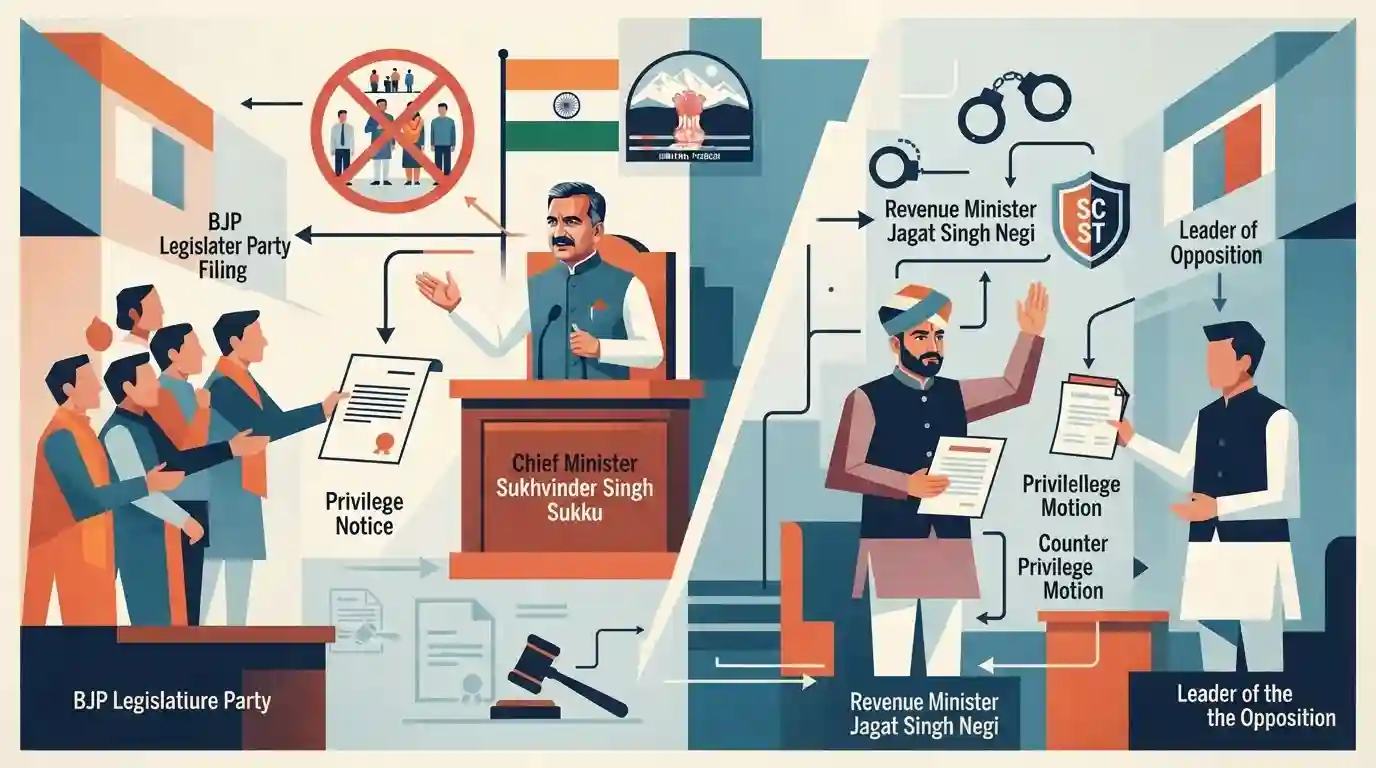
The BJP Legislature Party in Himachal Pradesh has filed a privilege notice against Chief Minister Sukhvinder Singh Sukhu, accusing him of falsely claiming that opposition MLAs disrespected the national anthem during the monsoon session. The BJP maintains this false accusation breaches parliamentary privilege and may warrant criminal defamation charges. The conflict has escalated with Revenue Minister Jagat Singh Negi threatening a counter privilege motion against the Leader of the Opposition under the SC/ST Prevention of Atrocities Act.
Key Points
- The BJP Legislature Party submitted a privilege notice to Assembly Speaker Kuldeep Singh Pathania against Himachal Pradesh CM Sukhvinder Singh Sukhu.
- The notice was filed over the CM's allegations that BJP MLAs disrespected the national anthem by raising slogans on the opening day of the monsoon session.
- BJP leaders are contemplating filing a criminal defamation case against the Chief Minister over the alleged false accusations.
- In retaliation, Revenue Minister Jagat Singh Negi indicated he would move a counter privilege motion against the Leader of the Opposition under the SC/ST Prevention of Atrocities Act.
Important Terms
Parliamentary Privileges

Special rights, freedoms, and immunities granted to legislators to discharge their duties without obstruction. Under Article 194, state legislators enjoy freedom of speech and immunity from court proceedings for statements made in the House.
UPSC context
Highly relevant for GS Paper II (Polity). Central to the BJP submitting a privilege notice against the state Chief Minister.
Scheduled Castes and Scheduled Tribes (Prevention of Atrocities) Act, 1989
A landmark 1989 law designed to protect SC/ST communities from caste-based violence and humiliation. It defines specific atrocities, ensures stringent punishments, and establishes special courts for speedy justice.
UPSC context
Important for GS Paper II (Social Justice). In this event, a state minister threatened to invoke the Act against opposition MLAs.
Fundamental Duties
Constitutional obligations of citizens introduced in Part IV-A (Article 51A). Specifically, Article 51A(a) mandates that every Indian citizen abide by the Constitution and respect its ideals, institutions, the National Flag, and the National Anthem.
UPSC context
Tests Indian Polity concepts. The legislative row arose directly from accusations that opposition MLAs violated their constitutional duty to respect the national anthem.
Himachal Pradesh Vidhan Sabha
The unicameral state legislature of Himachal Pradesh, consisting of elected MLAs. It serves as the primary forum for state-level lawmaking, debating critical public issues, and holding the state executive accountable.
UPSC context
Essential for HPAS GS covering State Government. The Vidhan Sabha is the venue of the ongoing privilege motion and political dispute.
BJP Legislature Party
The formally recognized group of elected Members of the Legislative Assembly (MLAs) representing the Bharatiya Janata Party within the state legislature. They currently serve as the principal opposition in Himachal Pradesh.
UPSC context
Tests knowledge of legislative functioning and opposition roles in State Polity. They submitted the privilege notice against the Chief Minister.
Prelims Trap
"Disrespecting the National Anthem is directly penalized under Article 51A (Fundamental Duties) of the Indian Constitution."
Fundamental Duties (Article 51A) are non-justiciable and carry no direct penal sanctions. Punishments for disrespecting national symbols come from statutory laws like the 1971 Act.
Static Concepts Connected
What are the constitutional provisions for State Legislature privileges?
- Article 194: Grants specific powers, privileges, and immunities to State Legislatures, their members, and associated committees.
- Absolute Immunity: Members are immune from court proceedings for anything said or any vote given within the State Legislature or its committees.
- Uncodified Status: State Legislatures have not fully codified their privileges by law, relying largely on conventions and precedents.
What is the legal framework governing respect for the National Anthem?
- Article 51A(a): It is a Fundamental Duty to abide by the Constitution and respect its ideals, institutions, the National Flag, and the National Anthem.
- Statutory Backing: Penalties for actively insulting or preventing the singing of the anthem are derived from the Prevention of Insults to National Honour Act, 1971.
- Judicial Precedent: In the landmark Bijoe Emmanuel case (1986), the Supreme Court ruled that standing respectfully without singing does not constitute a legal offence.
Cross-Topic Patterns
Privileges vs Statutory Criminal Law
Threatening SC/ST Act proceedings over assembly behavior highlights the tension between Article 194 (legislative immunity inside the House) and statutory criminal liabilities, a frequent constitutional gray area.
Fundamental Duties & Legal Enforceability
The National Anthem dispute reiterates that while Article 51A duties are non-justiciable, they are actively enforced through specific statutory laws like the Prevention of Insults to National Honour Act.

Expect a multi-statement question mixing Article 194 (State Privileges), the 1971 National Honour Act, and the Bijoe Emmanuel case.
Linked PYQs · 3
Linked PYQs · 3
- 2025HPAS_PRELIMSGS1
In which case Supreme Court decided that not singing of National Anthem cannot be considered its disrespect or offence ?
- 2025HPAS_PRELIMSGS1
Who decides the disqualification of members of State Legislative Assembly, for matters other than those in the Tenth Schedule of the Constitution ?
- 2023HPAS_PRELIMSGS1
Consider the following statements : (1) Constitution's 61st amendment is related to the reduction in voting age. (2) Constitution's 93rd amendment is related to reservation for EWS category. (3) Constitution's 86th amendment added Article 19A in the Constitution. (4) In 2002, duty of parents to provide education to their children from 6 to 14 years was added. Choose the correct answer from the options given below :
