Himachal Unveils Fruit Procurement Scheme for Growers
Source:keekli ↗
Why It Matters
This scheme is crucial for HPAS Prelims as it highlights the state government's strategies to support horticulture, which forms the backbone of Himachal Pradesh's agrarian economy. Knowledge of specific procurement prices, participating state agencies (like HPMC and HIMFED), and the nuances of the Market Intervention Scheme helps tackle questions related to the economy, governance, and agricultural geography of Himachal Pradesh.
Summary
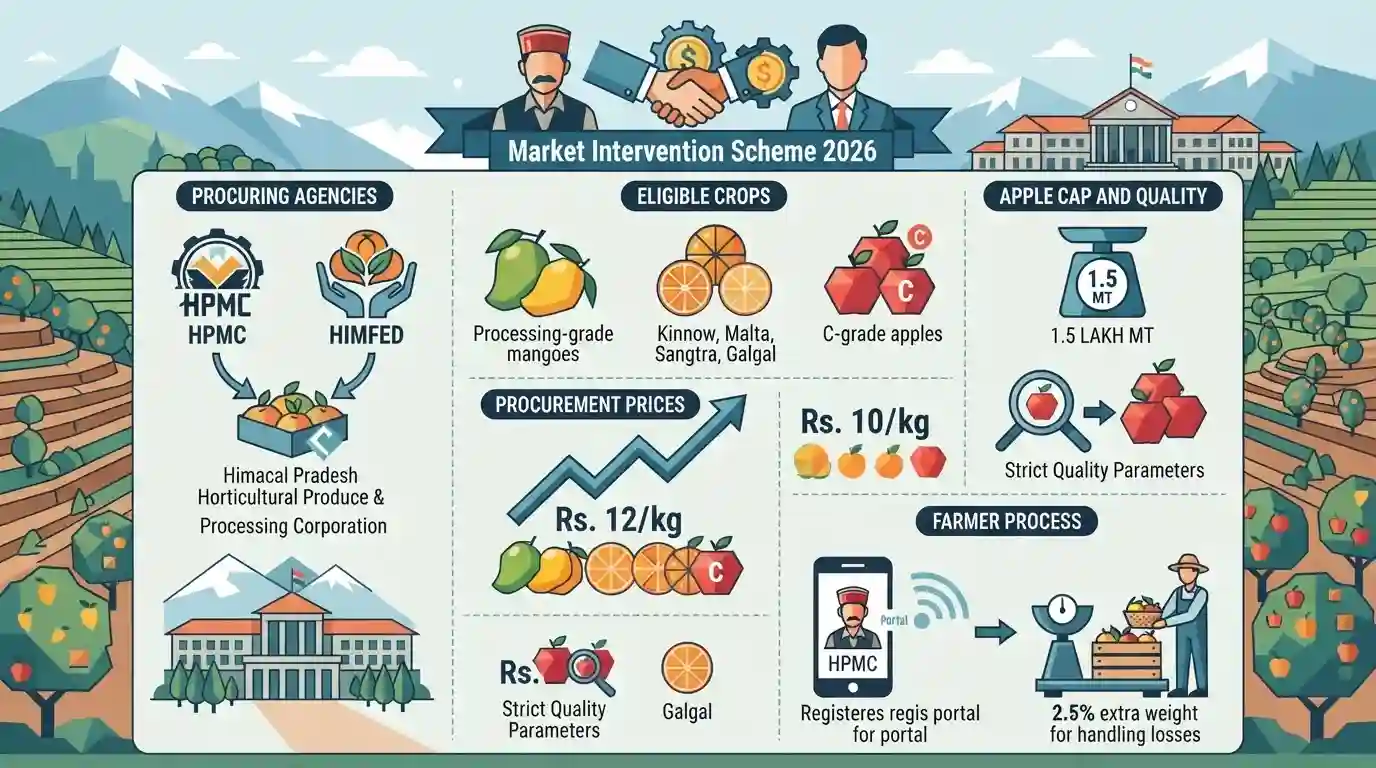
The Himachal Pradesh government has announced the implementation of the Market Intervention Scheme (MIS) for 2026, aimed at providing assured prices and market support to fruit growers. Under this scheme, processing-grade mangoes, citrus fruits (Kinnow, Malta, Sangtra, Galgal), and C-grade apples will be procured by the Himachal Pradesh Horticultural Produce Marketing and Processing Corporation (HPMC) and HIMFED. The procurement price is set at Rs. 12 per kg for most fruits, except Galgal, which is priced at Rs. 10 per kg. A cap of 1.5 lakh metric tonnes has been placed on C-grade apples, which must meet strict quality parameters. Eligible farmers must register on the HPMC MIS portal and provide an extra 2.5% weight to cover handling losses.
Key Points
- The Himachal Pradesh government has approved the Market Intervention Scheme (MIS) for 2026 to procure processing-grade mangoes, citrus fruits, and C-grade apples.
- Procurement prices are fixed at Rs. 12 per kg for Achari mangoes, Kinnow, Malta, Sangtra, and C-grade apples, while Galgal will be procured at Rs. 10 per kg.
- Procuring agencies include HPMC, with possible association of HIMFED for apple procurement.
- Up to 1.5 lakh metric tonnes of C-grade apples (diameter above 51 mm) will be procured; rotten or diseased apples are excluded.
- Farmers are required to register on the HPMC MIS Portal and must provide an additional 2.5% weight to offset handling and storage losses.
Important Terms
Market Intervention Scheme (MIS)

An ad-hoc price support mechanism by the Centre and States. It protects growers of perishable horticultural and agricultural crops, which lack Minimum Support Price (MSP) coverage, from distress sales during bumper crops or sudden market price crashes.
UPSC context
GS Paper 3 (Agriculture). Important for contrasting with MSP and understanding interventions to stabilize perishable commodity markets and farmer incomes.
Himachal Pradesh Horticultural Produce Marketing and Processing Corporation (HPMC)
A state public sector undertaking established in 1974 to market fresh fruits and process surplus horticultural produce in Himachal Pradesh. It provides essential supply chain services like procurement, grading, packing, and value-added processing for orchardists.
UPSC context
GS Paper 3 (Agricultural Marketing). Highlights state-led institutions managing supply chain logistics, value addition, and agro-processing in the horticulture sector.
HIMFED (Himachal Pradesh State Cooperative Marketing and Consumers Federation Ltd)
The apex cooperative marketing federation of Himachal Pradesh. Founded in 1952, it supports farmers by procuring agricultural produce, often executing the Market Intervention Scheme, and distributing essential farming inputs like chemical fertilizers.
UPSC context
GS Paper 3 (Cooperatives). Relevant for understanding the role of state-level cooperative societies in rural economic empowerment and agricultural input distribution.
Prelims Trap
MIS is a permanent, centrally funded procurement guarantee for horticultural crops.
MIS is not a permanent guarantee. It is an ad-hoc emergency measure activated only upon a State's request, and financial losses are shared 50:50 between the Center and States.
Static Concepts Connected
What differentiates the Market Intervention Scheme (MIS) from Minimum Support Price (MSP)?
- Crop Coverage: MSP covers 22 mandated crops on a permanent basis. MIS acts as a temporary safety net for perishable horticultural/agricultural commodities explicitly outside the MSP framework.
- Nature of Intervention: MSP is announced pre-sowing annually. MIS is an ad-hoc, post-harvest measure activated only when states formally request intervention during market distress.
- Financial Liability: MSP procurement operations are entirely centrally funded. Under MIS, any financial losses incurred are shared (50:50, or 75:25 for North-Eastern and Himalayan states).
What are the specific trigger parameters for activating the MIS?
- Price Crash: Prevailing open-market prices must drop by at least 10% compared to the previous normal year's rates.
- Production Surge: Alternatively, the scheme can be triggered if there is a 10% or more increase in production against the previous normal year.
- Procurement Cap: Physical procurement under the scheme is strictly restricted to a maximum of 25% of the total estimated crop production.
Cross-Topic Patterns
Climate volatility and MIS activation
Unseasonal rains in Himalayan states often cause low-grade 'C-category' fruit gluts. The MIS acts as a critical climate-adaptation safety net, absorbing weather-battered produce that would otherwise collapse local markets.
Fiscal Federalism in Agri-marketing
Unlike MSP’s centralized burden, MIS requires states to share 25-50% of financial losses. This demonstrates a cooperative federalist approach to managing localized, ad-hoc agricultural market failures.

Expect a 2026 Prelims multi-statement question contrasting MIS's ad-hoc, cost-sharing triggers with MSP's universal central funding.
Linked PYQs · 3
Linked PYQs · 3
- 2025HPAS_PRELIMSGS1
Match List I with List II : | List-I (Scheme) | List-II (Launch Year) | |---|---| | (a) Mukhya Mantri Roshni Yojana | (i) 2015 | | (b) Himachal Pradesh Horticulture Development Project | (ii) 2019 | | (c) Mukhya Mantri Gram Path Yojana | (iii) 2009 | | (d) Swavalamban Yojana | (iv) 2020 | Choose the correct answer from the options given below : Code: (a) (b) (c) (d)
- 2018HPAS_PRELIMSGS1
'Lanjī', 'Saro' and 'Rajnagar' in Chamba district are the centres for development of the following :
- 2025HPAS_PRELIMSGS1
Mountain Soil Zone in Himachal Pradesh is found between :
