Himachal Pradesh Panchayat Disaster Response System Initiative
Source:tribuneindia ↗
Why It Matters
Crucial for understanding decentralised disaster management strategies and institutional arrangements at the grassroots level in Himachal Pradesh.
Summary
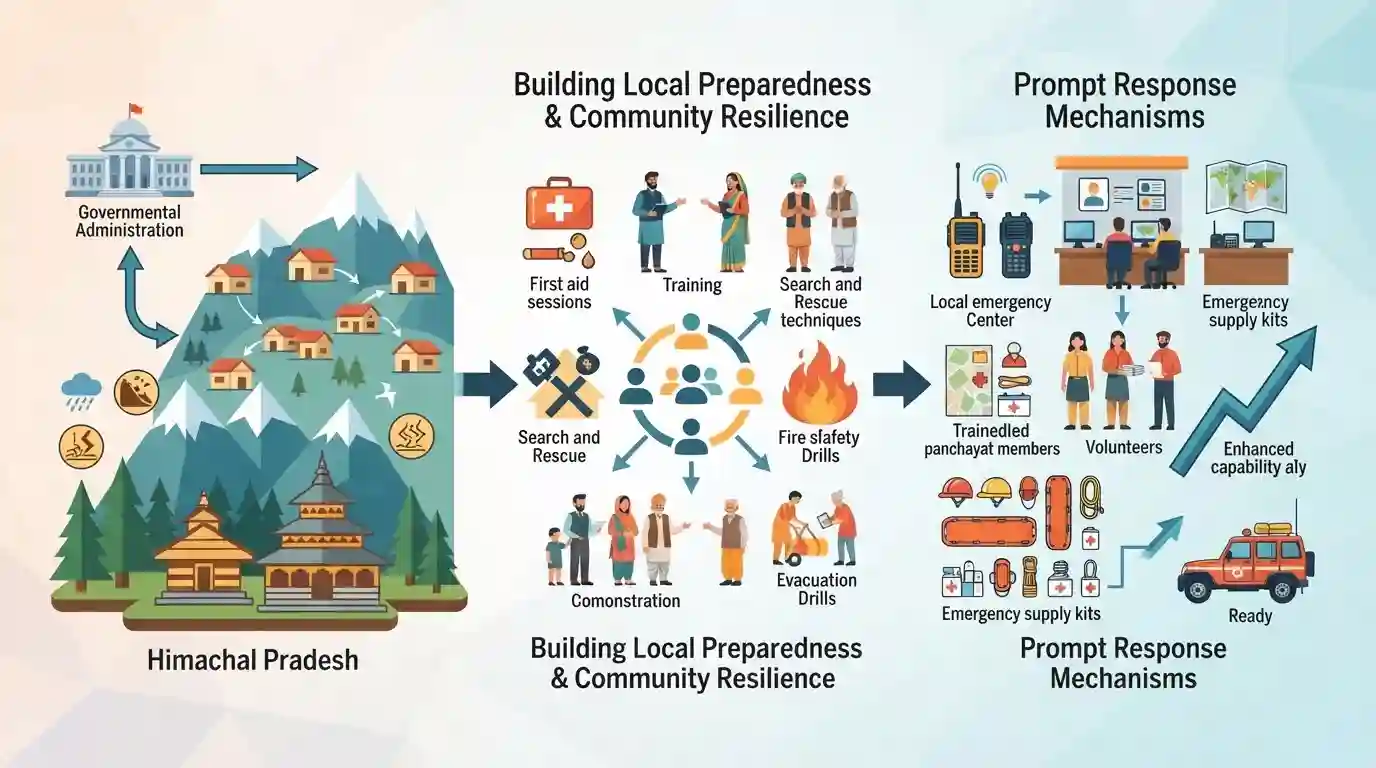
Himachal Pradesh has initiated steps to establish a comprehensive disaster response system across all panchayats in the state to enhance local preparedness, community resilience, and prompt response mechanisms against natural hazards.
Key Points
- Himachal Pradesh plans to set up a disaster response system across all its panchayats to strengthen grassroots-level disaster management and preparedness.
- The initiative aims to train local communities and village-level bodies to effectively respond to natural calamities and emergencies like landslides, floods, and earthquakes.
- The step integrates grassroots democratic institutions (Panchayats) into the state's broader disaster mitigation and emergency response framework.
Important Terms
Himachal Pradesh State Disaster Management Authority (HPSDMA)

The apex state-level body responsible for coordinating disaster management policies, formulating mitigation strategies, and overseeing disaster response mechanisms across Himachal Pradesh.
UPSC context
Important for HPAS GS Paper III (Disaster Management) and institutional framework of disaster response in the state.
Aapda Mitra Scheme
A centrally sponsored scheme implemented through state authorities to train local community volunteers in disaster response for immediate search, rescue, and relief operations.
UPSC context
Relevant for HPAS GS Paper III under community-based disaster management and grassroots resilience topics.
Prelims Trap
Panchayats have no statutory role in disaster response as disaster management is solely a state-level subject under the Disaster Management Act.
Aspirants often assume disaster management is exclusively a central or state subject, overlooking the mandatory executive and planning roles assigned to local bodies under state-specific disaster frameworks.
Static Concepts Connected
What are the key institutional tiers under the Disaster Management Act, 2005 in India?
- NDMA role: Apex body chaired by the Prime Minister for laying down disaster management policies.
- SDMA role: State-level body headed by the Chief Minister responsible for implementing state plans.
- DDMA function: District-level authority chaired by the Deputy Commissioner/District Collector to plan, coordinate, and implement response measures.
Cross-Topic Patterns
Disaster Resilience meets Grassroots Democracy
Integrating disaster management with PRIs operationalises the Sendai Framework's priority of 'Understanding disaster risk' and 'Strengthening disaster risk governance' at the lowest administrative tier in fragile Himalayan ecosystems.
Panchayat Finances and Disaster Mitigation
Decentralized disaster response in hill states tests fiscal federalism and capacity building under the 15th Finance Commission grants for disaster risk management.

Expect a statement-based question combining HP Disaster Management Act provisions with 73rd Amendment powers devolved to Panchayats.
Linked PYQs · 2
Linked PYQs · 2
- 2024HPAS_PRELIMSGS1
Consider the following statements regarding Panchayati Raj system in Himachal Pradesh. Statement I : In 1949, the Punjab Village Panchayat Act of 1939 was enforced and 132 panchayats were established in Himachal. Statement II : By the end of 1956, there were 466 Gram Panchayats and 26 Tehsil Panchayats in Himachal. Choose the correct option from the following :
- 2025HPAS_PRELIMSGS1
When was the National Centre for Disaster Management established in India ?
