Himachal Launches Vulture Conservation Awareness Drive
Source:uniindia ↗
Why It Matters
Vulture conservation is an essential topic for HPAS and UPSC Prelims under environmental ecology. Vultures are keystone species whose rapid decline in South Asia (primarily due to diclofenac poisoning) led to major ecological disruptions. Knowing their conservation status, local habitats in Himachal Pradesh, and international collaboration programs like ZSL's 'EDGE of Existence' is highly relevant for competitive examinations.
Summary
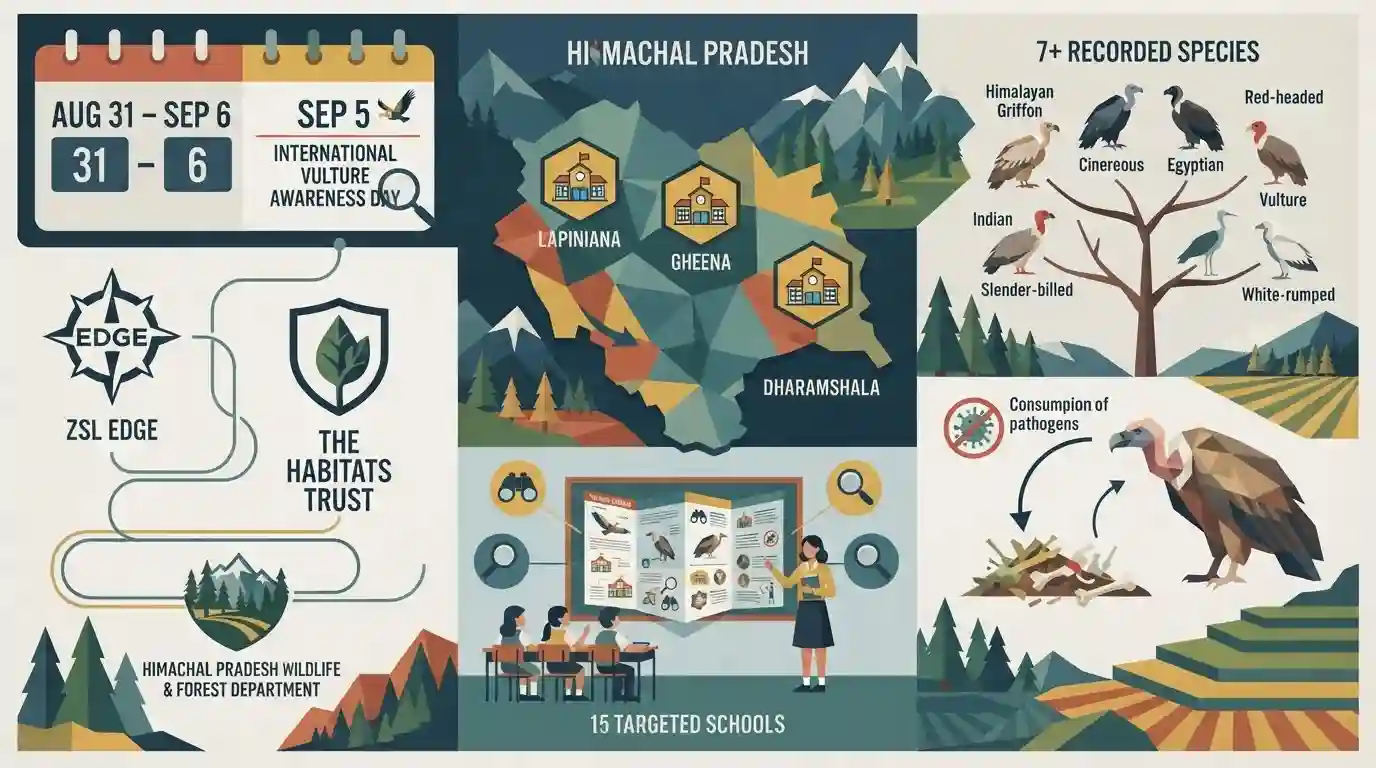
Himachal Pradesh is holding a week-long vulture conservation awareness campaign from August 31 to September 6, leading up to International Vulture Awareness Day on September 5. Organised by ZSL EDGE and The Habitats Trust in collaboration with the Himachal Pradesh Wildlife and Forest Department, the campaign targets 15 schools in Kangra district (specifically Lapiana, Gheena, and Dharamshala). Vultures act as nature's clean-up crew by consuming carcasses and preventing pathogens. Himachal Pradesh is an essential landscape for vulture conservation, with more than seven species of vultures recorded across the state.
Key Points
- Himachal Pradesh is hosting a week-long public awareness campaign on vulture conservation from August 31 to September 6, in the run-up to International Vulture Awareness Day on September 5.
- The initiative is a collaboration between ZSL EDGE (Zoological Society of London's 'EDGE of Existence' programme), The Habitats Trust, and the Himachal Pradesh Wildlife and Forest Department.
- The awareness campaign will specifically target 15 schools across Lapiana, Gheena, and Dharamshala in the Kangra district of Himachal Pradesh.
- Activities include educational campaigns, street plays (nukkad nataks), short films, and painting competitions to change public perception and involve local communities in vulture protection.
- Vultures are vital ecological 'clean-up crews' that consume carcass remains, helping prevent the multiplication of pathogens like anthrax, rabies, and botulism.
- Himachal Pradesh is a crucial landscape for vulture conservation, having recorded more than 7 of the 9 vulture species found in India.
Important Terms
International Vulture Awareness Day

A global annual event observed on the first Saturday of September to highlight the ecological importance of vultures, address the threats they face, and promote international conservation efforts.
UPSC context
GS Paper III (Ecology & Biodiversity). Tests international environmental observances, keystone species, and conservation.
ZSL EDGE
A global conservation initiative by the Zoological Society of London that prioritizes the protection of species that are Evolutionarily Distinct and Globally Endangered (EDGE).
UPSC context
GS Paper III (Ecology). Tests conservation frameworks, evolutionary diversity metrics, and global preservation programmes.
The Habitats Trust
An Indian wildlife conservation foundation founded in 2018 that works to protect and restore lesser-known species, threatened habitats, and neglected ecosystems across India through grants.
UPSC context
GS Paper III (Biodiversity). Tests role of non-governmental organizations, philanthropy, and grassroots conservation in India.
Himachal Pradesh Wildlife and Forest Department
The state government division in Himachal Pradesh responsible for conserving wildlife, managing protected areas, and implementing anti-poaching, eco-tourism, and biodiversity protection laws.
UPSC context
HPAS GS Paper III (HP GK/Environment). Tests state-level conservation initiatives, wildlife management, and institutional efforts.
Zoological Society of London
An international scientific, conservation, and educational charity founded in 1826, dedicated to the global promotion and facilitation of animal conservation and habitat protection.
UPSC context
GS Paper III (Environment). Tests international conservation bodies, scientific organizations, and biodiversity frameworks.
Prelims Trap
The unique 'Vulture Restaurant' in Himachal Pradesh is located within the Great Himalayan National Park.
The vulture restaurant (established in 2008) is actually located at Sukhnara (near Nagrota Surian) within the Pong Dam Lake Wildlife Sanctuary, Kangra, not GHNP.
Static Concepts Connected
What is the 'Vulture Restaurant' initiative in Himachal Pradesh?
- Location & Origin: Established in 2008 at Sukhnara (near Nagrota Surian) within the Pong Dam Lake Wildlife Sanctuary, Kangra district.
- Core Objective: Provides safe, diclofenac-free carcasses to vultures, reducing mortality rates from toxic veterinary drug residues in livestock.
- Community Role: Encourages local communities to bring deceased, drug-free cattle to the designated feeding station, boosting local nesting pairs.
What are the 9 vulture species found in India and their IUCN status?
- Critically Endangered: Includes White-rumped, Indian (Long-billed), Slender-billed, and Red-headed (Asian King) Vultures.
- Endangered: The Egyptian Vulture is classified as Endangered under the IUCN Red List.
- NT and LC: Himalayan Griffon, Bearded Vulture (Lammergeier), Cinereous Vulture are Near Threatened; Eurasian Griffon is Least Concern. All 9 exist in HP.
Cross-Topic Patterns
Pong Dam Ramsar & eco-tourism
Links wetlands conservation under the Ramsar Convention with community-managed conservation initiatives like the Sukhnara Vulture Restaurant in Kangra.
Veterinary drugs & wildlife policy
Connects the ban on veterinary Diclofenac and Ketoprofen with HP’s localized vulture nesting recovery under the Wildlife Protection Act.

HPAS may couple Pong Dam Ramsar site facts with IUCN status of India's 9 vulture species and localized conservation initiatives.
Linked PYQs · 2
Linked PYQs · 2
- 2018HPAS_PRELIMSGS1
Which of the following national parks/sanctuaries of H.P. occupies 1171 sq. km. of area ?
- 2025HPAS_PRELIMSGS1
Given below are two statements : Statement I : India's first wolf sanctuary is located at Bankapur in Karnataka. Statement II : The Indian grey wolf is classified as endangered species by the IUCN. In the light of the above statements, choose the most appropriate answer from the options given below :
