Himachal Pradesh partners with DEVI Sansthan for ALfA programme
Source:crazynewsindia ↗
Why It Matters
State-level interventions in education, especially those aligning with national frameworks like NEP 2020 and Nipun Bharat, are frequent subjects in HPAS Prelims and Mains. The innovative 'ALfA' peer-learning model marks a significant shift in addressing foundational literacy and is an excellent case study for governance and social sector policy.
Summary
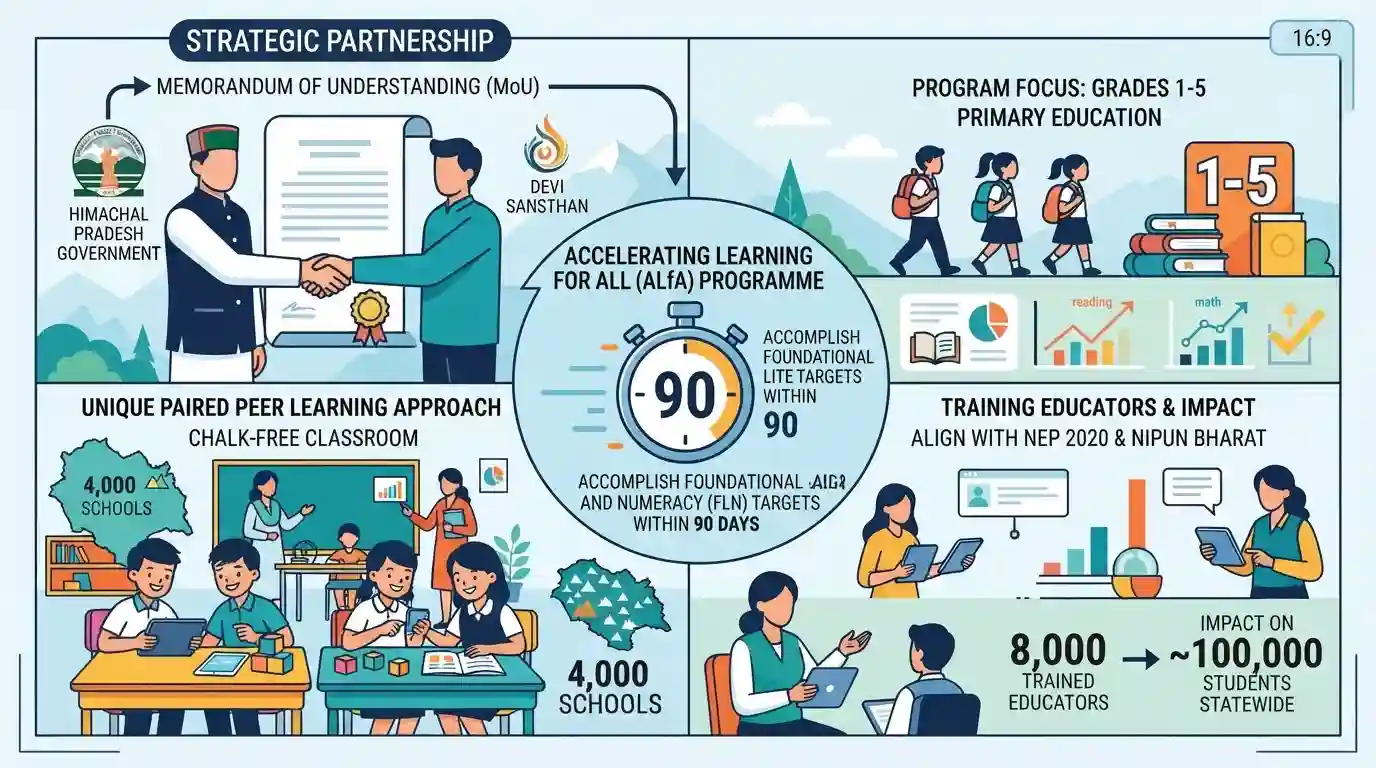
The Himachal Pradesh government has entered a strategic partnership with DEVI Sansthan by signing a Memorandum of Understanding (MoU) to implement the Accelerating Learning for All (ALfA) programme across the state. Focused on primary education (Grades 1 to 5), the initiative intends to accomplish Foundational Literacy and Numeracy (FLN) targets within just 90 days. It uses a unique paired peer learning approach, operating 'chalk-free' classrooms in 4,000 schools. The programme aligns with NEP 2020 and Nipun Bharat goals, training 8,000 educators to impact roughly 100,000 students statewide.
Key Points
- The Himachal Pradesh government signed an MoU with DEVI Sansthan to launch the ALfA (Accelerating Learning for All) programme statewide.
- The programme aims to achieve Foundational Literacy and Numeracy (FLN) targets within 90 days for students in Grades 1 to 5.
- It utilizes a 'chalk-free' paired peer learning model, replacing traditional instruction with interactive, fast-tracked learning.
- The initiative will be rolled out across 4,000 schools in all 12 districts, training 8,000 teachers and benefiting around 1 lakh students.
- This MoU aligns with the larger National Education Policy (NEP) 2020 and Nipun Bharat guidelines to transform primary education.
Important Terms
Accelerating Learning for All (ALfA) Programme

An innovative, low-cost, child-led pedagogy designed by DEVI Sansthan. It uses peer-paired learning to help primary school students rapidly acquire foundational literacy and numeracy skills, typically within 45 to 90 days.
UPSC context
GS Paper II: Social Justice/Education. Tests understanding of scalable, non-traditional classroom methodologies to resolve India's acute foundational learning crisis.
DEVI Sansthan (Dignity Education Vision International)
A Lucknow-based non-profit organization established in 1992 that specializes in implementing innovative, low-cost, scalable educational frameworks (like the ALfA pedagogy) to accelerate foundational literacy and numeracy across India.
UPSC context
GS Paper II: Role of NGOs and Civil Society in the social sector. Examines the importance of public-private partnerships (PPPs) in driving state-level education outcomes.
Foundational Literacy and Numeracy (FLN)
The fundamental ability of young children to read with comprehension, write basic sentences, and perform simple arithmetic operations (such as addition and subtraction) by the end of Grade 3.
UPSC context
GS Paper II: Social Sector (Education). Tests understanding of critical learning metrics, human capital development, and policy implementation gaps in primary schooling.
NIPUN Bharat Mission
A national flagship initiative launched in 2021 by the Ministry of Education to ensure every child in India achieves universal Foundational Literacy and Numeracy (FLN) by the end of Grade 3 by 2026-27.
UPSC context
GS Paper II: Government Schemes & Policies. Frequently tested on primary education targets, five-tier implementation structures, and state-level education deliverables.
National Education Policy (NEP) 2020
A comprehensive national framework designed to restructure India's entire education system. It establishes universal foundational literacy and numeracy (FLN) as the highest priority and primary milestone for elementary schooling.
UPSC context
GS Paper II: Social Sector/Education. Tests knowledge of policy reforms, holistic developmental benchmarks, and educational governance across India.
Prelims Trap
The national NIPUN Bharat Mission targets the universal acquisition of foundational literacy and numeracy for all children up to Grade 5.
The National NIPUN Bharat Mission strictly targets foundational literacy and numeracy up to Grade 3. State-level initiatives (like HP's ALfA) may extend to Grade 5, but the national baseline standard is Grade 3.
Static Concepts Connected
What is the NIPUN Bharat Mission?
- Core Objective: Launched under the centrally sponsored Samagra Shiksha scheme to create an enabling environment for universal acquisition of FLN.
- Target Group: Focuses on children in the age group of 3 to 9 years, covering preschool to Grade 3.
- Goal Timeline: Aims to ensure every child achieves desired learning competencies in reading, writing, and numeracy by the end of Grade 3 by 2026-27.
How does NEP 2020 prioritize Foundational Literacy and Numeracy (FLN)?
- Highest Priority: Identifies FLN as an urgent national prerequisite, stating that the rest of the policy will lose relevance if basic reading and arithmetic are not achieved first.
- National Mission: Advocates a dedicated National Mission on FLN to track and support early-grade learning outcomes systemically.
- Pedagogical Shift: Recommends a curriculum transition away from rote learning towards activity-based, interactive, and collaborative peer learning.
Cross-Topic Patterns
State-NGO synergy in governance
NGO-State partnerships highlight a shift in governance where educational public service delivery is co-designed with civil society organizations for rapid, agile scaling.
FLN and demographic dividend
Early-grade learning gaps permanently curtail workforce quality, showing how foundational cognitive development directly dictates India's long-term demographic dividend potential.

NIPUN Bharat targets (Grade 3/Age 3-9) vs state-level deviations (Grade 5) likely to be tested in multi-statement prelims questions.
Linked PYQs · 2
Linked PYQs · 2
- 2016HPAS_PRELIMSGS1
As per Census 2011, literacy rate in Himachal Pradesh for male and female respectively is :
- 2017HPAS_PRELIMSGS1
To improve the Gross Enrolment Ratio (GER) in Higher Education the Government of H.P. has adopted 'Rashtriya Uchtar Shikha Abhiyan' the centrally sponsored scheme in the year :
