Kishau Hydro Project: Himachal secures better terms and revenue share
Source:propnewstime ↗
Why It Matters
Crucial for Himachal Pradesh's state economy, hydro-revenue generation, and inter-state resource management policy questions in the HPAS Prelims exam.
Summary
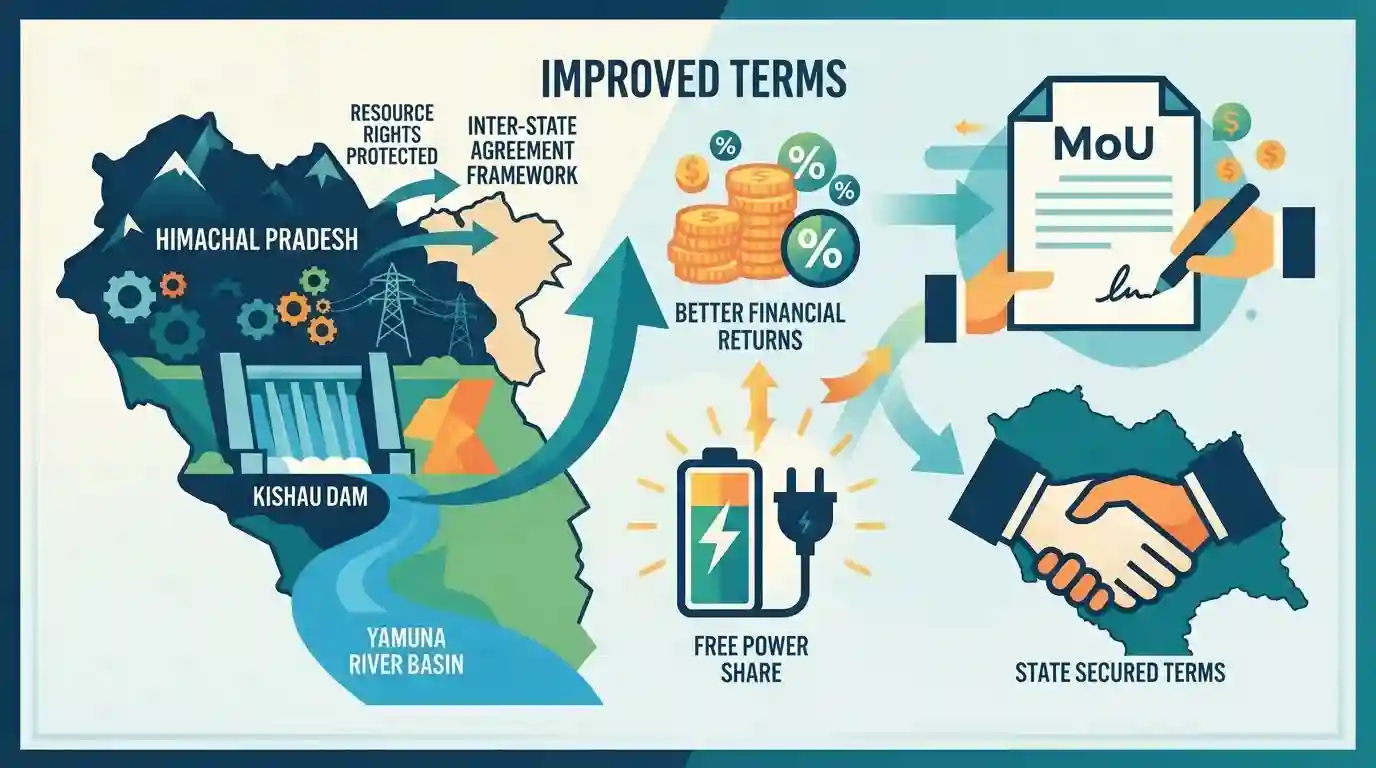
Himachal Pradesh secured improved terms for the Kishau Hydro Project ahead of signing the MoU, focusing on better financial returns, free power share, and protection of state resource rights within the Yamuna river basin framework.
Key Points
- Himachal Pradesh has successfully negotiated improved terms and conditions for the Kishau Hydroelectric Project ahead of signing the Memorandum of Understanding (MoU).
- The project relates to the Yamuna river basin and involves inter-state coordination regarding water sharing, royalty, and energy benefits for Himachal Pradesh.
- The revised terms aim to safeguard the economic and resource interests of the hill state, ensuring higher revenue and power share from the project.
Important Terms
Kishau Hydro Project MoU

A 660 MW multipurpose hydroelectric initiative on the Tons River (Yamuna basin) along the Himachal Pradesh-Uttarakhand border, involving six stakeholder states and central funding assistance.
UPSC context
Important for HPAS Paper II (Geography & Economy of HP) and inter-state water sharing disputes in the Yamuna basin.
Kishau Hydro Project Corporation
A joint venture entity between Himachal Pradesh and Uttarakhand tasked with implementing the Kishau Multipurpose Dam Project.
UPSC context
Relevant for HPAS Governance and Economy topics focusing on state-level corporate bodies managing hydroelectric resources.
Prelims Trap
Kishau Hydroelectric Project is located on the main stem of the Yamuna River in Himachal Pradesh.
The Kishau project is built on the Tons River (a tributary of Yamuna), not directly on the main stem of the Yamuna River or the Sutlej River.
Static Concepts Connected
What are the key funding and structural features of National Hydroelectric Projects in India?
- Funding Pattern: National Project status involves 90:10 funding pattern between Centre and participating states for the irrigation/water component.
- River System: The Kishau project is constructed across the Tons River, a major tributary of the Yamuna River.
- Stakeholder States: Six riparian states viz. HP, Uttarakhand, UP, Haryana, Rajasthan, and Delhi are stakeholders in the Upper Yamuna basin framework.
Cross-Topic Patterns
Inter-state Water Sharing & Fiscal Autonomy
Kishau links inter-state water disputes with HP's fiscal autonomy, mirroring debates on royalty rights in Sutlej-Beas basin projects for GS Paper III.

Kishau project details (Tons river, Yamuna basin, National Project funding) frequently appear as matching or statement-based Prelims questions.
Linked PYQs · 2
Linked PYQs · 2
- 2017HPAS_PRELIMSGS1
What is the approximate capacity of ‘Shontong-Karcham’ Hydro Electric Power Project ?
- 2025HPAS_PRELIMSGS1
Consider the following statements : (1) The first step in rural electrification was taken on January 14, 1958 when lights were switched on at Sundernagar. (2) At the time of electrification of Sundernagar in Mandi district, its population was nearly 12,000 when its 20 nearby villages in fertile Balh Valley were given electrification. (3) The electrification programme in the state was divided into two parts (i) Local power generation was proposed in high valleys remote from the district headquarters (ii) The lower belts of the state near Punjab were to get electricity from the Nangal and Uhl river feeder. (4) The Shanan powerhouse is currently under the control of Punjab State Electricity Board and whole of the revenue goes to Punjab Government. Select the correct answer given below :
