Kinnaur Flash Flood Response and Community Resilience
Source:uniindia ↗
Why It Matters
It emphasizes the crucial role that localized grassroots bodies—such as Panchayats and Mahila Mandals—play as initial responders during natural disasters in ecologically fragile and remote zones like the Himalayas.
Summary
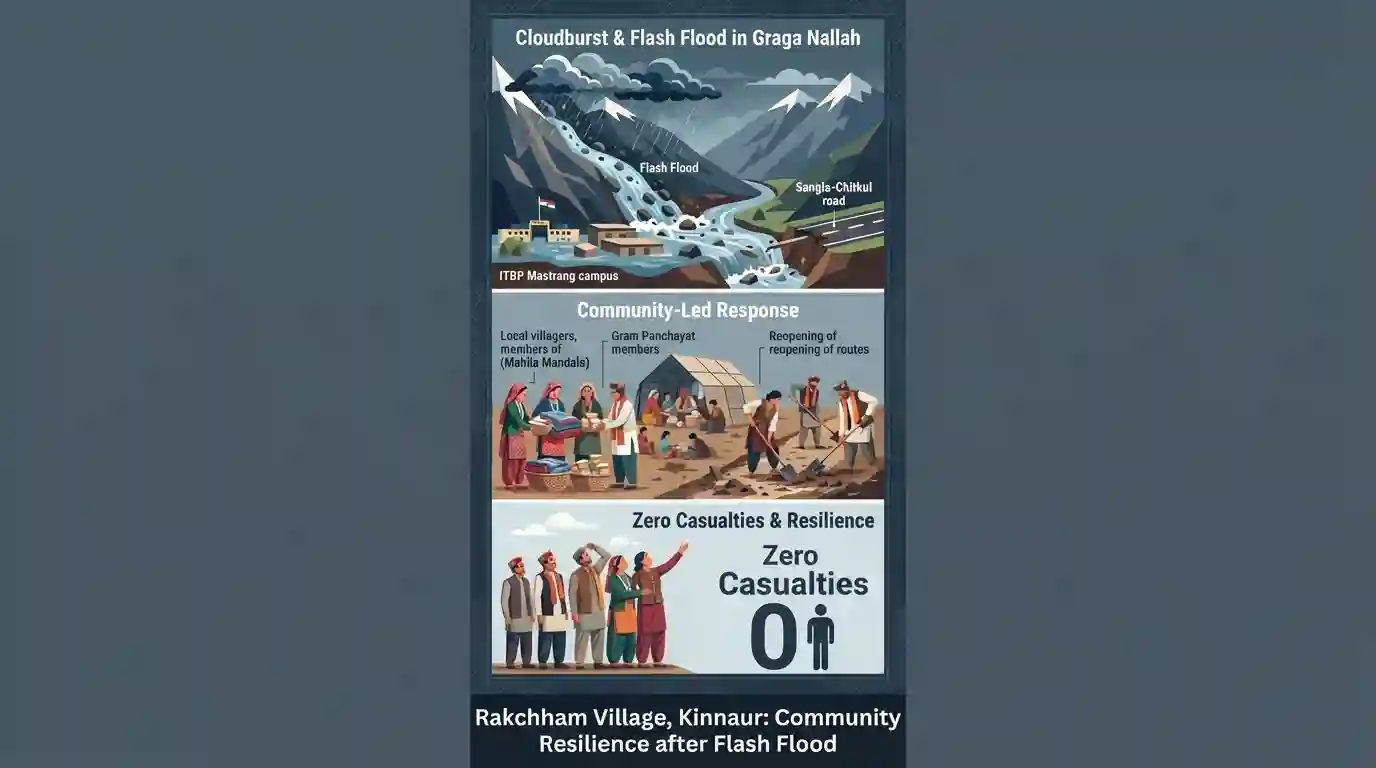
Residents of Rakchham village in Himachal Pradesh's Kinnaur district exemplified community resilience following a severe cloudburst and flash flood in the Graga Nallah. The deluge inundated the ITBP campus at Mastrang and severed the Sangla-Chitkul road, but resulted in zero casualties. Local Mahila Mandals and Gram Panchayat members immediately stepped in to provide relief, shelter, and manual clearing assistance, proving the vital importance of community-led first response in disaster-prone Himalayan regions where external aid can be delayed by harsh terrain.
Key Points
- A cloudburst in the Graga Nallah triggered a massive flash flood in the Mastrang area of Kinnaur district, bringing mud and boulders into the 2nd Battalion ITBP campus and blocking the Sangla-Chitkul road.
- Despite the extensive damage to barracks and infrastructure, no casualties were reported among civilians or ITBP personnel.
- Demonstrating extraordinary community resilience, members of the Rakchham Gram Panchayat and local Mahila Mandals immediately mobilized to provide food, temporary shelter, and assistance to stranded travelers and affected personnel.
- The spontaneous community-led disaster response highlighted the critical role of local cooperation in remote tribal areas, where harsh terrain and weather frequently delay external rescue machinery.
Important Terms
Indo-Tibetan Border Police (ITBP)

A Central Armed Police Force (CAPF) under the Ministry of Home Affairs, raised in 1962. Known as "Himveers," they guard the India-China border and serve as crucial first responders for natural disasters in the high-altitude Himalayan region.
UPSC context
GS Paper 3 (Internal Security & Disaster Management). Tests knowledge of CAPFs, border management, and institutional first-responder frameworks.
Mahila Mandals
Grassroots women's volunteer organizations focused on socio-economic empowerment and community development. Historically rooted in 19th-century reform movements, they play a crucial role in mobilizing rural women for collective action and localized disaster relief.
UPSC context
GS Papers 1 & 2 (Indian Society & Social Justice). Tests the role of women's organizations, NGOs, and SHGs in grassroots empowerment.
Rakchham Gram Panchayat
The lowest tier of rural local self-government in India. In disaster-prone areas like Kinnaur's Rakchham, these bodies coordinate immediate community-led rescue and relief, proving vital when harsh terrain delays external state aid.
UPSC context
GS Papers 2 & 3 (Local Governance & Disaster Management). Tests the application of the 73rd Amendment and decentralized disaster resilience.
Cloudburst
An extreme weather event featuring sudden, highly localized rainfall exceeding 100 mm per hour over a small area (20-30 sq km). Driven by orographic lift, it causes devastating flash floods and landslides in mountainous terrains.
UPSC context
GS Papers 1 & 3 (Geography & Disaster Management). Tests understanding of extreme meteorological events, climate change impacts, and Himalayan vulnerability.
Community-Based Disaster Management (CBDM)
A bottom-up disaster risk reduction strategy that empowers local communities to proactively prepare for and respond to hazards. It recognizes that locals are the first responders, utilizing indigenous knowledge for immediate, effective relief.
UPSC context
GS Paper 3 (Disaster Management). Tests decentralized DRR strategies and the role of local capacity-building in national disaster policy frameworks.
Prelims Trap
"A cloudburst is classified by IMD as any sudden, intense rainfall causing flash floods in mountainous regions."
The IMD has a strict mathematical criteria for a cloudburst: rainfall equal to or greater than 100 mm per hour over a localized area of 20-30 sq km.
Static Concepts Connected
What is the course of the Sutlej river system through Himachal Pradesh?
- Origin & Entry: Originates in Tibet (Rakas Lake) as Satudri/Shatadru and enters India through the high-altitude Shipki La pass located in Kinnaur district.
- Baspa Tributary: The Baspa River is a major left-bank tributary of the Sutlej that carves the Sangla Valley, merging with it near Karcham.
What meteorological factors trigger devastating cloudbursts in the Himalayas?
- Orographic Lifting: Steep mountain slopes force warm, moisture-laden monsoon winds upward rapidly, causing rapid cooling and massive condensation.
- Cumulonimbus Updrafts: Strong vertical updrafts hold massive amounts of rainwater within dense cumulonimbus clouds until the updrafts fail, causing a sudden, concentrated downpour.
Cross-Topic Patterns
Sendai Framework & PRI empowerment
The spontaneous response by Mahila Mandals operationalizes the Sendai Framework's emphasis on local capacity building and GS2 themes of empowering Panchayati Raj Institutions as first responders.
Valley geomorphology + Infra vulnerability
Locating strategic assets (like ITBP camps) and run-of-the-river hydro projects on floodplains of dynamic Himalayan rivers highlights the conflict between border infrastructure and geomorphological hazards.

Expect a Prelims pair-matching question on Himalayan valleys (Baspa, Sangla) and river passes (Shipki La) linked to Sutlej tributaries.
Linked PYQs · 2
Linked PYQs · 2
- 2020HPAS_PRELIMSGS1
Consider the given four statements and choose the correct answer from the given options. Select the true statements from the following: 1. Chamba, Kullu and Kinnaur are considered the most susceptible of landslide threat. 2. Una, Bilaspur, Sirmaur, Shimla and Solan are considered as low vulnerable of disaster threats. 3. Hum valley of Una district has hardly any natural drinking water source. 4. As per the study of central water board, Kala Amb valley in Sirmaur district has exploited the least underground water.
- 2025HPAS_PRELIMSGS1
When was the National Centre for Disaster Management established in India ?
