Himachal revises HIMCARE rules to cap hospital reimbursement costs
Source:aninews ↗
Why It Matters
It highlights the administrative challenges of managing state-sponsored health insurance schemes, specifically the need for financial rationalization and preventing overlapping claims to ensure sustainable public healthcare funding.
Summary
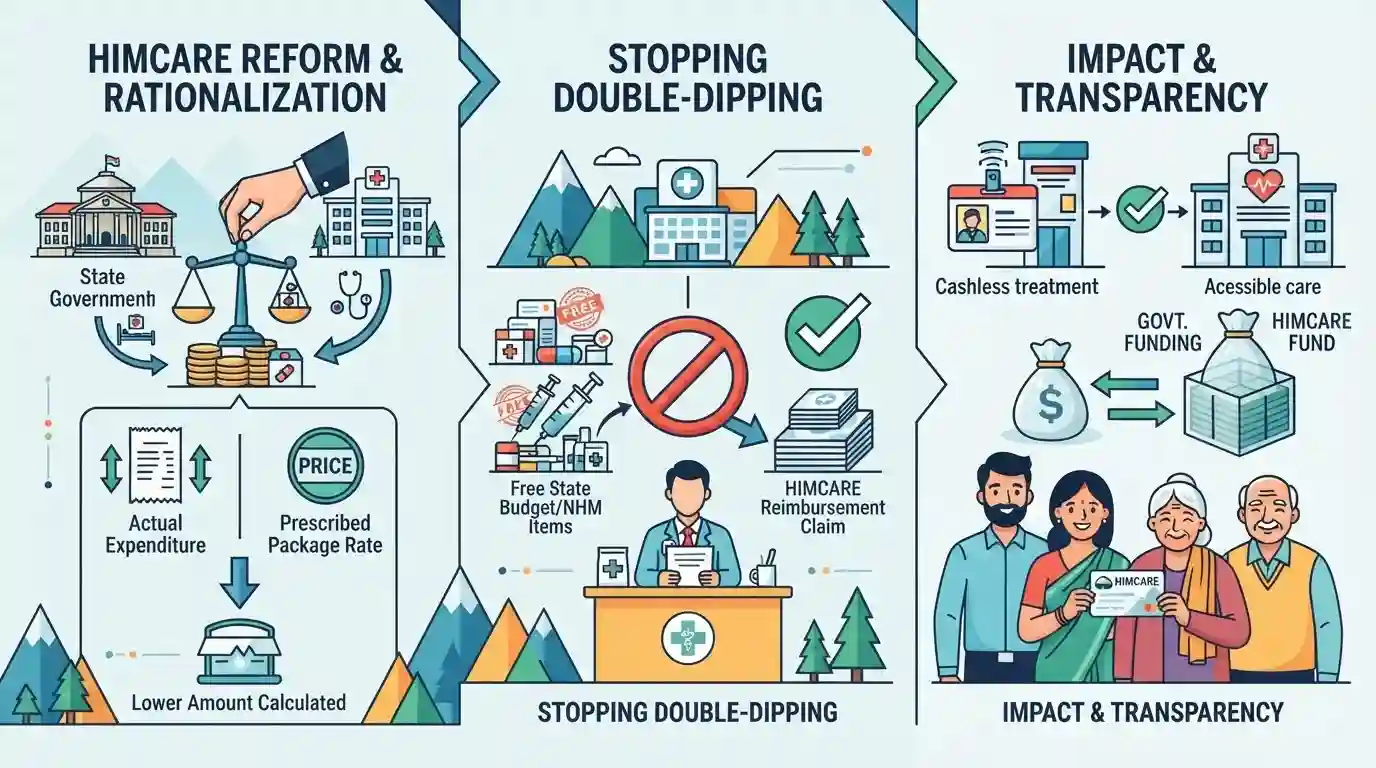
The Himachal Pradesh government has implemented new reimbursement rules for its HIMCARE health insurance scheme, applicable to all government hospitals and medical colleges. The revised guidelines aim to rationalize healthcare spending by capping reimbursements at either the actual expenditure or the prescribed package rate, whichever is lower. Crucially, the policy stops hospitals from "double-dipping" by prohibiting claims for items already provided free of cost through the state budget or the National Health Mission (NHM). This move targets financial efficiency and transparency in public healthcare funding while continuing to offer cashless treatment for enrolled patients.
Key Points
- The Himachal Pradesh government has revised the reimbursement guidelines for its flagship HIMCARE health insurance scheme across all state government hospitals and medical colleges.
- Under the new norms, healthcare institutions can claim reimbursement for either the actual expenditure incurred on treatment or the prescribed package rate, whichever is lower.
- The policy prohibits hospitals from claiming reimbursement for medicines, implants, or services already funded through the state budget, the National Health Mission (NHM), or other free supply policies.
- These revisions are designed to rationalise healthcare reimbursements, prevent duplication of claims, and ensure efficient use of public health funds while maintaining cashless treatment for beneficiaries.
Important Terms
HIMCARE Scheme

A Himachal Pradesh government health insurance initiative providing cashless medical treatment up to ₹5 lakh annually per family. It specifically covers permanent residents excluded from the central Ayushman Bharat (PM-JAY) program.
UPSC context
Crucial for HPAS GS Paper 2 (State Welfare Schemes). Tests its coverage limits, beneficiaries, and functional distinctions from PM-JAY.
National Health Mission (NHM)
A flagship Indian government program launched in 2013 that integrates rural and urban sub-missions. It aims to strengthen public healthcare infrastructure and ensure equitable, affordable medical access for vulnerable populations.
UPSC context
Highly relevant for HPAS GS Paper 2 (Health). Tests knowledge on centre-state health funding and primary healthcare delivery frameworks.
Double-Dipping (Healthcare Finance)
An unethical financial practice where healthcare institutions submit reimbursement claims for medical supplies or services that were already subsidized or provided free of cost through parallel state budgets or schemes.
UPSC context
Important for HPAS GS Paper 2 (Governance & Accountability). Tests concepts of financial rationalization, corruption prevention, and transparency in public funding.
Prelims Trap
"Under revised HIMCARE rules, hospitals are reimbursed at fixed package rates irrespective of actual expenditure."
The revised rules cap the reimbursement at actual expenditure OR the prescribed package rate, whichever is LOWER, specifically to prevent excess claiming.
Static Concepts Connected
What are the key features and eligibility criteria of the HIMCARE scheme?
- Coverage Limit: Provides cashless treatment coverage up to ₹5 lakh per family per year.
- Target Beneficiaries: Strictly targets households in Himachal Pradesh that are NOT covered under the central Ayushman Bharat (PM-JAY) scheme.
- Premium Structure: Premium is free for BPL, registered street vendors, and orphans; it uses a tiered premium (₹365 or ₹1000) for other categories.
What are the core components and funding models of the National Health Mission (NHM)?
- Core Sub-missions: Integrates the National Rural Health Mission (NRHM) and the National Urban Health Mission (NUHM) to provide universal access to equitable healthcare.
- Funding Pattern: As a Centrally Sponsored Scheme, the funding pattern for special category/Himalayan states like Himachal Pradesh is 90:10 (Centre:State).
- Target Areas: Focuses heavily on Maternal and Child Health (RMNCH+A), communicable and non-communicable diseases, and health system strengthening.
Cross-Topic Patterns
Health Schemes + Fiscal Prudence
Capping hospital reimbursements links public health administration directly to state financial management, highlighting the governance challenge of scheme duplication (double-dipping) in heavily funded welfare sectors.
Ayushman Bharat + HIMCARE Overlay
State schemes like HIMCARE are designed to plug universal health coverage gaps left by central schemes like PM-JAY and NHM, creating complex multi-tiered funding that requires strict audit mechanisms.

Expect a multi-statement question contrasting HIMCARE and Ayushman Bharat eligibility, coupled with the new reimbursement capping rules.
Linked PYQs · 1
Linked PYQs · 1
- 2024HPAS_PRELIMSGS1
Consider the following Health programmes and policy : (1) The National Health Policy (2) National Health Mission (NHM) (3) National Rural Health Mission (NRHM) (4) National Urban Health Mission (NUHM) With reference to the Health programmes and policy mentioned above, in terms of their starting year which one of the following is the correct order year ? Choose the correct answer from the options given below :
