Himachal secures third rank in investment friendliness index
Source:tribune-india ↗
Why It Matters
NITI Aayog's periodic indices and states' rankings in ease of doing business are highly recurring themes in prelims. Knowledge of Himachal's specific strengths (e.g., female workforce participation and infrastructure) is crucial for state-specific economy questions.
Summary
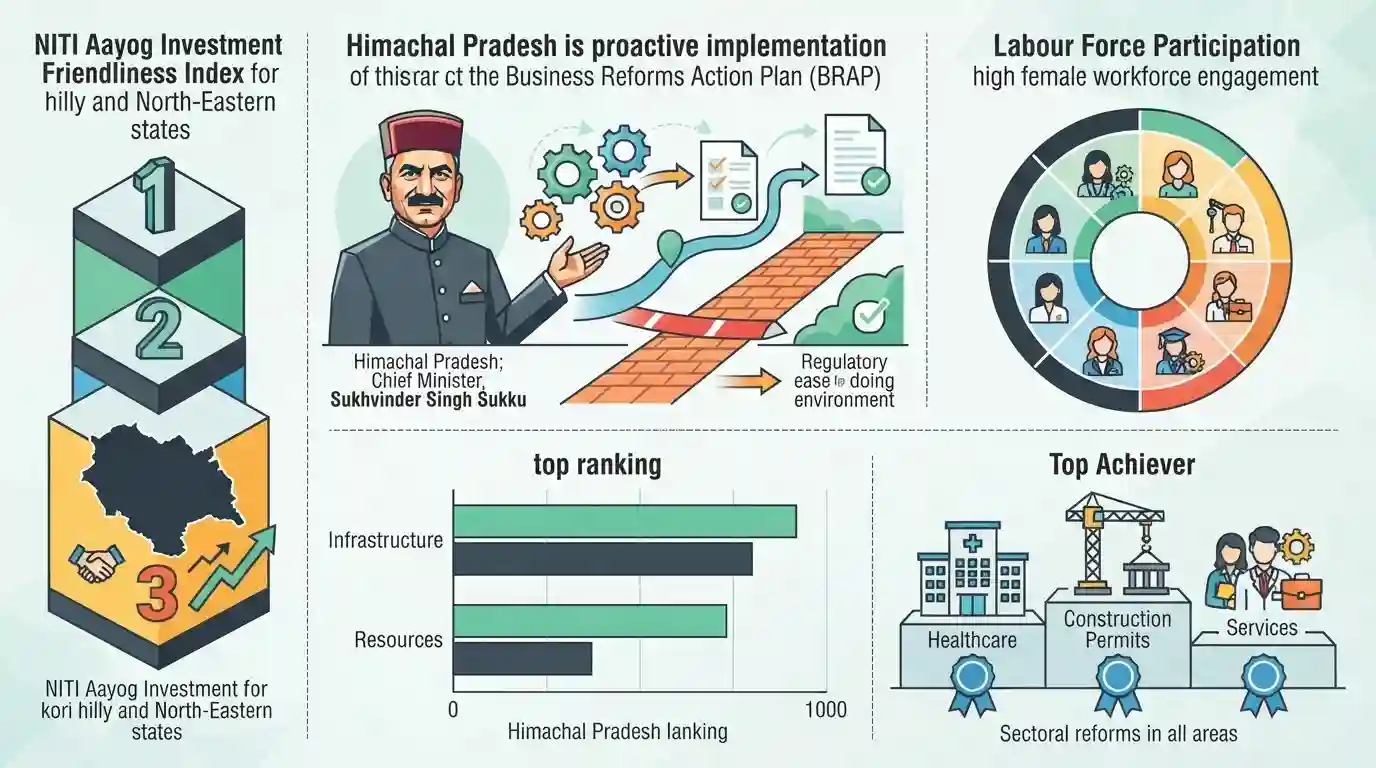
Himachal Pradesh has been ranked third among hilly and North-Eastern states in NITI Aayog's Investment Friendliness Index (IFI) 2026. Chief Minister Sukhvinder Singh Sukhu highlighted the state's proactive implementation of the Business Reforms Action Plan (BRAP) to improve the ease of doing business. The state topped the Infrastructure and Resources pillars, propelled by strong labour force participation and high female workforce engagement. Additionally, it was categorized as a 'Top Achiever' for sectoral reforms in healthcare, construction permits, and services.
Key Points
- NITI Aayog released the Investment Friendliness Index 2026, evaluating the business environment across states.
- Himachal Pradesh secured the 3rd rank among hilly and North-Eastern states in the index.
- The state ranked 1st in both the Infrastructure Pillar and Resources Pillar, driven by high labour force and female workforce participation.
- Himachal Pradesh was also recognised in the 'Top Achievers' category for construction permit enablers, healthcare, and services sector reforms under BRAP.
Important Terms
Investment Friendliness Index (IFI) 2026

An index launched by NITI Aayog in 2026 to benchmark and evaluate the readiness of Indian States and Union Territories in attracting, facilitating, and sustaining domestic and foreign investments.
UPSC context
GS Paper III (Indian Economy, mobilization of resources); tests understanding of competitive federalism and regional investment dynamics.
Business Reforms Action Plan (BRAP)
A national initiative launched in 2014 by DPIIT that evaluates and ranks Indian States and Union Territories on implementing business-friendly regulatory reforms to enhance ease of doing business.
UPSC context
GS Paper III (Industrial policy, growth); tests knowledge of regulatory simplification, administrative reforms, and ease of doing business.
NITI Aayog
The premier policy think tank of the Indian Government, established in 2015 to replace the Planning Commission, focused on fostering cooperative federalism and designing long-term policy strategies.
UPSC context
GS Paper II (Statutory, regulatory, and various quasi-judicial bodies); tests understanding of developmental planning and federal governance in India.
Labor Force Participation Rate (LFPR)
The percentage of the working-age population (typically 15 years and above) that is either actively employed or seeking employment within the economy.
UPSC context
GS Paper III (Employment and growth); tests understanding of labor market indicators, workforce dynamics, and economic development.
Female Labor Force Participation Rate (FLFPR)
The percentage of the working-age female population (15 years and above) that is either employed or actively seeking/available for work.
UPSC context
GS Paper III (Inclusive growth, employment) and GS Paper I (Women's issues); tests gender-inclusive economic indicators.
Prelims Trap
The Investment Friendliness Index (IFI) is released by DPIIT as part of the annual Business Reforms Action Plan (BRAP) evaluation.
IFI is NITI Aayog's independent sub-national framework, whereas BRAP is evaluated by the Department for Promotion of Industry and Internal Trade (DPIIT).
Static Concepts Connected
How do sub-national indices foster competitive federalism in India?
- Competitive federalism: Promotes healthy policy competition among states to attract investments, improve ease of doing business, and upgrade infrastructure.
- Policy benchmarking: Uses robust, data-driven frameworks to help states identify governance gaps and adopt peer-tested regulatory best practices.
- NITI Aayog's role: Replaces centralized planning with evidence-based policy advocacy, ranking states to drive cooperative-competitive dynamics.
What is the Business Reforms Action Plan (BRAP) framework?
- Nodal agency: Initiated by the Department for Promotion of Industry and Internal Trade (DPIIT) under the Ministry of Commerce and Industry.
- Assessment model: Shifts from absolute numerical ranking to categorization of states (e.g., Top Achievers, Achievers) to prevent toxic rivalries.
Cross-Topic Patterns
Mountain economies and gendered labor
Hilly states like Himachal Pradesh often show higher female labor force participation due to robust community-based agricultural structures and high literacy rates.
Sub-national indices and fiscal rewards
The Center increasingly links performance in competitive federalism indices (like BRAP) to untied capital expenditure grants for states.

DPIIT's BRAP categorization vs NITI Aayog's new IFI parameters likely to be paired in a comparative 2026 Prelims question.
Linked PYQs · 5
Linked PYQs · 5
- 2023HPAS_PRELIMSGS1
Which organisation releases the SDG India-Index, which comprehensively documents the progress made by India's States and Union Territories towards implementing the 2030 SDG targets ?
- 2014HPAS_PRELIMSGS1
'NITI' in NITI Aayog stands for :
- 2024HPAS_PRELIMSGS1
Economic Growth in country X will necessarily have to occur if :
- 2024HPAS_PRELIMSGS1
For the year 2022-23, match the Industry sub-sector in Himachal Pradesh with the percentage of workers employed in them : | List I (Industry Sub-sector) | List II (Percentage of workers employed) | |---|---| | (a) Mining and Quarrying | (i) 2 | | (b) Manufacturing | (ii) 41 | | (c) Electricity and Other Utilities | (iii) 50 | | (d) Construction | (iv) 7 | Choose the correct option : Code: (a) (b) (c) (d)
- 2025HPAS_PRELIMSGS1
According to PLFS 2023-24, share of secondary and tertiary sector in total employment in Himachal Pradesh respectively are :
