Orange alert issued across districts amid heavy monsoon road blocks
Source:tribuneindia ↗
Why It Matters
The vulnerability of the Himalayan ecosystem to extreme weather events like cloudbursts, flash floods, and landslides is a critical topic for HPAS Prelims. It emphasizes the need for robust disaster management frameworks, effective early warning systems, and an understanding of the region's climatic zones.
Summary
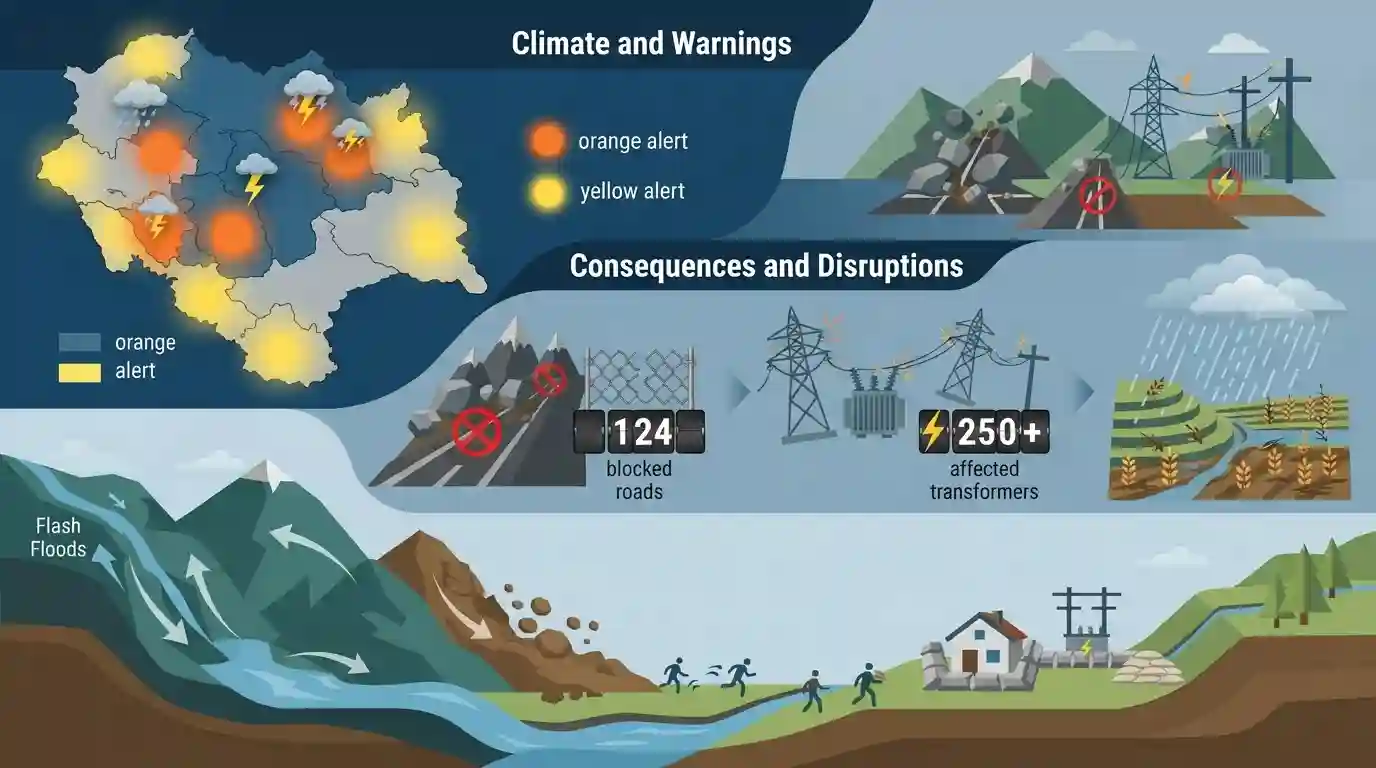
Heavy rains in Himachal Pradesh have led to severe disruptions, blocking 124 roads and affecting over 250 power transformers. The local meteorological department has issued an 'orange' alert for isolated areas across six districts, forecasting heavy to very heavy rainfall, accompanied by thunderstorms and lightning. Additionally, a 'yellow' alert is active for other regions. Authorities emphasize the high risk of landslides and flash floods, urging precautions to protect infrastructure, vulnerable populations, and agricultural assets in the hilly terrain.
Key Points
- Heavy rains in Himachal Pradesh blocked 124 roads and disrupted 255 transformers and 17 water supply schemes.
- The meteorological department issued an 'orange' alert for six districts, warning of heavy to very heavy rainfall and thunderstorms.
- Mandi district experienced the most severe disruptions, including 51 blocked roads and 245 affected transformers.
- Authorities have warned about a high risk of landslides and flash floods, posing dangers to infrastructure and vulnerable populations in the state.
Important Terms
State Emergency Operation Centre (SEOC)

The State Emergency Operation Centre (SEOC) acts as the primary command hub for coordinating disaster response, early warning dissemination, and inter-agency relief efforts at the state tier.
UPSC context
Relevant to GS Paper 3 (Disaster Management). Tests knowledge of institutional frameworks operating under the State Disaster Management Authority (SDMA).
India Meteorological Department (IMD)
Established under the Ministry of Earth Sciences, the India Meteorological Department is the principal national agency responsible for meteorological observations, weather forecasting, and issuing hazard warnings.
UPSC context
Pertains to GS Papers 1 and 3. Tests awareness of India's nodal scientific agencies, early warning systems, and climate forecasting capabilities.
Orange Alert
A color-coded warning issued by the IMD directing authorities and the public to "be prepared." It signifies severe weather conditions likely to cause significant disruptions, infrastructure damage, or commute hazards.
UPSC context
Important for GS Paper 3 (Disaster Management). Evaluates knowledge of standard operating procedures, risk communication, and weather-related early warning protocols.
Flash Floods
Sudden, high-intensity localized floods developing rapidly—usually within six hours—triggered by extreme precipitation, cloudbursts, or dam breaches. They offer minimal response time and cause severe destruction.
UPSC context
Covers GS Papers 1 and 3. Tests understanding of geomorphological hazards, climate-induced extreme events, and adherence to NDMA mitigation guidelines.
Prelims Trap
An IMD 'Orange' alert mandates the immediate evacuation of populations from vulnerable weather-affected areas.
An 'Orange' alert signifies 'Be Prepared' for potential disruptions. Immediate evacuation and preventive action are protocols typically associated with a 'Red' alert ('Take Action').
Static Concepts Connected
What makes the Himalayan region intrinsically vulnerable to landslides?
- Young Fold Mountains: The Himalayas are young, tectonically active fold mountains, making them naturally prone to seismic activity and geological instability.
- Lithology & Topography: The region features steep gradients and a high composition of fragile sedimentary rocks that are easily destabilized.
- High Precipitation: Concentrated monsoon rainfall and rapid snowmelt act as primary triggers for mass movement and flash floods.
What is the IMD's colour-coded weather warning system?
- Yellow Alert: Signifies 'Be Aware' for severely bad weather over multiple days. Keep track of changing weather conditions.
- Orange Alert: Signifies 'Be Prepared' for extremely bad weather with potential power, transport, and daily life disruptions.
- Red Alert: Signifies 'Take Action' for extreme weather with imminent threat to life and property, requiring preventive measures.
Cross-Topic Patterns
Himalayan Infrastructure vs. Ecology
Frequent flash floods bridge GS-1 (Geography) and GS-3 (Disaster Management), frequently tested alongside the ecological impacts of hydroelectric tunneling, unscientific slope-cutting, and road-widening projects.
Climate Change and Monsoon Shifts
Changing monsoon patterns, characterized by short-duration extreme precipitation events (like cloudbursts), are amplifying vulnerabilities in terrain historically accustomed to steady, moderate rainfall.

IMD weather colour codes and anthropogenic vs geological triggers for Himalayan landslides are highly likely to form a paired question.
Linked PYQs · 3
Linked PYQs · 3
- 2024HPAS_PRELIMSGS1
Arrange the following climatic zones of Himachal Pradesh according to rainfall amount from lowest to highest : (1) Frigid aridic zone (2) Wet temperate zone (3) Humid sub-tropical zone (4) Sub-humid sub-tropical zone Choose the correct answer from the options given below :
- 2025HPAS_PRELIMSGS1
When was the National Centre for Disaster Management established in India ?
- 2025HPAS_PRELIMSGS1
Match List I with List II : | List-I (Code) | List-II (District) | |---|---| | (a) Highest Rainfall (2018 Data) | (i) Shimla | | (b) Second Most Incidents Reported (2024 Crime Data) | (ii) Mandi | | (c) Fourth Highest Population (2011 Census) | (iii) Kangra | | (d) Fourth Largest Area | (iv) Solan | Choose the correct answer from the options given below : Code: (a) (b) (c) (d)
