Supreme Court panel to inspect Shimla green belts over violations
Source:hindustantimes ↗
Why It Matters
Crucial for HPAS aspirants tracking environmental governance, urban planning regulations, and Supreme Court interventions concerning ecological conservation within Himachal Pradesh's fragile hill stations.
Summary
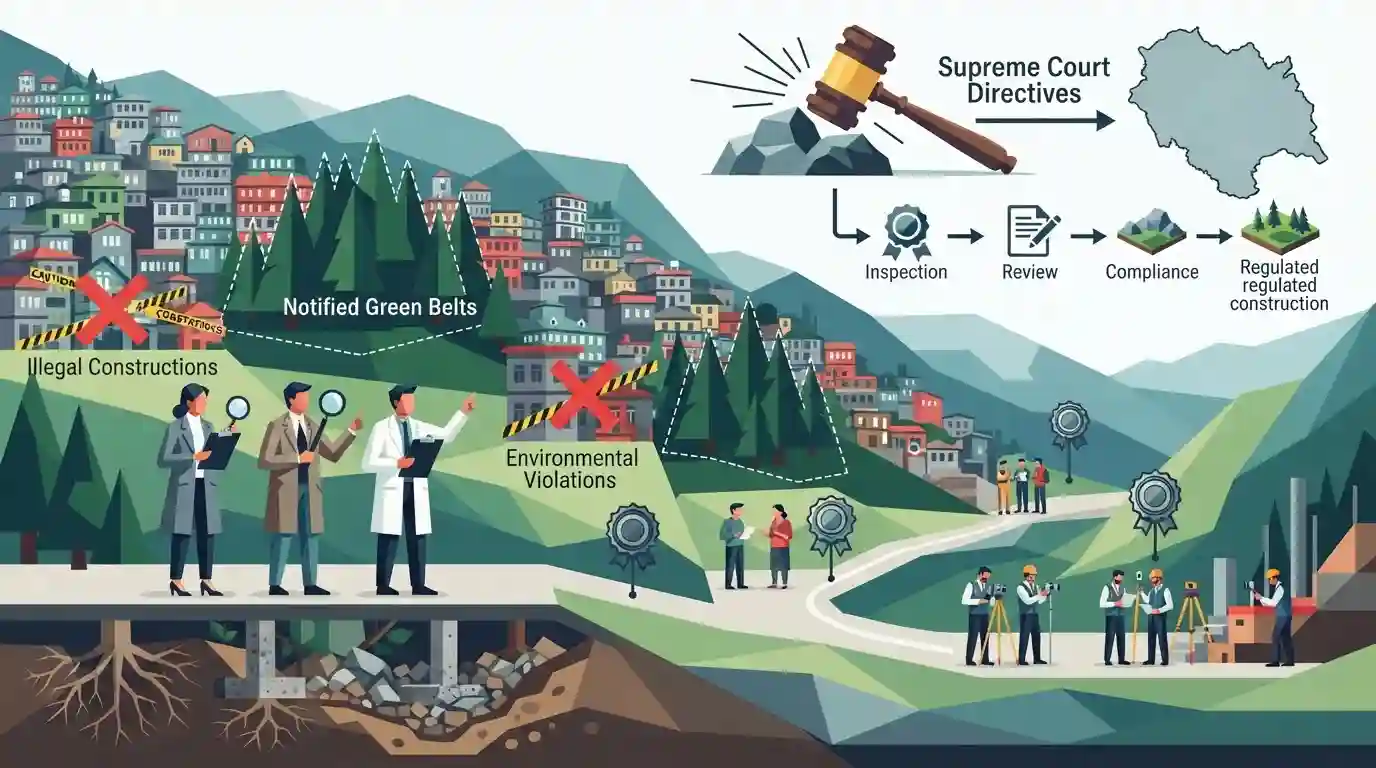
A Supreme Court-appointed panel is scheduled to inspect Shimla's notified green belts to review ongoing investigations and compliance regarding illegal constructions and environmental rule violations by the Himachal Pradesh government.
Key Points
- The Supreme Court-appointed panel is set to inspect Shimla's protected green belts to check for illegal construction and environmental violations.
- The Himachal Pradesh government is actively probing violations of environmental laws and unauthorized constructions in notified green areas of Shimla.
- Shimla's green belts play a vital role in local ecology, biodiversity conservation, and preventing urban congestion and landslides in the fragile Himalayan ecosystem.
Important Terms
Supreme Court

The apex judicial body of India, which can intervene suo motu in environmental matters to protect fragile mountain ecosystems and enforce constitutional safeguards.
UPSC context
Relevant for HPAS GS Paper II (Indian Polity, Judiciary) and GS Paper III (Environment & Ecology, judicial activism).
Supreme Court-appointed panel
A specialized expert body, such as the Central Empowered Committee (CEC), mandated by the apex court to investigate environmental violations and compliance in ecologically sensitive areas.
UPSC context
Important for HPAS Paper III (Environmental degradation, pollution, and regulatory institutions in Himachal Pradesh).
Himachal Pradesh government
The executive authority of Himachal Pradesh responsible for implementing state laws, urban planning regulations, and environmental protection directives concerning notified green belts.
UPSC context
Crucial for HPAS GS Paper III (State administration, governance, and developmental challenges in hilly regions).
Prelims Trap
notified green areas of Shimla permit regulated commercial constructions with municipal approval
Aspirants often confuse green belt regulations (which are absolute or highly restrictive under Supreme Court/NGT orders) with normal municipal zoning laws that permit conditional commercial construction.
Static Concepts Connected
What are the statutory classifications and ecological functions of Shimla's green belts under judicial monitoring?
- Notified Extent: Shimla houses 17 notified green belts spanning over 400 hectares, primarily dominated by dense Deodar forests crucial for ecological balance.
- Judicial Protection: Strict prohibitions exist against commercial construction, tree felling, and non-forestry activities under directives from the Supreme Court and NGT.
- Ecological Role: They act as critical carbon sinks, prevent soil erosion, maintain slope stability, and curb haphazard urban sprawl in a seismic zone.
Cross-Topic Patterns
Green Belts + Disaster Management + Urban Vulnerability
Shimla's green belt protection is directly tied to disaster management, as unregulated construction in fragile slopes accelerates slope destabilization and monsoon flash floods.
Judiciary vs Executive + Urban Local Bodies
Judicial activism through Supreme Court panels in state municipal governance mirrors broader interventions in urban master plan enforcement across Indian hill stations.

Supreme Court green belt interventions + Himalayan ecology fragile ecosystem rules frequently appear in HPAS Mains GS-3/GS-1 environment.
Linked PYQs · 1
Linked PYQs · 1
- 2022HPAS_PRELIMSGS1
Select the correct statements from the following : (i) Supreme Court of India has allowed the State for silviculture green felling of three species on experimental basis. (ii) Forests in H.P. cover an area of 37947 sq. kms of total geographical area of the state (iii) In H.P. presently 30% of the total geographical areas support forest cover. (iv) The aim of the forest department is to enhance the forest cover in the state to 35% of its geographical area by 2030.
