Himachal political appointees cabinet rank withdrawal and expenditure
Source:The Hindu ↗
Why It Matters
Crucial for HPAS aspirants tracking state administrative policy, governance reforms, and public expenditure management within Himachal Pradesh.
Summary
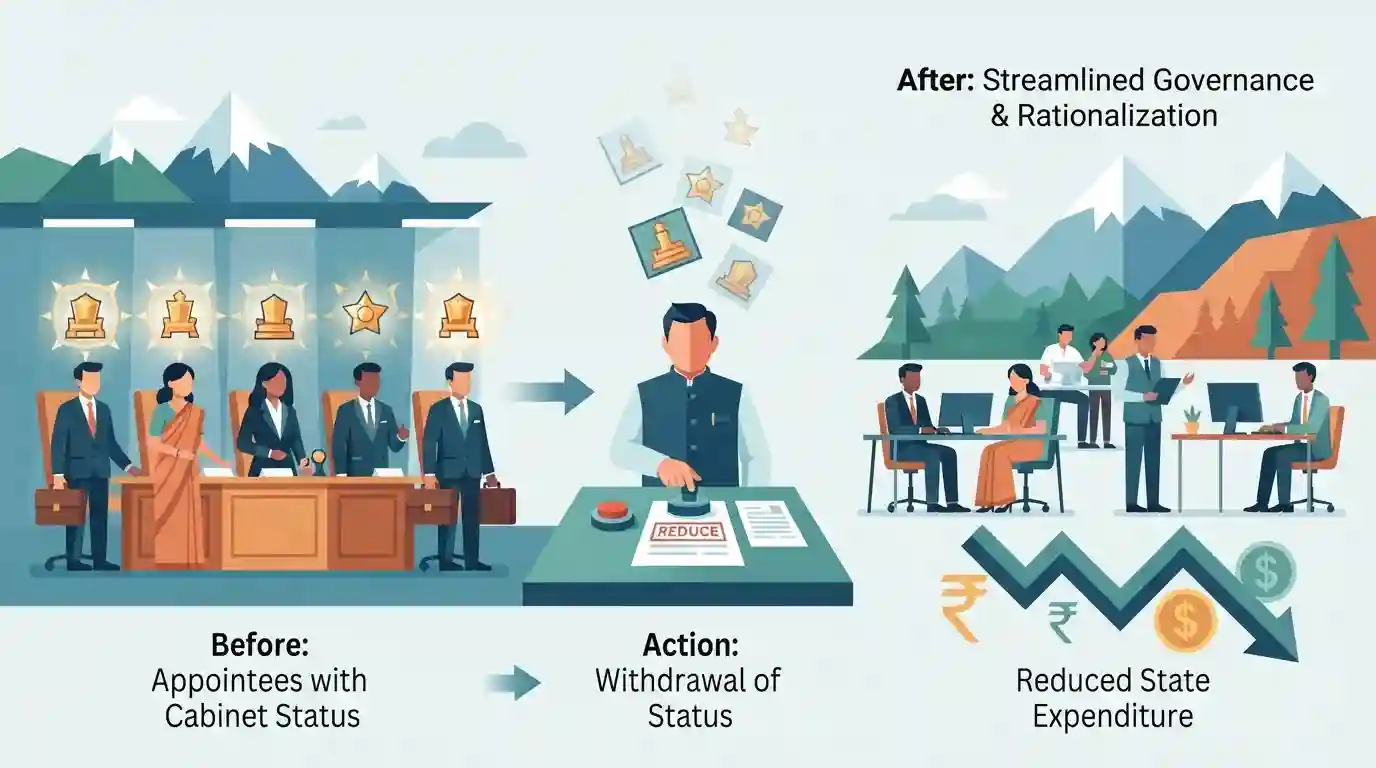
The Himachal Pradesh government has withdrawn the cabinet rank status accorded to various political appointees, advisors, and heads of boards and corporations as part of measures to streamline governance and rationalize state expenditure.
Key Points
- The Himachal Pradesh government decided to withdraw the cabinet rank status previously conferred on various political appointees, advisors, and chairpersons of boards and corporations.
- This administrative decision aims to rationalise public expenditure and streamline governance structures in the state.
- The move affects several non-official political appointees holding high-ranking protocol positions equivalent to cabinet ministers or ministers of state.
Important Terms
Himachal Pradesh Government

The executive branch of the state comprising the Governor, Chief Minister, and Council of Ministers, responsible for executing policies and administering the state of Himachal Pradesh.
UPSC context
HPAS GS Paper II (Polity and Governance): Tests understanding of state executive powers, administrative protocol, and fiscal management.
State Cabinet
The highest decision-making body of the state executive, consisting of senior cabinet ministers headed by the Chief Minister, which formulates key administrative and financial policies.
UPSC context
HPAS GS Paper II (State Government Administration): Tests knowledge of cabinet hierarchy, protocol privileges, and executive decision-making.
Prelims Trap
Withdrawal of cabinet rank status for political appointees implies the removal of elected constitutional ministers from the council of ministers.
Aspirants often confuse cabinet rank protocol conferred on political advisors with constitutional cabinet ministers appointed under Article 163/164.
Static Concepts Connected
What are the constitutional provisions regarding the Council of Ministers in a State?
- Article 163: Article 163 mandates a Council of Ministers with the Chief Minister at the head to aid and advise the Governor.
- Article 164: Article 164 governs the appointment, tenure, responsibility, and oath of ministers, including the 15% cap on total strength.
- Protocol Status: Non-constitutional political appointees given cabinet 'rank' hold executive protocol status rather than constitutional membership of the Council of Ministers.
Cross-Topic Patterns
State Debt Sustainability & Fiscal Federalism
HP's fiscal stress mirrors broader sub-national debt trends across India, testing the limits of fiscal federalism and RBI oversight on state guarantees.
Political Patronage vs State Fiscal Health
Austerity measures involving political offices highlight the tension between party patronage structures and constitutional propriety in state governance.

HP fiscal crisis + constitutional limits of office of profit / cabinet ranks in states is a high-yield GS-2 governance theme.
Linked PYQs · 1
Linked PYQs · 1
- 2018HPAS_PRELIMSGS1
The Govt. of H.P. has changed the name of 'Kanya Sashaktikaran and Kalyan Board Himachal Pradesh' to that of :
