Himachal Withdraws Cabinet Rank Status For Political Appointees
Source:The Hindu ↗
Why It Matters
Important for understanding state-level political administration, executive decision-making, and financial governance trends in Himachal Pradesh.
Summary
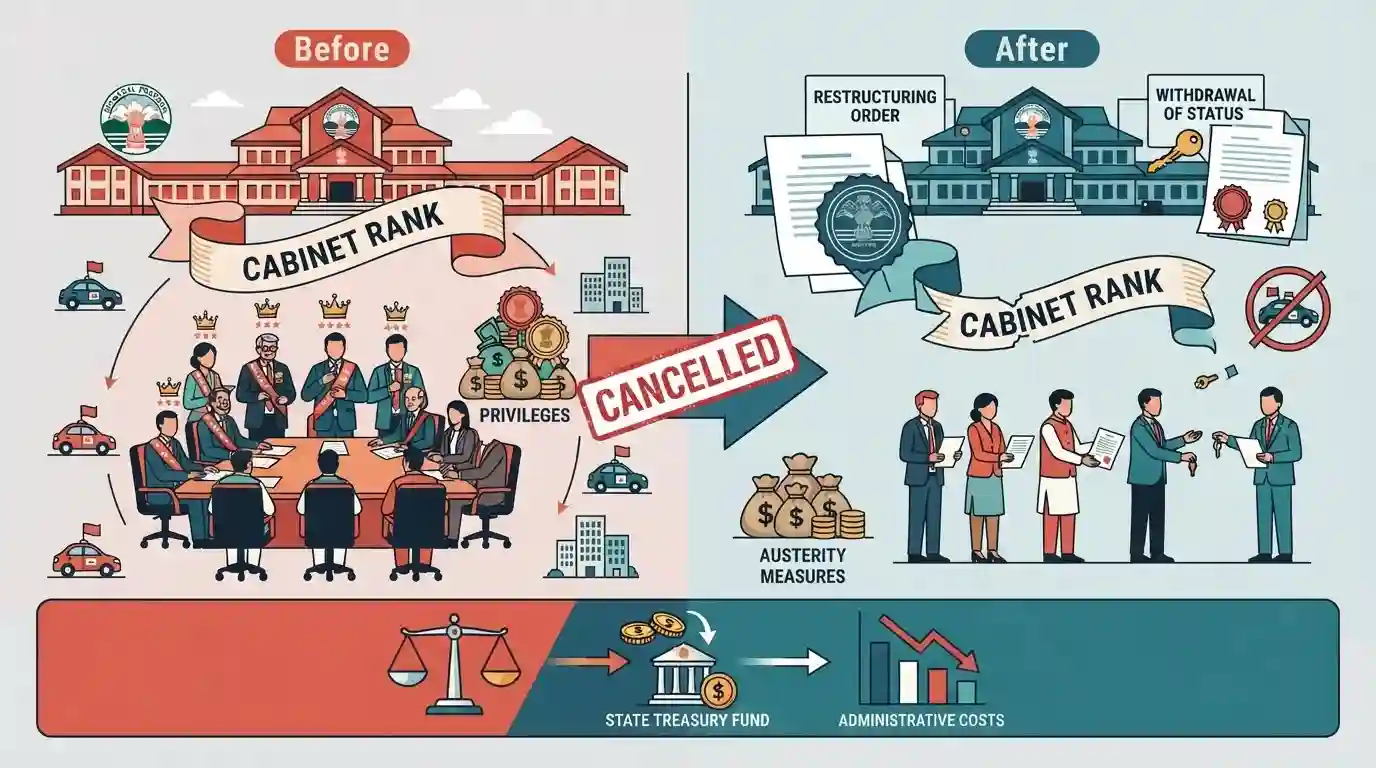
The Himachal Pradesh government has officially withdrawn the cabinet rank status given to political appointees, advisors, and heads of various state boards and corporations, aligning with austerity measures and restructuring of state-level political offices.
Key Points
- The Himachal Pradesh government decided to withdraw the cabinet rank status previously conferred on various political appointees, advisors, and chairpersons of boards and corporations.
- This administrative measure is aimed at reducing financial burdens and rationalizing official privileges and perks associated with political appointments in the state.
- The decision reflects changes in policy regarding the distribution of high-ranking state honors and official protocol designations for non-ministerial political functionaries.
Important Terms
Himachal Pradesh Cabinet

The executive decision-making body of the state government, headed by the Chief Minister and comprising ministers who hold charge of various portfolios.
UPSC context
HPAS Paper II (Polity and Governance): Important for understanding state executive, cabinet decisions, administrative protocols, and political appointments in Himachal Pradesh.
State Government of Himachal Pradesh
The supreme executive authority within Himachal Pradesh, responsible for state administration, policy implementation, fiscal management, and the governance of public sector undertakings.
UPSC context
HPAS Paper II (Polity and Governance): Tests knowledge of state-level administrative machinery, austerity measures, and governance reforms.
Prelims Trap
Cabinet rank status granted to political advisors makes them official members of the Himachal Pradesh Council of Ministers.
Aspirants might assume cabinet rank conferred on advisors makes them members of the Council of Ministers, which is constitutionally capped and requires gubernatorial appointment under Article 164.
Static Concepts Connected
What are the constitutional provisions and limits regarding the creation of offices of profit and cabinet rank in states?
- Size Limit: Article 164(1A) limits the total number of ministers including the Chief Minister to 15% of the total strength of the Legislative Assembly.
- Executive Status: Conferring cabinet rank on non-ministers (advisors/chairpersons) is an executive privilege often scrutinized under Article 191 (office of profit) and protocol rules.
- State Entities: State boards and corporations are statutory or executive bodies whose heads do not automatically enjoy ministerial constitutional protections unless explicitly provided.
Cross-Topic Patterns
State Fiscal Stress & FRBM Limits
HP's fiscal crisis mirrors trends in states facing mounting revenue deficit grants and borrowing limits under Article 293(3) of the Constitution.

HP fiscal austerity + cabinet rank withdrawals tested via statement-based questions on executive privileges and state debt.
Linked PYQs · 2
Linked PYQs · 2
- 2023HPAS_PRELIMSGS1
Towards its journey to become full state what is correct about Himachal Pradesh ? (1) It became Chief Commissioner's Province in 1948 (2) It became Union Territory in 1956 (3) It got its first Chief Minister in 1967 (4) It became 18th State of the Union in 1971 Choose the correct answer from the options given below :
- 2025HPAS_PRELIMSGS1
Match the representative of princely hill states who participated as their representative of population for the constitution of Himachal Pradesh into a single state : | List I (Representative Name) | List II (Name of the Princely State) | |---|---| | (a) Surat Ram Prakash | (i) Jubbal | | (b) Hira Singh Pal | (ii) Bhajji | | (c) Bhaskara Nand | (iii) Baghat | | (d) Salig Ram Tejta | (iv) Theog | Choose the correct answer : Code: (a) (b) (c) (d)
