Himachal Government Revokes Cabinet Rank For Political Appointees
Source:The Hindu ↗
Why It Matters
Important for HPAS aspirants to understand the administrative setup, state governance reforms, and measures related to fiscal management in Himachal Pradesh.
Summary
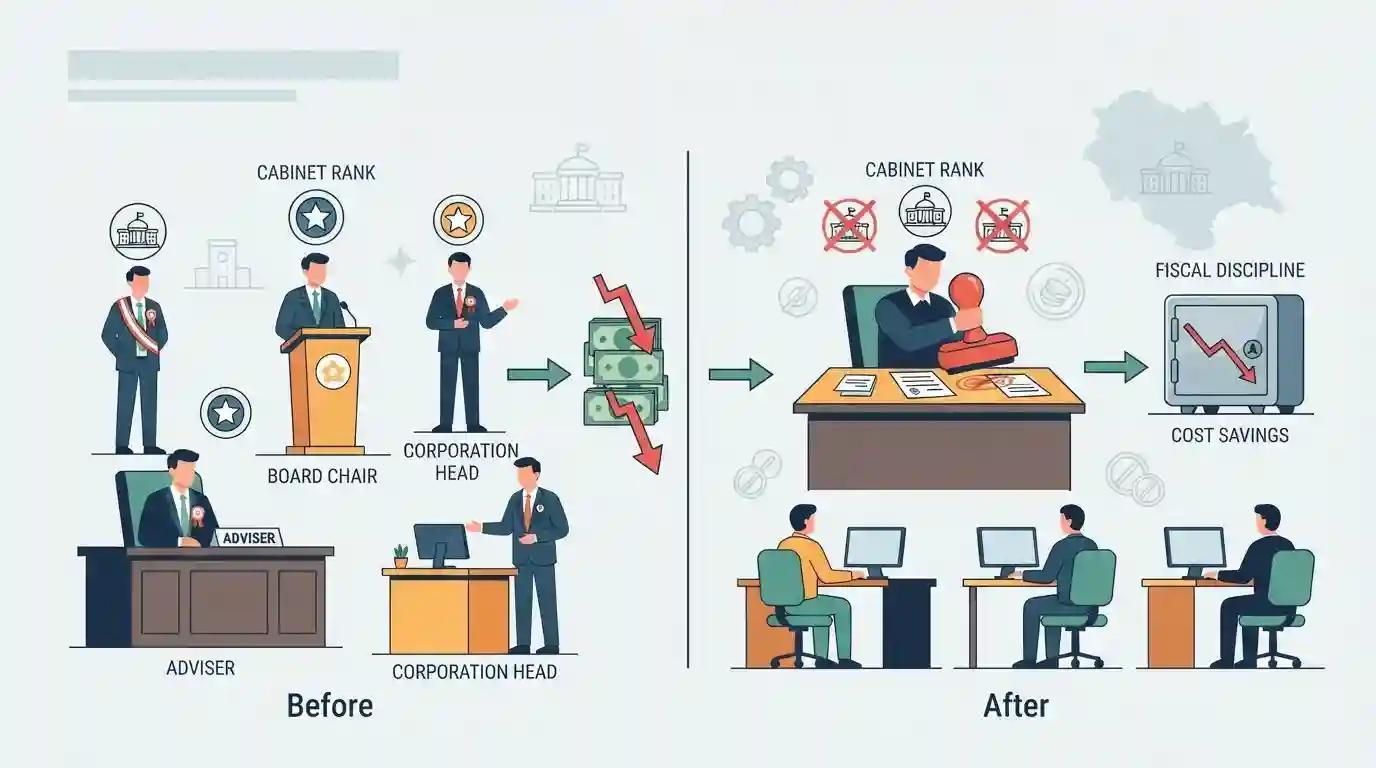
The Himachal Pradesh government decided to withdraw the cabinet rank status given to political appointees, advisers, and heads of boards and corporations as part of measures to cut down unnecessary expenditure and enforce fiscal discipline.
Key Points
- The Himachal Pradesh government has withdrawn the cabinet rank status previously conferred on political appointees, advisers, and chairpersons of various boards and corporations.
- This decision aims to rationalise government expenditure and ensure financial prudence amidst fiscal challenges faced by the state.
- Such political appointments had previously drawn public scrutiny regarding extra financial burden on the state exchequer.
Important Terms
Cabinet Rank Status

The executive body of the state government comprising ministers, headed by the Chief Minister, responsible for policy formulation, administrative governance, and financial decisions.
UPSC context
Important for HPAS GS Paper II (Polity and Governance); tests understanding of executive powers, state administration, and ministerial protocol.
Fiscal Discipline
Measures adopted by the government to control public spending, reduce unnecessary administrative costs, and maintain budgetary discipline amid financial strain.
UPSC context
Important for HPAS GS Paper III (Economy and Public Finance); tests knowledge of state fiscal management and expenditure control.
Political Appointees
Individuals appointed to key advisory, board, or corporation positions by the ruling political executive, often enjoying perks and ministerial protocol.
UPSC context
Important for HPAS GS Paper II (State Administration); tests governance norms, political patronage, and public resource allocation.
Prelims Trap
Cabinet rank status cannot be conferred on non-elected political appointees or advisers in state governments.
Aspirants often assume Cabinet rank can only be conferred on elected ministers, whereas states routinely confer it on non-elected political appointees and advisers through executive resolutions.
Static Concepts Connected
What are the constitutional and statutory limitations on the size of the Council of Ministers in states?
- 91st Amendment: Article 165 and Article 164(1A) limit the total number of Ministers, including the Chief Minister, to 15% of the total strength of the Legislative Assembly.
- Cabinet Rank Loophole: However, conferring 'Cabinet rank' status on political advisers, board chairpersons, and parliamentary secretaries bypasses these limits without technically making them cabinet ministers.
Cross-Topic Patterns
State Fiscal Discipline and FRBM Act Targets
HP's fiscal stress connects directly with the 15th Finance Commission recommendations on state-level debt sustainability and revenue deficit grants.
Executive Patronage vs. Constitutional Post Constraints
The removal of perks from political appointees highlights executive overreach and misuse of public office for patronage.

HPAS exams often test state-specific fiscal health metrics; expect questions on state debt sustainability and austerity measures.
Linked PYQs · 1
Linked PYQs · 1
- 2018HPAS_PRELIMSGS1
The Govt. of H.P. has changed the name of 'Kanya Sashaktikaran and Kalyan Board Himachal Pradesh' to that of :
