Himachal Withdraws Cabinet Rank Status For Political Appointees
Source:The Hindu ↗
Why It Matters
This decision reflects important state-level administrative and fiscal measures in Himachal Pradesh regarding political patronage, government expenditure, and public resource management, making it relevant for HPAS governance questions.
Summary
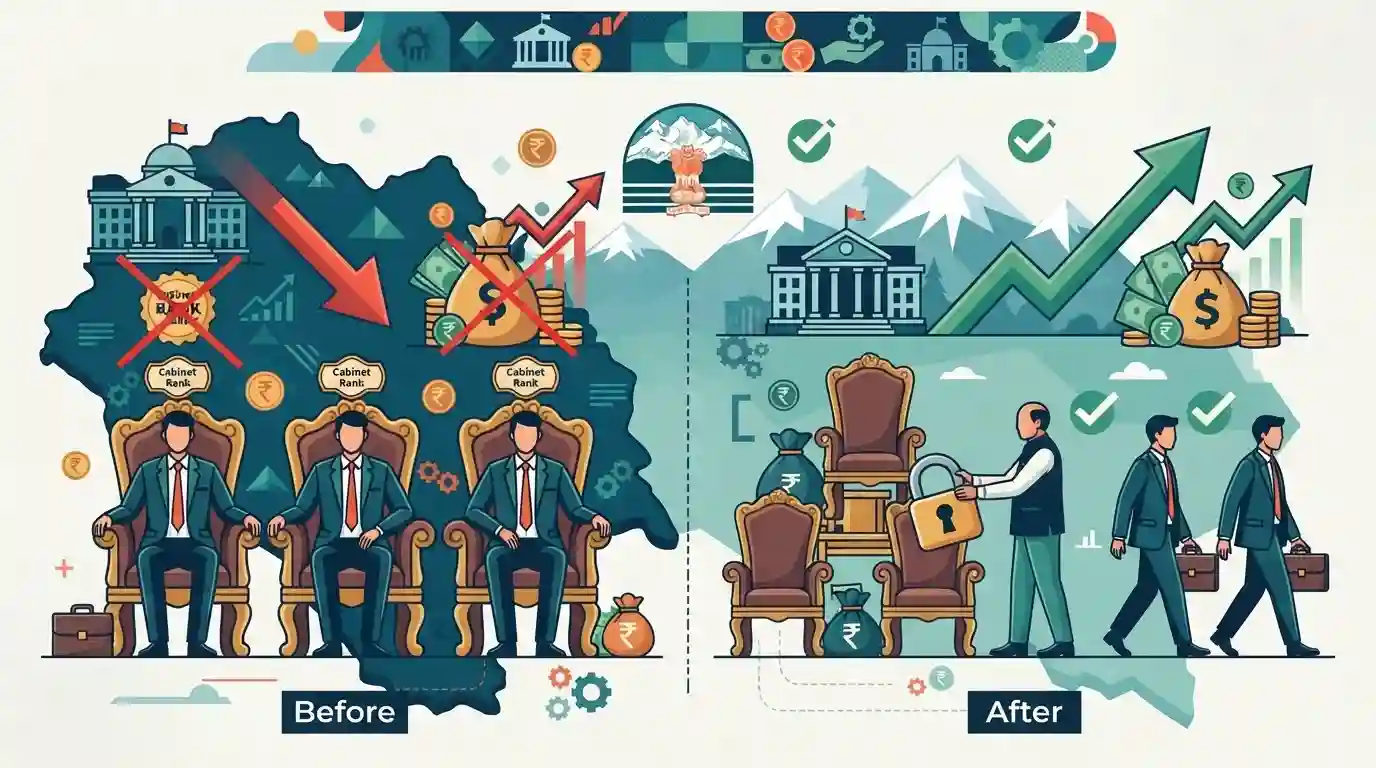
The Himachal Pradesh government has officially withdrawn the cabinet rank status earlier accorded to certain political appointees and advisors, aligning with measures to ensure fiscal discipline and curb avoidable public expenditure in the State.
Key Points
- The Himachal Pradesh government decided to withdraw the cabinet rank status previously given to various political appointees, chairpersons, and advisors.
- The move is aimed at rationalizing state expenditure, enhancing administrative efficiency, and exercising fiscal prudence amidst financial constraints.
- Political appointees who held equivalent cabinet ranks will no longer enjoy those perks and status privileges.
Important Terms
State Cabinet

The supreme executive authority in Himachal Pradesh, comprising the Chief Minister and cabinet ministers, responsible for formulating state policies, administrative governance, and fiscal decision-making.
UPSC context
GS Paper II (Polity and Governance - State Executive). Tests understanding of cabinet structures, ministerial responsibilities, and executive decision-making processes in Indian states.
Fiscal Discipline
Measures adopted by the Himachal Pradesh government to curb avoidable public expenditure, reduce protocol costs, and manage a severe financial crunch amid revenue shortfalls.
UPSC context
GS Paper III (Economy - Public Finance). Tests knowledge of fiscal consolidation, public expenditure management, and state-level budgetary challenges in India.
Political Appointees
Non-civil service positions filled by political nominees, such as chairpersons of boards and advisors, granted high administrative perks and cabinet-equivalent ranks.
UPSC context
GS Paper II (Governance and Public Administration). Tests understanding of political patronage, administrative appointments, and executive governance costs in state bodies.
Prelims Trap
Cabinet rank status accorded to political appointees carries constitutional protection similar to elected cabinet ministers.
Aspirants often confuse cabinet rank status given to political advisors with constitutional cabinet ministers appointed under Article 163/164, forgetting the former are executive creations lacking constitutional backing.
Static Concepts Connected
What are the constitutional provisions and limitations regarding the size and status of the Council of Ministers in a State under the Indian Constitution?
- Constitutional Basis: Article 163 provides for a Council of Ministers with the Chief Minister at the head to aid and advise the Governor.
- Strength Cap: Article 164(1A) limits the total number of ministers, including the Chief Minister, to 15% of the total strength of the State Legislative Assembly.
- Non-Constitutional Ranks: Cabinet rank bestowed on non-legislator political advisors by executive order does not form part of the constitutional Council of Ministers under Article 163.
Cross-Topic Patterns
Austerity measures and FRBM borrowing ceilings
State-level austerity drives directly connect to Article 293 borrowing limits imposed by the Centre under the Fiscal Responsibility and Budget Management (FRBM) framework.
Political appointees vs. Office of Profit rules
Political appointments and office-of-profit disputes often intersect when holders of cabinet-equivalent ranks exercise executive powers without legislative sanction.

HPAS Mains GS-2/GS-3: Questions on state fiscal stress often require analyzing specific austerity tools like salary deferments and cabinet rank withdrawals.
Linked PYQs · 1
Linked PYQs · 1
- 2025HPAS_PRELIMSGS1
Consider the following statements regarding public finance of Himachal Pradesh : (1) According to Budget Estimate for the year 2024-25, share of revenue expenditure out of total expenditure is around 80 percent. (2) Debt as a percentage of GSDP reached 75.33 during the year 2022-23. (3) State's own tax revenue as a percentage of total revenue for the year 2024-25 (BE) increased to 27.4. (4) During FY 2024-25 (BE) education and health sector were allocated Rs. 9995 and Rs. 8575 crores respectively. Choose the correct answer from the options given below :
