Himachal withdraws cabinet rank perks for political appointees
Source:The Hindu ↗
Why It Matters
Important from the perspective of Himachal Pradesh state governance, executive decision-making, and fiscal discipline regarding political appointments and cabinet-rank privileges.
Summary
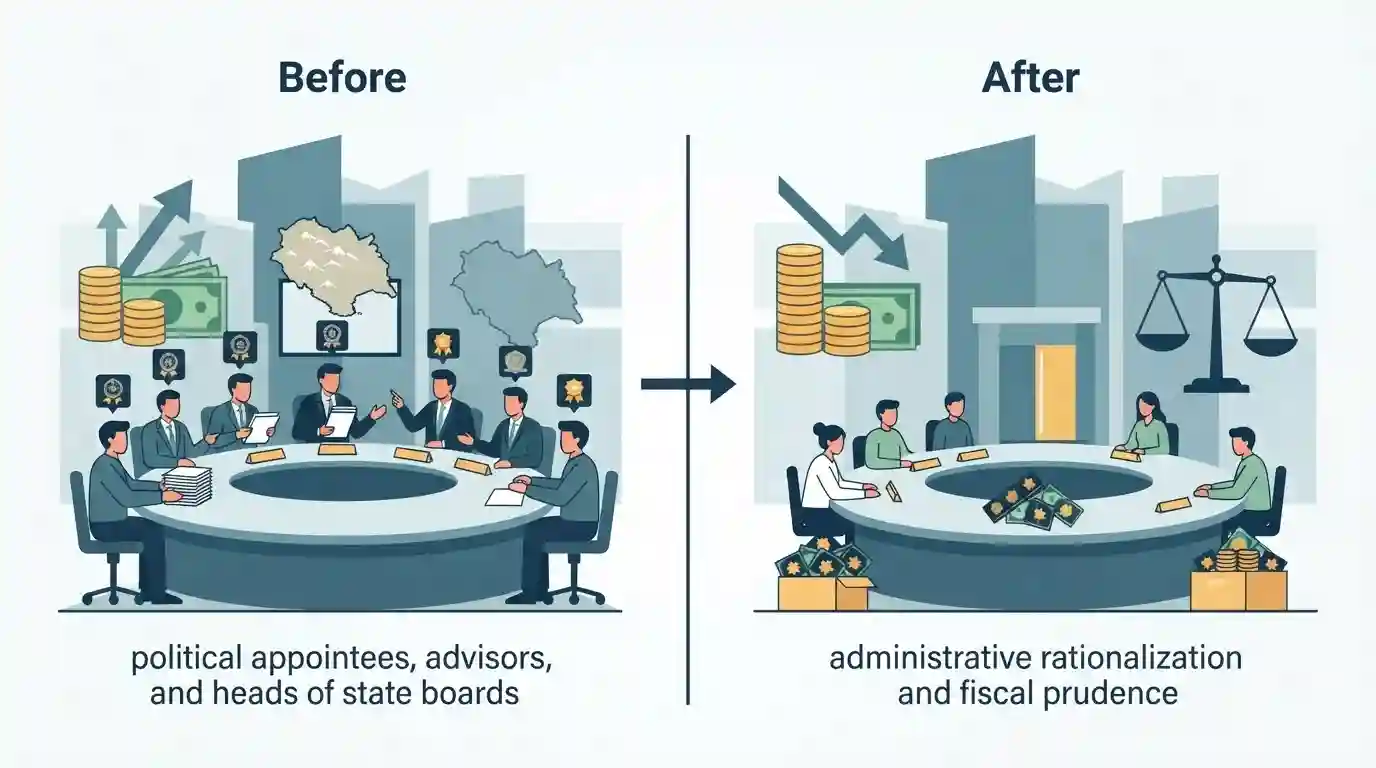
The Himachal Pradesh government has withdrawn the cabinet rank status given to political appointees, advisors, and heads of various state boards and corporations as part of an administrative rationalization and fiscal prudence measure.
Key Points
- The Himachal Pradesh government decided to withdraw cabinet rank status previously accorded to political appointees, advisors, and chairpersons of various boards and corporations.
- The move aims to rationalize public expenditure and curb unnecessary administrative burdens on the state exchequer.
- Such perks and cabinet-rank statuses are often scrutinized for adherence to constitutional limits on council of ministers and fiscal prudence.
Important Terms
Cabinet Rank Status

An executive status bestowed by the state government on non-ministerial political appointees, advisors, and corporation heads to grant them official protocol perks equivalent to state cabinet ministers.
UPSC context
Important for HPAS Polity and Governance (Paper II); tests executive powers, political patronage, and state administrative rationalization measures.
Fiscal Prudence and Administrative Rationalization
A fiscal and administrative reform strategy adopted by governments to eliminate wasteful expenditure, optimize human resources, and curtail non-essential protocol perks during economic crises.
UPSC context
Crucial for HPAS Economy and Governance (Papers II & III); evaluates state financial health, austerity measures, and public expenditure management.
State Boards and Corporations
State-level public sector undertakings and boards headed by political appointees whose chairperson or vice-chairperson positions often carry official cabinet status and perks.
UPSC context
Relevant for HPAS State Administration (Paper II); tests the governance, autonomy, and political appointments within Himachal Pradesh public enterprises.
Prelims Trap
Withdrawal of cabinet rank status violates the 91st Constitutional Amendment Act ceiling on ministers.
Aspirants often confuse executive political appointees holding cabinet-rank perks with constitutionally sworn Cabinet Ministers who fall under the 91st Constitutional Amendment Act limits.
Static Concepts Connected
What are the constitutional limits and provisions regarding the size of the Council of Ministers in states?
- 91st Amendment: 91st Amendment Act, 2003 capped the total strength of the Council of Ministers in a state at 15% of the total strength of the Legislative Assembly, subject to a minimum of 12 ministers.
- Inclusions: The Chief Minister is included in this 15% ceiling, ensuring checks on bloated executive cabinets and associated state expenditure.
Cross-Topic Patterns
Fiscal Prudence vs. Political Patronage in States
State decisions on cabinet ranks and advisory perks directly touch upon fiscal deficit limits and FRBM Act targets, tying executive patronage directly to state debt sustainability.

HPAS Mains questions often ask about fiscal federalism and state expenditure rationalization; expect queries on non-statutory cabinet posts.
Linked PYQs · 2
Linked PYQs · 2
- 2018HPAS_PRELIMSGS1
The Govt. of H.P. has changed the name of 'Kanya Sashaktikaran and Kalyan Board Himachal Pradesh' to that of :
- 2023HPAS_PRELIMSGS1
Towards its journey to become full state what is correct about Himachal Pradesh ? (1) It became Chief Commissioner's Province in 1948 (2) It became Union Territory in 1956 (3) It got its first Chief Minister in 1967 (4) It became 18th State of the Union in 1971 Choose the correct answer from the options given below :
