Himachal Pradesh revokes cabinet rank for political appointees
Source:The Hindu ↗
Why It Matters
Crucial for understanding state-level administrative reforms, political appointments, executive structures, and fiscal management measures taken by the Himachal Pradesh government.
Summary
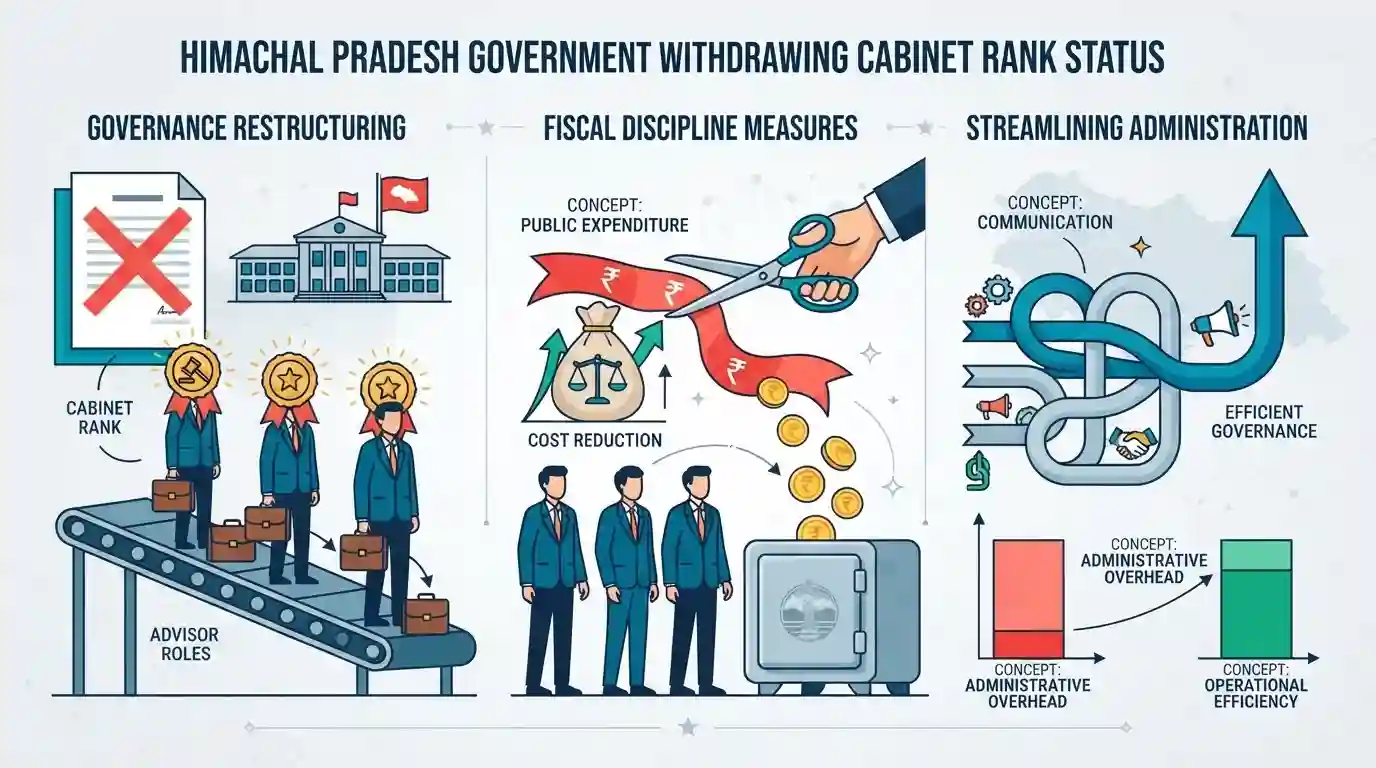
The Himachal Pradesh government has officially withdrawn the cabinet rank status accorded to several political appointees and advisors. This move is part of the state administration's broader measures toward fiscal discipline, streamlining governance costs, and managing public expenditure amid fiscal constraints.
Key Points
- The Himachal Pradesh government withdrew the cabinet rank status previously extended to various political appointees, advisors, and chairpersons.
- The decision is aimed at exercising fiscal prudence, cutting down avoidable administrative overheads, and rationalizing public expenditure in the State.
- Such administrative perks and cabinet-equivalent statuses for non-constitutional or political appointees have frequently been a subject of debate regarding state fiscal health and resource allocation.
Important Terms
Himachal Pradesh Cabinet

The highest executive decision-making body in the state government, consisting of ministers headed by the Chief Minister, responsible for framing state policies and administrative direction under Article 163 of the Constitution.
UPSC context
HPAS Paper II (Polity & Governance): Essential for understanding state executive powers, collective responsibility, and executive decision-making frameworks.
Government of Himachal Pradesh
The executive organ of the state comprising the Governor, Chief Minister, Council of Ministers, and state bureaucracy, charged with executing laws and governance in Himachal Pradesh.
UPSC context
HPAS Paper II & III: Important for studying state administration, public policy implementation, administrative machinery, and fiscal management.
Static Concepts Connected
What are the constitutional and statutory provisions regarding the size and composition of a State Council of Ministers?
- 15% Cap: Article 164(1A) restricts the total number of Ministers, including the Chief Minister, in the Council of Ministers in a State to 15% of the total strength of the Legislative Assembly.
- Legislative Mandate: A minister must be a member of either House of the State Legislature, or if not, must be elected within six consecutive months.
Cross-Topic Patterns
Fiscal federalism and Revenue Deficit Grants
State-level fiscal distress and revenue deficit grants (RDG) intersect with the Finance Commission's horizontal devolution criteria and article 275 grants.

HPAS frequently tests fiscal parameters: expect a question linking HP's debt burden, RDG cuts, and austerity measures.
Linked PYQs · 1
Linked PYQs · 1
- 2025HPAS_PRELIMSGS1
Consider the following statements regarding public finance of Himachal Pradesh : (1) According to Budget Estimate for the year 2024-25, share of revenue expenditure out of total expenditure is around 80 percent. (2) Debt as a percentage of GSDP reached 75.33 during the year 2022-23. (3) State's own tax revenue as a percentage of total revenue for the year 2024-25 (BE) increased to 27.4. (4) During FY 2024-25 (BE) education and health sector were allocated Rs. 9995 and Rs. 8575 crores respectively. Choose the correct answer from the options given below :
