Himachal Pradesh Revokes Cabinet Rank Status for Political Appointees
Source:The Hindu ↗
Why It Matters
Directly relates to governance, political appointments, and state-level fiscal management in Himachal Pradesh, which are important aspects of the HPAS exam syllabus.
Summary
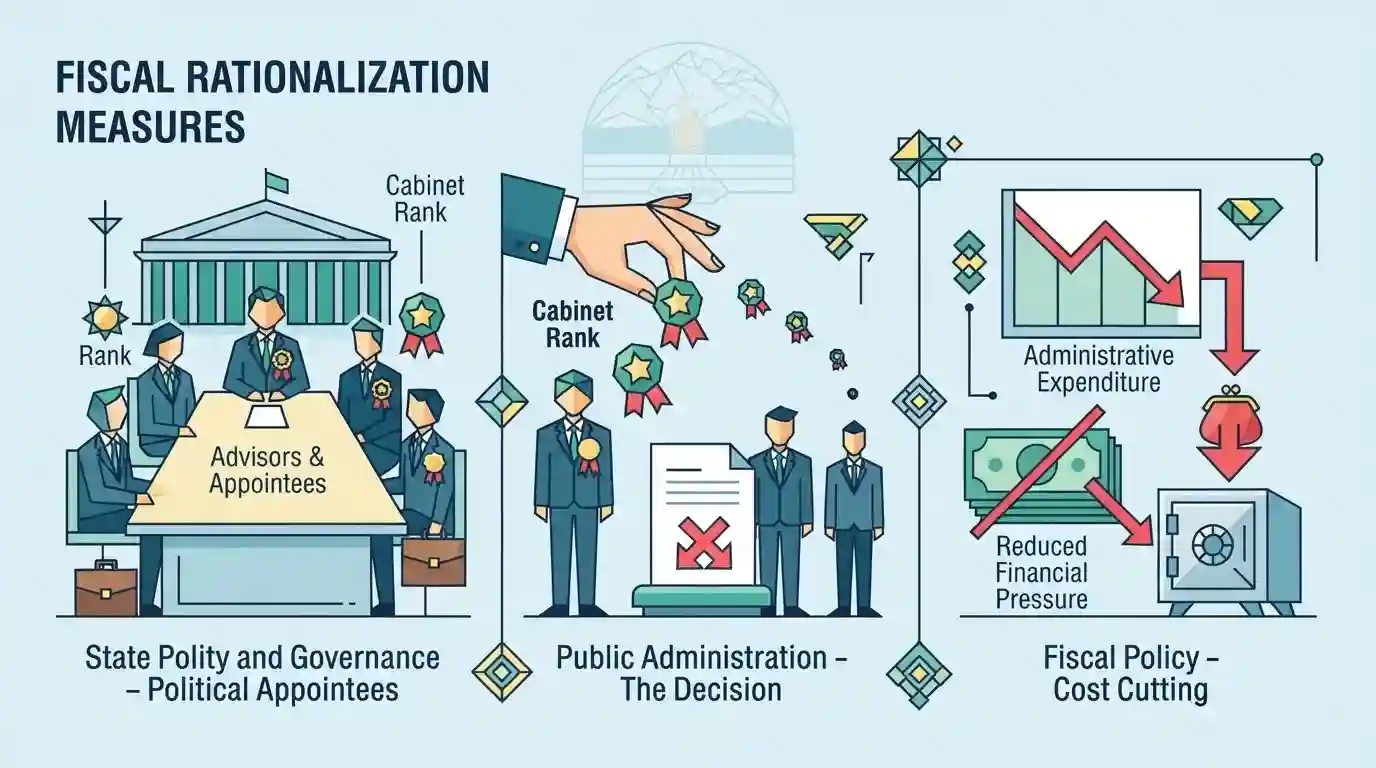
The Himachal Pradesh government has decided to withdraw the cabinet rank status previously given to several political appointees and advisors. This move is part of fiscal rationalization measures adopted by the state to cut down unnecessary administrative expenditure and cope with financial pressures.
Key Points
- The Himachal Pradesh government withdrew the cabinet rank status earlier granted to various political appointees, chairpersons, and advisors.
- The decision aims to exercise fiscal prudence and curb administrative expenditure amidst economic constraints.
- Political appointees and non-constitutional posts that previously enjoyed perks and cabinet status will be affected by this rollback.
Important Terms
Himachal Pradesh Cabinet

The highest executive decision-making body in the state government, consisting of the Chief Minister and other cabinet ministers responsible for policy formulation and administration.
UPSC context
State Polity and Governance (HPAS GS-II); tests understanding of the executive structure, ministerial responsibilities, and cabinet rank status in Himachal Pradesh.
Government of Himachal Pradesh
The executive organ of the state responsible for governance, public administration, and implementation of laws and fiscal policies within Himachal Pradesh.
UPSC context
Public Administration and Fiscal Policy in Himachal Pradesh (HPAS GS-II/III); tests knowledge of state-level administration, fiscal rationalization, and governance challenges.
Prelims Trap
cabinet rank status previously given to several political appointees
Aspirants often assume that advisors and chairpersons of state boards automatically hold constitutional or statutory cabinet rank. In reality, cabinet rank can be conferred via executive resolution without Constitutional backing.
Static Concepts Connected
What are the constitutional provisions regarding the size and composition of a State Cabinet in India?
- Constitutional Basis: Article 163 provides for a Council of Ministers with the Chief Minister at the head to aid and advise the Governor.
- Strength Limit: The total number of ministers, including the Chief Minister, in the Council of Ministers in a State shall not exceed 15% of the total strength of the Legislative Assembly (91st Amendment Act, 2003), with a minimum of 12.
- Cabinet Rank vs Minister: Cabinet rank is an executive designation conferring specific protocol and perks, distinct from constitutional minister status, often extended to political advisors and board chairpersons.
Cross-Topic Patterns
Fiscal Deficit & State Borrowing Limits
Fiscal rationalization moves by hill states highlight structural revenue deficits, testing the limits of borrowing ceilings under Article 293 and recommendations of the Finance Commission.
Office of Profit & Political Appointments
Creating non-constitutional political posts with cabinet rank often triggers public interest litigations over office of profit rules and misuse of public exchequer.

HP fiscal crisis + austerity measures likely to be tested via state-specific administrative structure & constitutional post limits.
Linked PYQs · 2
Linked PYQs · 2
- 2025HPAS_PRELIMSGS1
Consider the following statements regarding public finance of Himachal Pradesh : (1) According to Budget Estimate for the year 2024-25, share of revenue expenditure out of total expenditure is around 80 percent. (2) Debt as a percentage of GSDP reached 75.33 during the year 2022-23. (3) State's own tax revenue as a percentage of total revenue for the year 2024-25 (BE) increased to 27.4. (4) During FY 2024-25 (BE) education and health sector were allocated Rs. 9995 and Rs. 8575 crores respectively. Choose the correct answer from the options given below :
- 2025HPAS_PRELIMSGS1
Who decides the disqualification of members of State Legislative Assembly, for matters other than those in the Tenth Schedule of the Constitution ?
