Himachal Pradesh Announces Salary Hike for Trainee Doctors
Source:medgatetoday ↗
Why It Matters
Understanding state-level interventions to retain qualified medical personnel is crucial for analyzing how to address rural-urban healthcare disparities and strengthen grassroots-level public health systems.
Summary
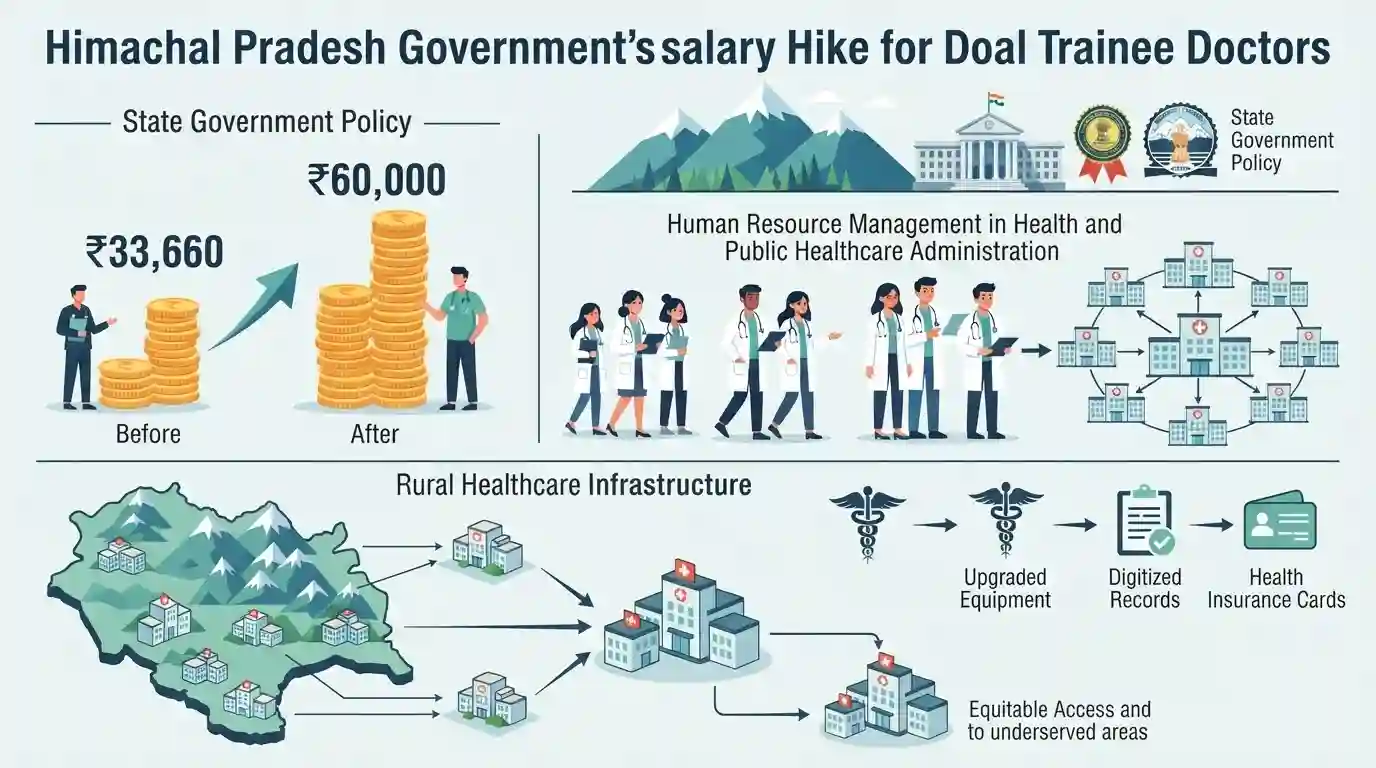
The Himachal Pradesh Government has announced a 78% salary hike for trainee doctors, increasing their monthly stipends from ₹33,660 to ₹60,000. This substantial raise is designed to strengthen the state's public healthcare system by improving the retention of young medical professionals and addressing workforce shortages, especially in rural and remote government hospitals. The move builds on a prior salary revision implemented in 2022 following the Sixth Pay Commission. It represents a component of a broader healthcare investment strategy by the state to upgrade medical infrastructure, expand health insurance, and ensure equitable access to quality medical care.
Key Points
- The Himachal Pradesh Government has increased the monthly remuneration of trainee doctors by 78%, raising it from ₹33,660 to ₹60,000.
- This significant hike aims to address workforce shortages and improve the retention of medical professionals in government hospitals, particularly in rural and remote regions of the state.
- The salary increase builds upon a previous revision implemented in 2022, which was based on the recommendations of the Sixth Pay Commission.
- This initiative is part of a broader healthcare investment strategy in the state, which includes upgrading medical colleges, expanding district hospitals, and launching new health insurance and digital healthcare programmes.
Important Terms
Sixth Pay Commission

A state-constituted body in Himachal Pradesh tasked with revising the pay scales of government employees. Its recommendations, implemented in 2022, notably adjusted the stipends of trainee medical officers to improve retention.
UPSC context
GS Paper II (Governance). Relevant for understanding state fiscal policies, public administration, and public sector human resource management.
Rural Healthcare Infrastructure
The network of health facilities in rural regions, comprising Sub-Centres, Primary Health Centres (PHCs), and Community Health Centres (CHCs), along with the medical professionals required to operate them.
UPSC context
GS Paper II (Social Sector/Health). Essential for analyzing rural-urban developmental gaps and healthcare accessibility in India.
Public Healthcare Administration
The management, financing, and structural organization of public health systems. It involves formulating policies—like targeted stipend hikes—to optimize the deployment of medical professionals and improve service delivery.
UPSC context
GS Paper II (Social Justice & Governance). Tests knowledge of state-level health policy implementation and systemic administrative reforms.
Job Trainee Medical Officers
Newly inducted medical specialists in government service who undergo training while providing clinical care. States often use financial incentives for these officers to address specialist shortages in underserved rural areas.
UPSC context
GS Paper II (Human Resources in Health). Highlights strategies for capacity building and workforce retention in the public health sector.
Prelims Trap
The National Medical Commission centrally funds and standardizes stipend amounts for all medical interns across state government colleges.
While the National Medical Commission (NMC) advocates for stipend parity, the actual financial allocation and stipend rates are entirely determined and funded by individual state governments.
Static Concepts Connected
Under which Schedule of the Indian Constitution does 'Public Health and Sanitation' fall?
- Constitutional listing: Placed under Entry 6 of the State List (List II) of the Seventh Schedule, making states primary policy designers.
- Concurrent jurisdiction: Medical education is under Entry 25 of the Concurrent List, allowing both Centre and States to legislate on training standards.
- Central oversight: The Union government manages international health quarantine and central medical institutions under the Union List (List I).
What are the key policy recommendations for retaining rural healthcare professionals in India?
- Mudaliar Committee (1962): Suggested establishing an All India Health Service to standardize administrative cadres and improve rural deployment.
- Bhore Committee & NHP: Recommended compulsory rural postings coupled with financial incentives, housing, and preferential post-graduate admission quotas.
Cross-Topic Patterns
State fiscal space vs. health outcomes
Financial incentives showcase how state-level fiscal choices directly influence local human resource retention, contrasting with centralized, national health scheme funding.
NMC regulations vs. state autonomy
While the National Medical Commission (NMC) mandates stipend parity, actual implementation and financial disbursements remain subject to state-level budgetary capacities.

Mains 2026 may evaluate fiscal and structural strategies required to address the rural-urban disparity in India's medical workforce.
Linked PYQs · 2
Linked PYQs · 2
- 2020HPAS_PRELIMSGS1
Consider the given four statements and choose the correct answer from the given options. Which of the following statement(s) is / are not correct about the Social Welfare programs of Government of Himachal Pradesh? 1. e-Udyan portal: Where farmers can avail Horticulture farming service benefits while sitting in their home. 2. Vishesh Mahila Uthan Yojna: Scheme formulated for rehabilitation of physically and sexually abused women through technical and vocational training. 3. Medha Protsahan Yojna: Rupees one lakh is provided to the meritorious students to provide guidance at coaching centers. 4. Mukhya Mantri Ek Bigha Scheme: State Government will empower rural women by helping them become self-sufficient and get employment under MGNREGS.
- 2023HPAS_PRELIMSGS1
Consider the following statements : (1) The sex ratio in the state is 972 females per 1000 males, which is higher than the national average of 940 females per 1000 males. (2) Service is the primary occupation of people in Himachal Pradesh, with over 90% of the population dependent on it for their livelihood. (3) Himachal Pradesh has a per capita income of Rs. 3,58,369, which is higher than the national average. (4) The state has a high Human Development Index (HDI) of 0.707, which is higher than the national average of 0.640. Choose the correct answer from the options given below :
