HP teachers protest school complex system via hunger strike
Source:freepressjournal ↗
Why It Matters
Understanding state-level implementation of education reforms (like school clustering models often linked to NEP 2020 objectives) is crucial for HPAS aspirants. It highlights the administrative friction between resource consolidation and maintaining the grassroots autonomy of primary education.
Summary
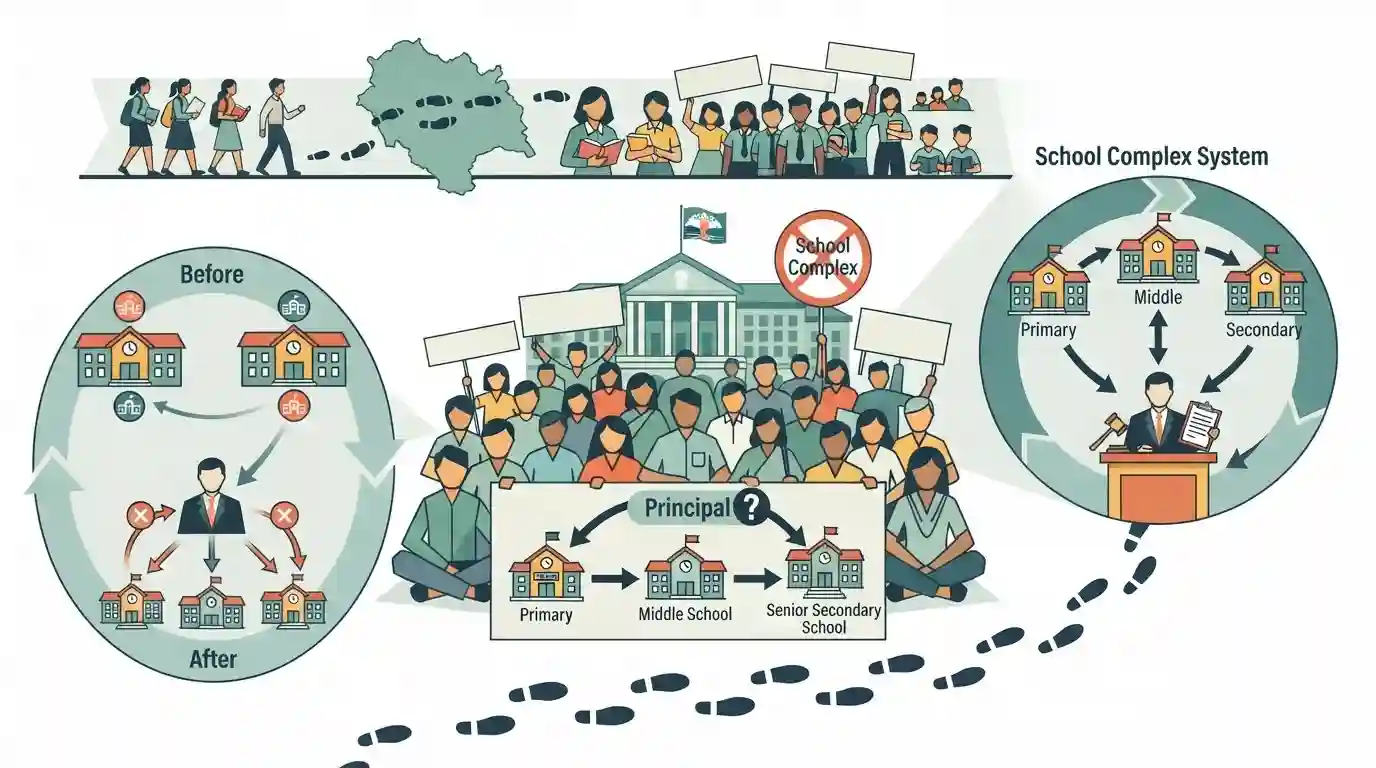
Primary teachers across Himachal Pradesh have launched an indefinite relay hunger strike in Shimla demanding the rollback of the newly introduced 'School Complex System'. Implemented by the state government, the system brings multiple primary, middle, and senior secondary schools under the administrative control of a single principal. The Himachal Pradesh Primary Teachers Federation argues that this consolidation undermines the autonomy of primary schools, negatively affects teacher deployment, and ultimately harms elementary education. The protest follows a 15-day foot march across the state.
Key Points
- Thousands of primary teachers in Himachal Pradesh began an indefinite relay hunger strike in Shimla to protest the 'School Complex System'.
- The system, implemented in September 2025, clusters 15 to 20 primary, middle, and senior secondary schools under a single principal or administrative head.
- Teachers argue this policy strips primary schools of their independent administrative identity and disrupts proper teacher deployment.
- The protest follows a 15-day 'Save Primary Education' march, with warnings of a mass hunger strike if the state government ignores their demands.
Important Terms
School Complex System

An administrative policy of grouping several primary, middle, and high schools under a single secondary school principal's headship to facilitate resource sharing and localized governance.
UPSC context
GS Paper II (Social Justice/Governance). Tests understanding of administrative reforms and decentralized school resource planning.
National Education Policy (NEP) 2020
India’s comprehensive framework for transforming education from foundational to higher levels, emphasizing a holistic, multidisciplinary approach, flexible curriculum, and decentralized administrative governance.
UPSC context
GS Paper II (Education Policy). Tests knowledge of structural and pedagogical reforms in India's education sector.
Directorate of School Education
A state education body restructured to manage and coordinate school administration, personnel, and policy implementation from the foundational level up to class 12.
UPSC context
GS Paper II (State Administration). Tests knowledge of institutional restructuring and policy implementation at the sub-national level.
Himachal Pradesh Primary Teachers Federation
A prominent union of primary school teachers in Himachal Pradesh that advocates for educators' rights, administrative autonomy, and structural changes in school governance.
UPSC context
GS Paper II (Pressure Groups). Tests understanding of interest groups and their role in influencing public governance policies.
Prelims Trap
The School Complex system is an entirely new organizational structure conceived and introduced for the first time by the National Education Policy 2020.
The 'School Complex' concept was actually first proposed by the Kothari Commission (1964-66) decades before NEP 2020, which merely revitalized its implementation framework.
Static Concepts Connected
What is the Kothari Commission's legacy on the 'School Complex' model?
- First Recommendation: Proposed by the Kothari Commission (1964-66) to break the isolation of small, under-resourced primary schools.
- Resource Pooling: Designed to share physical infrastructure, libraries, laboratories, and specialized subject teachers across a cluster of local schools.
- Academic Synergy: Envisioned cooperative planning and peer supervision among local primary and secondary institutions to uplift educational standards.
What are the statutory functions of School Management Committees (SMCs) under the RTE Act?
- Community Mandate: Requires 75% parent/guardian membership with 50% reserved for women to secure direct community-led supervision.
- Development Planning: Tasked with formulating the School Development Plan and monitoring the utilization of government grants.
Cross-Topic Patterns
Federal policy vs state-level administration
Examines how central guidelines (NEP 2020) intersect with state-specific teacher unions, recruitment rules, and localized educational administrative machinery.
Consolidation vs grassroots decentralization
Highlights the structural conflict between efficiency-driven administrative clustering and the RTE Act's localized, school-specific democratic governance via SMCs.

Mains 2026: Analyze the structural tension between school cluster centralization under NEP 2020 and decentralized RTE-mandated SMC governance.
Linked PYQs · 2
Linked PYQs · 2
- 2020HPAS_PRELIMSGS1
Match List I with List II and choose the correct answer from the given options. | List-I Amendments | List-II Issues | |---|---| | A. First amendment | 1. Right to Education | | B. Forty fourth amendment | 2. Reservation for EWS | | C. Eighty sixth amendment | 3. Right to Property | | D. One hundred and third amendment | 4. Nineth Schedule | Code: A B C D
- 2017HPAS_PRELIMSGS1
To improve the Gross Enrolment Ratio (GER) in Higher Education the Government of H.P. has adopted 'Rashtriya Uchtar Shikha Abhiyan' the centrally sponsored scheme in the year :
