Supreme Court Rules on Execution Court Limits and Fence-Sitters Claims
Source:legal-republic ↗
Why It Matters
Understanding the limits of appellate/execution jurisdiction and judicial doctrines like 'delay and laches' is vital for civil servants dealing with government litigation, service tribunals, and the financial implications of court orders on state exchequers.
Summary
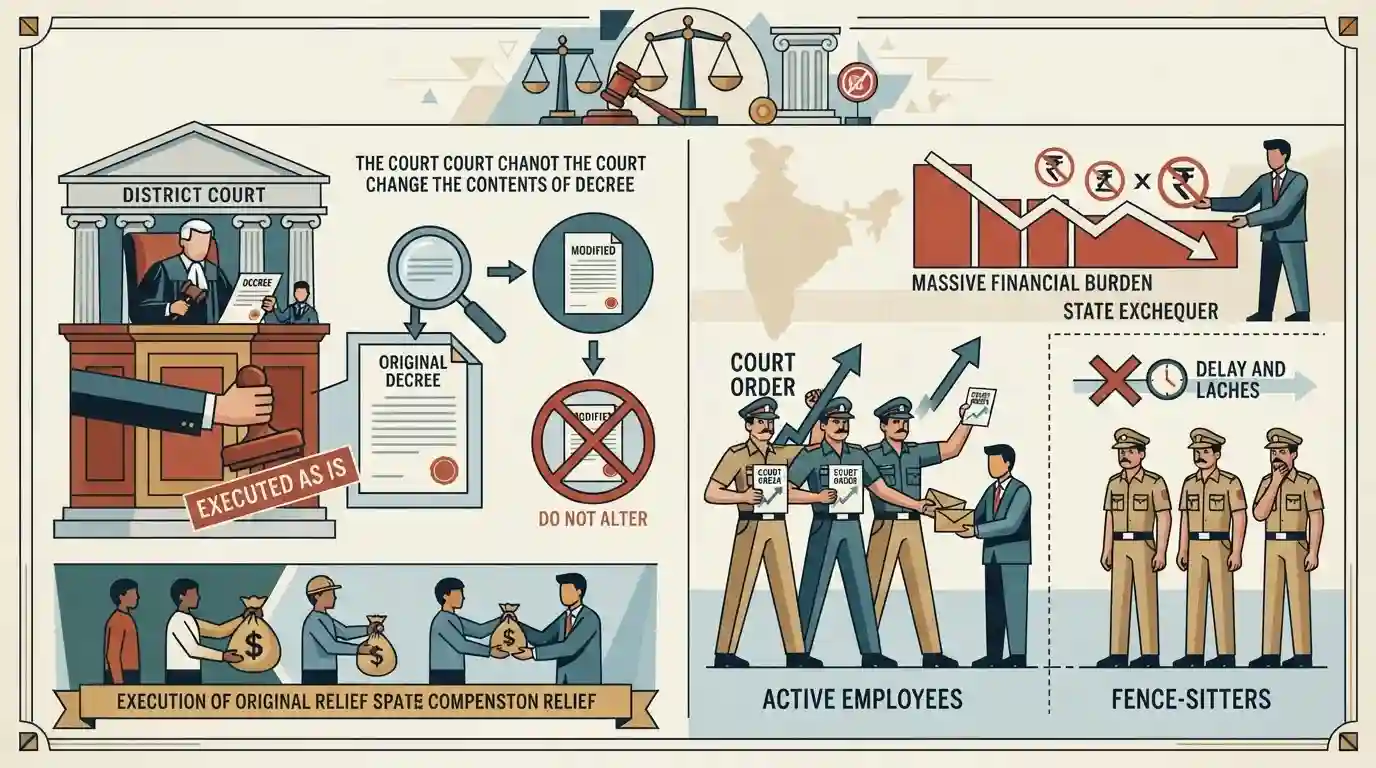
The Supreme Court of India set aside an order by the Himachal Pradesh High Court, reaffirming two key principles of civil and service jurisprudence. First, it held that an Execution Court cannot go behind the decree it is executing; it lacks the jurisdiction to modify or expand the original relief granted. Second, the Court addressed the issue of 'fence-sitters'—employees who delay asserting their legal rights until co-workers obtain a favorable judgment. The Court ruled that such individuals are not automatically entitled to retrospective benefits, particularly when their belated claims are barred by delay and laches, and granting relief would impose a massive financial burden on the State.
Key Points
- The Supreme Court ruled that an Execution Court's jurisdiction is strictly limited to enforcing the decree as it stands; it cannot alter, modify, or expand the terms of the original order.
- The Court firmly applied the doctrine of laches against 'fence-sitters'—litigants who sleep on their rights and approach the court belatedly only after their peers receive a favorable judgment.
- While similarly situated employees are usually entitled to identical benefits, this principle does not apply when the late claim causes significant administrative disruption or a severe financial burden on the State exchequer.
- The ruling overturned a Himachal Pradesh High Court decision that had effectively modified the date from which school lecturers were to receive revised pay scales during execution proceedings.
Important Terms
Execution Court

A civil court responsible exclusively for implementing a finalized judgment or decree. In Indian jurisprudence, an execution court lacks the jurisdiction to modify, interpret beyond, or "go behind" the specific relief granted in the original order.
UPSC context
Relevant to HPAS GS Paper 2 (Governance & Law). Tests knowledge of civil procedure and limits on judicial jurisdiction.
Fence-sitters
In service jurisprudence, employees who avoid litigation while others fight, only asserting claims after a favorable outcome. Courts typically deny them retrospective benefits due to principles of delay, laches, and the financial burden imposed on the State.
UPSC context
Pertinent to HPAS GS Paper 2 (Administrative Law). Tests principles of equity, service matters, and delayed legal claims.
Supreme Court of India
The apex judicial body in India, holding original, appellate, and advisory jurisdictions. It acts as the ultimate interpreter of the Constitution and final court of appeal, establishing binding precedents that ensure uniform legal application across states.
UPSC context
Essential for HPAS GS Paper 2 (Indian Polity). Tests knowledge of the apex court's appellate power over state high courts.
Himachal Pradesh High Court
The highest constitutional court in Himachal Pradesh, exercising original, appellate, and writ jurisdictions over the state. Its judicial decisions and execution orders remain subject to review, modification, or reversal by the Supreme Court.
UPSC context
Covered in HPAS GS Paper 2 (Governance in HP). Important for understanding state-level judicial administration and jurisdictional limits.
State Administrative Tribunal (Himachal Pradesh)
A quasi-judicial body created for the speedy redressal of service grievances of Himachal Pradesh state government employees. It has been periodically abolished and reinstated depending on the ruling state government.
UPSC context
Vital for HPAS GS Paper 2 (Public Administration). Tests understanding of state civil service grievance redressal and political impacts.
Himachal Pradesh Government
The state-level executive authority in Himachal Pradesh, headed by the Chief Minister. It manages state administration, policies, and finances, frequently appearing as the respondent in service-related litigation concerning its employees.
UPSC context
Fundamental for HPAS GS Paper 2 (Governance in HP). Tests understanding of state executive functions and public service management.
Prelims Trap
Similarly situated employees are absolutely entitled to identical retrospective benefits under Article 14.
The Supreme Court frequently invokes the Doctrine of Laches to deny retrospective benefits to "fence-sitters", especially if it imposes a massive financial burden on the state.
Static Concepts Connected
What are the jurisdictional limits of an Execution Court?
- Enforce, not alter: An Execution Court can only implement the decree as it stands; it cannot modify, alter, or expand the relief originally granted.
- No appellate power: It lacks the power to question the legality or correctness of the original decree, meaning it cannot "go behind" the order like an appellate court.
What is the Doctrine of Laches in Constitutional Law?
- Unreasonable delay: It is a legal principle that prevents litigants from seeking equitable relief if they have "slept on their rights" for an unreasonable period.
- Discretionary defense: Unlike statutory limitation periods, laches is an equitable defense decided at the court's discretion, often used to reject delayed Writ petitions under Articles 32 and 226.
Cross-Topic Patterns
Service jurisprudence vs. State finances
The SC weighed constitutional parity (Articles 14/16) against state exchequer strains, making massive financial burden a valid judicial defense against retrospective pay scale claims in state service matters.
Writ jurisdiction and Doctrine of Laches
Connects directly to limits on writ petitions under Article 226, where High Courts are bound to reject delayed, copy-cat claims by "fence-sitters" despite the original petitioner winning.

Expect a polity question testing if the 'doctrine of laches' and state financial burdens can restrict Article 14 equality in service claims.
Linked PYQs · 3
Linked PYQs · 3
- 2024HPAS_PRELIMSGS1
Consider the following statements : Which of the following are included in the original jurisdiction of Supreme Court ? (1) A dispute between Govt. of India and one or more states. (2) A dispute regarding elections to either House of Parliament. (3) A dispute between Govt. of India and a Union Territory. (4) A dispute between two or more states. Choose the correct answer from the options given below :
- 2022HPAS_PRELIMSGS1
When any official does not perform his duty, High Court/Supreme Court can issue which writ ?
- 2024HPAS_PRELIMSGS1
Match List I with List II : | List I | List II | |---|---| | (a) Habeas Corpus Writ | (i) Re-examining Lower Court records by Superior Court | | (b) Mandamus Writ | (ii) Exercising Power under which authority | | (c) Certiorari Writ | (iii) Restricting officials to act | | (d) Quo Warranto Writ | (iv) To produce in person | Choose the correct answer from the options given below : Code: (a) (b) (c) (d)
