Himachal Pradesh Revives State Lotteries to Boost Non Tax Revenue
Source:rediff ↗
Why It Matters
For HPAS Prelims, this touches directly on the state's economic governance, serving as an excellent case study of states seeking alternative non-tax revenues to manage fiscal deficits. It also brings into focus the legal framework surrounding gambling/lotteries in India, distinguishing between state subjects and union regulations (Entry 40 of List I covers state lotteries, despite gambling broadly falling under List II).
Summary
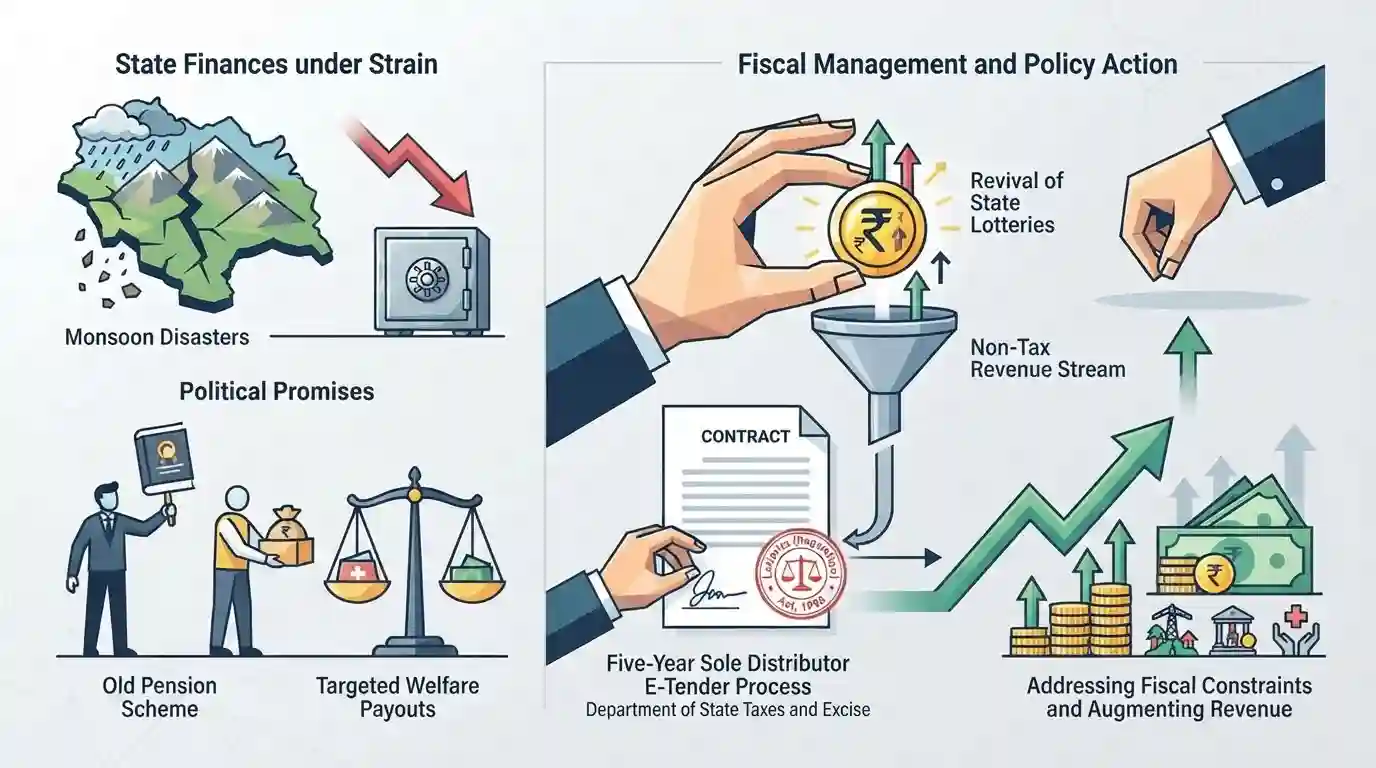
After a 25-year suspension, the Himachal Pradesh government is reviving state-run lotteries to address severe fiscal constraints and augment non-tax revenue. The Department of State Taxes and Excise is currently seeking a sole distributor via e-tender, offering a five-year contract governed by the Lotteries (Regulation) Act, 1998. The move is primarily driven by the financial burden of fulfilling political promises—such as the reinstatement of the Old Pension Scheme and targeted welfare payouts—as well as immense financial losses due to recent monsoon-related disasters.
Key Points
- Himachal Pradesh is reintroducing state-run lotteries after a 25-year hiatus to boost its non-tax revenue sources.
- The Department of State Taxes and Excise has floated an e-tender to appoint a sole selling agent for a five-year term to manage the lotteries.
- The state's finances are under strain due to commitments such as reverting to the Old Pension Scheme, funding welfare schemes like monthly allowances for women, and dealing with extensive monsoon damages.
- The lotteries will be regulated under the central Lotteries (Regulation) Act, 1998, which enables state governments to organize, conduct, and promote lotteries subject to parliamentary conditions.
Important Terms
Lotteries (Regulation) Act, 1998

A 1998 central law granting state governments the authority to organize, conduct, or ban lotteries within their jurisdictions. It mandates operational transparency, regulates prize distributions, and sets the legal foundation for state-run lottery operations across India.
UPSC context
Tests GS-2 (Polity) on Centre-State legislative division and GS-3 (Economy) on state revenue mobilization and gambling regulations.
Old Pension Scheme (OPS)
A defined-benefit retirement system ensuring government employees a guaranteed pension of 50% of their last drawn salary. Being unfunded, it relies entirely on current taxpayer revenues, causing severe fiscal strain on states like Himachal Pradesh.
UPSC context
Tests GS-3 (Economy) on public finance, state debt burdens, and the shift from defined-benefit to defined-contribution systems.
Lotteries (Regulation) Rules, 2010
Central rules under the Lotteries (Regulation) Act, 1998, outlining specific conditions for state governments to organize both paper and online lotteries, ensuring regulatory compliance and addressing concerns over fraudulent practices.
UPSC context
Relevant for GS-2 (Polity) understanding how states implement central gambling and betting legislations.
Department of State Taxes and Excise (Himachal Pradesh)
The administrative authority in Himachal Pradesh responsible for managing and collecting state-level taxes, regulating excise duties (like liquor), and overseeing non-tax revenue generation initiatives, including the reintroduced state lottery system.
UPSC context
Crucial for HPAS General Studies (State Economy) regarding administrative mechanisms for revenue collection and fiscal management.
Himachal Pradesh State Lottery (Regulation) Rules, 2026
Draft rules framed by the Himachal Pradesh government to regulate the reintroduction of state lotteries. They detail the conduct, transparent operation, and prize structure for both paper and online lotteries to generate state revenue.
UPSC context
Highly specific to HPAS current affairs, highlighting the state's legal mechanisms to combat financial distress via non-tax avenues.
Prelims Trap
State-run lotteries fall under the State List, granting Himachal Pradesh absolute regulatory and legislative control.
State and GoI lotteries actually fall under the Union List (Entry 40), regulated by a central Act. Only general betting/gambling is in the State List (Entry 34).
Static Concepts Connected
How does the 7th Schedule classify lotteries vs. betting and gambling?
- Union List: Entry 40 strictly covers lotteries organized by the Government of India or State Governments.
- State List: Entry 34 covers general betting and gambling, giving states legislative power over private entities.
- Parliamentary Domain: The Lotteries (Regulation) Act, 1998, is a central law empowering states to run lotteries under parliamentary conditions.
What are the key constraints on state borrowing under FRBM norms?
- Debt-to-GSDP Target: The NK Singh Committee recommended a 20% cap for states. Himachal Pradesh has breached 43%, signaling severe fiscal distress.
- Fiscal Deficit Limit: Typically capped at 3% of GSDP under FRBM frameworks, with occasional conditional relaxations linked to state reforms.
- Centre's Consent: Under Article 293(3) of the Constitution, states need the Centre's consent to raise fresh loans if they have outstanding debts.
Cross-Topic Patterns
OPS & Inter-generational Fiscal Liabilities
The shift back to the unfunded Old Pension Scheme forces desperate revenue-raising measures like lotteries. This highlights recent RBI and CAG warnings about HP's fiscal health and long-term unfunded liabilities.
GST Council & Uniform Lottery Taxation
State lotteries face a uniform 28% GST rate set by the historic 38th GST Council vote. This connects constitutional taxation changes directly to HP's current non-tax revenue mobilization efforts.

Expect a tricky prelims statement combining 7th Schedule entries for lotteries vs gambling alongside HP's soaring debt-to-GSDP ratio.
Linked PYQs · 3
Linked PYQs · 3
- 2025HPAS_PRELIMSGS1
Who decides the disqualification of members of State Legislative Assembly, for matters other than those in the Tenth Schedule of the Constitution ?
- 2020HPAS_PRELIMSGS1
According to FRBM Act, India's fiscal deficit should not exceed:
- 2020HPAS_PRELIMSGS1
There are two statements for each question. In the light of these two statements, choose the most appropriate answer from the options given below. Statement 1: Revenue Deficit is the excess of revenue expenditure over revenue receipts. Statement 2: Effective Revenue Deficit is the difference between Revenue Deficit and Grants for Creation of Capital Assets.
