Monsoon Disasters Cause Heavy Casualties in Himachal Pradesh
Source:The Hindu ↗
Why It Matters
The frequent occurrence of extreme weather events like cloudbursts, flash floods, and landslides in the Himalayan states poses significant disaster management and infrastructural challenges. This case study is critical for understanding the vulnerability of the Himalayan ecosystem, the economic impacts of natural disasters, and the need for robust mitigation and risk management strategies in India's mountainous regions.
Summary
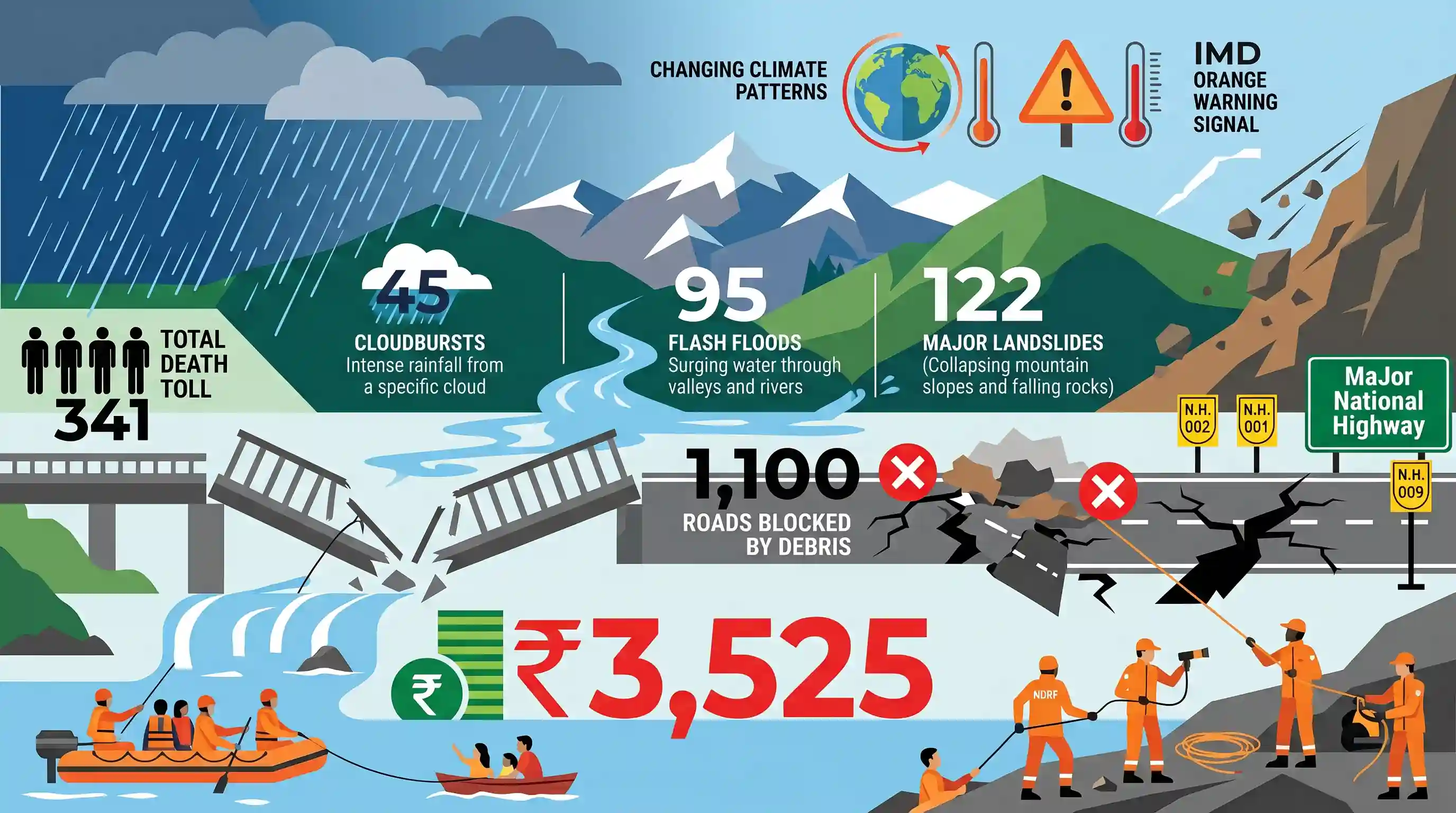
Himachal Pradesh has suffered extensively from rain-induced disasters during the 2025 monsoon, with the death toll climbing to 341. The state has experienced an alarming frequency of extreme weather events, including 95 flash floods, 45 cloudbursts, and 122 major landslides. The devastation has caused significant infrastructural disruption, blocking over 1,100 roads including major National Highways, and resulting in an estimated economic loss of ₹3,525 crore. The involvement of the NDRF and 'orange' warnings by the IMD underscore the severe disaster management challenges and vulnerability of the Himalayan region to changing climate patterns.
Key Points
- Extreme monsoon rains in Himachal Pradesh during 2025 have led to severe disasters, resulting in 341 deaths and leaving 41 people missing.
- The state witnessed 95 flash floods, 45 cloudbursts, and 122 major landslides since the onset of the monsoon on June 20.
- Massive infrastructural damage has been reported with 1,162 roads blocked, including critical National Highways (NH-3, NH-5, NH-21), and the Shimla-Kalka train service canceled.
- Economic losses are estimated at ₹3,525 crore, severely impacting districts like Mandi, Kullu, Kinnaur, Shimla, and Solan.
- The India Meteorological Department (IMD) issued an 'orange' warning, highlighting the persistent vulnerability of the Himalayan ecosystem to climate-induced extreme weather events.
Important Terms
National Disaster Response Force (NDRF)

Specialized Indian force established under the Disaster Management Act, 2005, for responding to natural and man-made disasters. It operates under the Ministry of Home Affairs with personnel from CAPFs.
UPSC context
GS Paper 3 (Disaster Management). Tests knowledge of India's institutional framework for specialized rescue and relief operations during national calamities.
India Meteorological Department (IMD)
Established in 1875, it is the principal government agency under the Ministry of Earth Sciences responsible for meteorological observations, weather forecasting, and seismology in India.
UPSC context
GS Paper 1 (Geography) and GS Paper 3 (Disaster Management). Tests understanding of weather forecasting agencies and early warning systems.
Cloudburst
An extreme weather event involving sudden, intense rainfall (usually exceeding 100 mm/hour over a 20-30 sq km area), often triggered by orographic lifting in mountainous regions.
UPSC context
GS Paper 1 (Geography). Tests knowledge of atmospheric phenomena and the geographical factors contributing to extreme precipitation in the Himalayas.
Flash Flood
A sudden, rapid flood occurring within six hours of intense localized rainfall. Unlike river floods, they provide little warning time and are highly destructive in hilly terrains.
UPSC context
GS Paper 1 (Geography). Focuses on distinguishing rapid-onset disasters from gradual flooding and their specific mitigation strategies.
Landslide
The downslope movement of rock, soil, or debris under gravity, triggered by heavy rainfall, earthquakes, or human activities. The Himalayas are highly susceptible due to fragile geology.
UPSC context
GS Paper 1 (Geography). Common topic comparing Himalayan and Western Ghats landslide causes and national risk management strategies.
Disaster Management Act, 2005
The statutory framework that mandated the creation of the NDMA and NDRF, shifting India's policy from reactive relief to proactive disaster preparedness and mitigation.
UPSC context
GS Paper 3 (Disaster Management). Core legislation defining the institutional roles for managing disasters at national, state, and district levels.
Prelims Trap
Any sudden and extremely heavy rainfall in a mountainous region is classified as a cloudburst.
IMD strictly defines a cloudburst as >100 mm of rain per hour over a localized area (20-30 sq. km). Intense, sudden rain does not automatically qualify.
Static Concepts Connected
What makes the Himalayas highly vulnerable to cloudbursts and extreme rainfall?
- Orographic lifting: Steep topography forces moisture-laden monsoon winds to rise rapidly, cool, and form massive cumulonimbus clouds, leading to sudden extreme localized precipitation.
- Topographic confinement: Deep Himalayan valleys restrict the movement of these weather systems, concentrating the intense rainfall in small geographical pockets of 20-30 sq. km.
- Geological youth: The ongoing Indian-Eurasian plate collision keeps the region geologically active, with unconsolidated sedimentary slopes highly prone to failure during heavy rains.
What are the IMD's upper-tier color-coded weather warnings?
- Orange warning: Advises authorities to 'Be prepared' for extremely bad weather causing transport disruptions and power cuts. Used in Himachal to signal imminent infrastructural risks.
- Red warning: Instructs authorities to 'Take action' as extreme weather is imminent, posing a severe threat to life, requiring immediate mobilization of NDRF and state disaster forces.
Cross-Topic Patterns
Infrastructure tunneling & disaster vulnerability
The geological youth of the Himalayas (GS-1) intersects with unregulated infrastructure development like hydropower tunneling and road-widening (GS-3), multiplying landslide and flash flood risks during the monsoon.
Himalayan ecological carrying capacity
Frequent landslides and cloudbursts in Himachal and Uttarakhand frequently trigger debates and NGT interventions regarding the strict calculation of ecological and tourism carrying capacity for Himalayan states.

Expect a Prelims question merging IMD's cloudburst definition (>100mm/hr over 20-30 sq km) with Himalayan orographic lifting mechanisms.
Linked PYQs · 5
Linked PYQs · 5
- 2022MainsGS3
Explain the mechanism and occurrence of cloudburst in the context of the Indian subcontinent. Discuss two recent examples.
- 2021MainsGS3
Describe the various causes and the effects of landslides. Mention the important components of the National Landslide Risk Management Strategy.
- 2019MainsGS3
Disaster preparedness is the first step in any disaster management process. Explain how hazard zonation mapping will help disaster mitigation in the case of landslides.
- 2021MainsGS1
Differentiate the causes of landslides in the Himalayan region and Western Ghats.
- 2016MainsGS1
The Himalayas are highly prone to landslides. Discuss the causes and suggest suitable measures of mitigation.
