Himachal issues red alert for heavy rains and closes schools
Source:The Hindu ↗
Why It Matters
The article highlights the vulnerability of the Himalayan region to extreme weather events such as cloudbursts, flash floods, and landslides. This is highly relevant for HPAS Prelims under Disaster Management and Himachal Pradesh's regional geography (e.g., Kinnaur, Sangla-Chitkul route, strategic border connectivity).
Summary
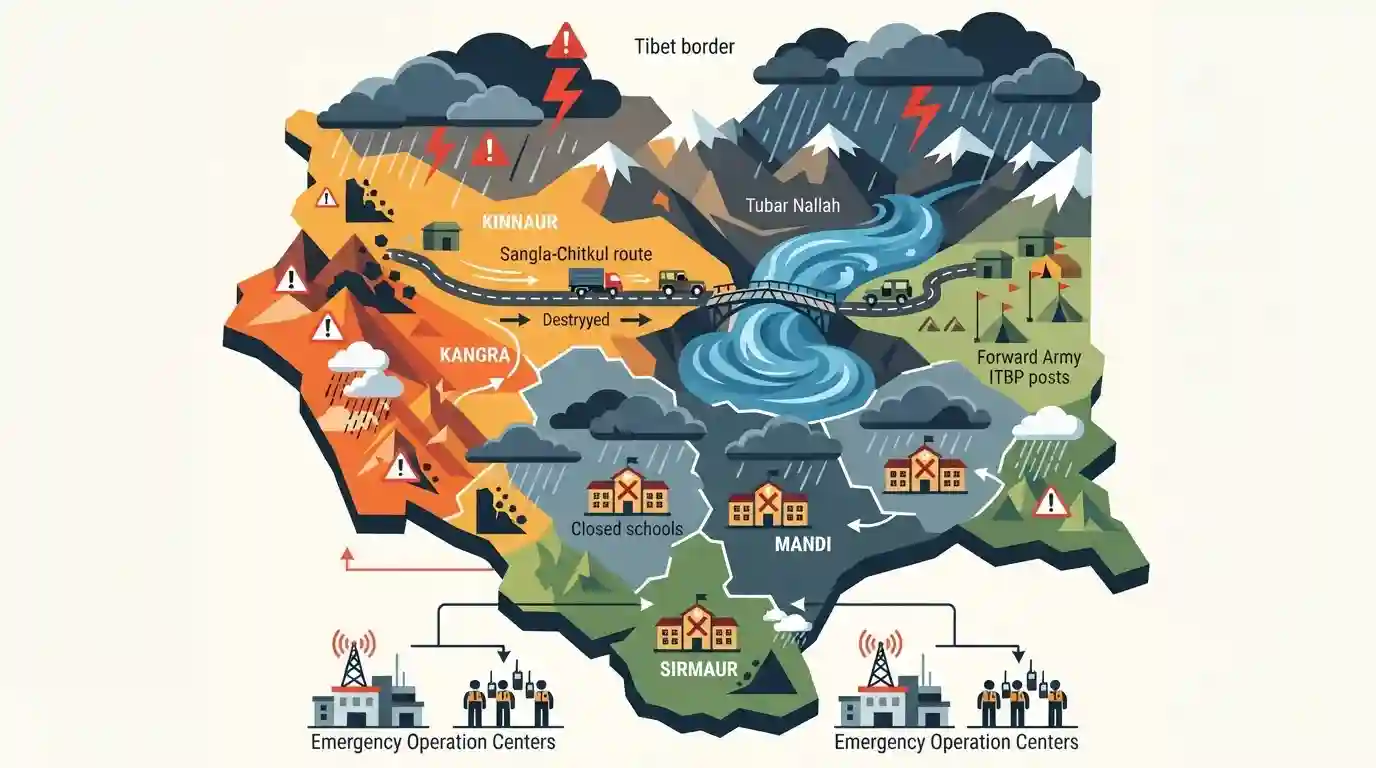
Himachal Pradesh has been placed on high alert following extreme weather warnings from the Met office, including a red alert for heavy rains. Consequently, all schools have been closed in the Kangra, Mandi, and Sirmaur districts. In Kinnaur district, a severe flash flood in Tubar Nallah near Rani Kanda destroyed a bridge on the Sangla-Chitkul route, cutting off road access to forward Army and ITBP posts near the Tibet border. The state government has mandated the activation of emergency operation centers and heightened vigilance at locations vulnerable to landslides, flash floods, and cloudbursts.
Key Points
- A red alert has been issued in Himachal Pradesh due to heavy rains, leading to the closure of all schools in Kangra, Mandi, and Sirmaur districts.
- A destructive flash flood occurred in Tubar Nallah near Rani Kanda along the Sangla-Chitkul route in Kinnaur district, washing away a bridge.
- The destruction of the bridge has severed road connectivity to forward Army and ITBP posts located near the Tibet border.
- The Met office has warned of very heavy to extremely heavy rainfall, prompting the Chief Secretary to order the activation of emergency operation centers.
- Authorities have been directed to identify and monitor vulnerable locations prone to landslides, flash floods, and cloudbursts.
Important Terms
Indian Meteorological Department (IMD)

Established in 1875 under the Ministry of Earth Sciences, the IMD is India's principal agency for meteorological observations, weather forecasting, and seismology.
UPSC context
GS Paper 1 and 3 (Geography, Disaster Management). Tested on structure, disaster warnings, and climate tracking.
Indo-Tibetan Border Police (ITBP)
A Central Armed Police Force raised in 1962 under the Ministry of Home Affairs, primarily tasked with guarding the 3,488 km India-China high-altitude border.
UPSC context
GS Paper 3 (Internal Security). Relevant for border management, CAPF roles, and disaster response in the Himalayas.
Flash Flood
A localized, destructive flood occurring within six hours of a triggering event like extreme rainfall, dam failure, or cloudburst, characterized by sudden high peak discharge.
UPSC context
GS Paper 1 and 3 (Geography, Disaster Management). Focus on NDMA guidelines, causes, and flood mitigation strategies.
Cloudburst
The IMD defines a cloudburst as unexpected intense precipitation exceeding 100 mm per hour over a localized geographical area of 20 to 30 square kilometers.
UPSC context
GS Paper 1 and 3 (Geography, Disaster Management). Tested on meteorological mechanisms like orographic lift and hilly area vulnerabilities.
Red Alert (Weather Warning)
The highest level in the IMD’s color-coded warning system. It signifies “Take Action,” indicating extremely severe weather expected to cause infrastructure damage and risk to life.
UPSC context
GS Paper 3 (Disaster Management). Important for assessing early warning systems and state disaster preparedness capacity.
Prelims Trap
"The Baspa river, which flows through the Sangla Valley, is a major tributary of the Beas River."
The Baspa is actually a tributary of the Sutlej River, which enters India through Shipki La and flows through Kinnaur, where the Baspa joins it.
Static Concepts Connected
What are the specific IMD meteorological criteria for classifying a 'Cloudburst'?
- Rainfall threshold: Unexpected, extreme precipitation exceeding 100 mm (10 cm) per hour.
- Spatial extent: It is a highly localized event, typically restricted to a small geographical area of roughly 20 to 30 square kilometers.
- Orographic lifting: Driven by steep mountain topography that rapidly forces warm, moisture-laden air upward, triggering sudden and violent downpours.
Which Central Armed Police Forces (CAPFs) guard India's respective borders?
- ITBP: Guards the 3,488 km border with China, stretching from the Karakoram Pass in Ladakh down to Arunachal Pradesh.
- BSF: Responsible for securing India's active and sensitive borders with Pakistan and Bangladesh.
- SSB: Mandated to guard the porous, open borders India shares with Nepal and Bhutan.
Cross-Topic Patterns
Climate risks to border security
Himalayan flash floods routinely wash away strategic infrastructure like the Sangla-Chitkul route, creating critical logistical vulnerabilities for forward ITBP and Army posts guarding the Tibet border.
Valleys and antecedent rivers
UPSC frequently tests trans-Himalayan rivers. The Kinnaur floods highlight the Sutlej (an antecedent river) and its tributary Baspa, which carves through the geologically fragile Sangla Valley.

Expect a 2026 mapping question matching Himalayan valleys (Sangla, Spiti) with their antecedent river systems (Sutlej, Baspa) and border passes.
Linked PYQs · 3
Linked PYQs · 3
- 2024HPAS_PRELIMSGS1
Arrange the following climatic zones of Himachal Pradesh according to rainfall amount from lowest to highest : (1) Frigid aridic zone (2) Wet temperate zone (3) Humid sub-tropical zone (4) Sub-humid sub-tropical zone Choose the correct answer from the options given below :
- 2020HPAS_PRELIMSGS1
Consider the given four statements and choose the correct answer from the given options. Which of the following statement(s) is / are not true? 1. Parangla pass lies between Kinnaur and Lahaul. 2. Manirang is the highest peak of Chamba. 3. Kalichho is the famous lake of Chamba district. 4. Chobia pass lies between Ladakh and Lahaul.
- 2025HPAS_PRELIMSGS1
Match List I with List II : | List-I (Code) | List-II (District) | |---|---| | (a) Highest Rainfall (2018 Data) | (i) Shimla | | (b) Second Most Incidents Reported (2024 Crime Data) | (ii) Mandi | | (c) Fourth Highest Population (2011 Census) | (iii) Kangra | | (d) Fourth Largest Area | (iv) Solan | Choose the correct answer from the options given below : Code: (a) (b) (c) (d)
