Monsoon rains inflict heavy financial losses across Himachal districts
Source:outlookbusiness ↗
Why It Matters
The recurring devastation highlights the extreme vulnerability of the Himalayan ecosystem to climate-induced disasters. It underscores the urgent necessity for climate-resilient infrastructure planning, effective early warning systems, and robust disaster management strategies in Himachal Pradesh.
Summary
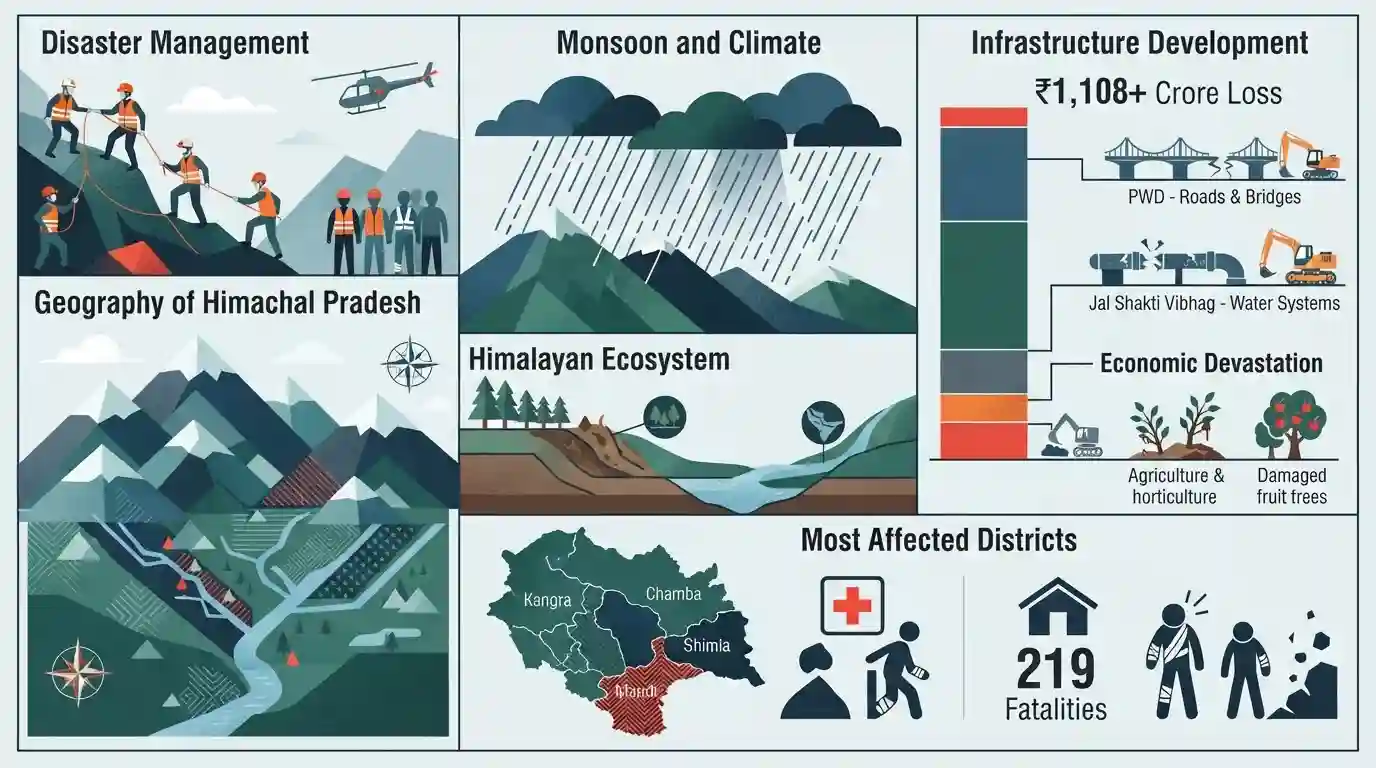
During the first 52 days of the monsoon season, Himachal Pradesh suffered severe infrastructural and economic devastation amounting to over ₹1,108 crore. The heavy rains triggered landslides, flash floods, and accidents across the state, resulting in 219 fatalities and numerous injuries. The state's critical infrastructure was hit the hardest, with the Public Works Department and Jal Shakti Vibhag accounting for the majority of the financial losses. Furthermore, agrarian sectors, including agriculture and horticulture, faced notable disruptions, while Kangra, Chamba, Shimla, and Mandi emerged as some of the most heavily affected districts.
Key Points
- Himachal Pradesh faced a staggering financial loss of ₹1,108.93 crore within 52 days of the monsoon season.
- The Public Works Department (PWD) and Jal Shakti Vibhag (JSV) bore the brunt of the infrastructure damage, with losses of ₹478.43 crore and ₹466.97 crore, respectively.
- The state witnessed significant human casualties, with 219 deaths and 330 injuries, driven largely by road accidents, falls from steep terrain, landslides, and flash floods.
- Agriculture and horticulture, the economic backbones of the state, sustained damages worth over ₹11 crore.
- Kangra district, which historically receives the highest rainfall in the state, recorded the highest property damage.
Important Terms
Public Works Department (PWD)

The primary state agency in Himachal Pradesh tasked with developing and maintaining public infrastructure, including roads, bridges, and government buildings, which routinely suffer massive monsoon damage.
UPSC context
Crucial for HPAS GS-3 (Infrastructure/Disaster Management) to analyze the economic fallout and structural vulnerability of state assets during climate extremes.
Jal Shakti Vibhag (JSV)
Renamed in 2020 from the Irrigation and Public Health Department, this agency manages Himachal Pradesh's drinking water, sewerage, irrigation, and critical flood protection infrastructure.
UPSC context
Tested in HPAS GS-2 and GS-3 regarding water governance, rural development, and mitigating infrastructural damages affecting the state's agrarian sector.
State Disaster Management Authority (SDMA)
Headed by the Chief Minister, the HPSDMA is the apex statutory body responsible for formulating and implementing state-level disaster mitigation, preparedness, and response strategies.
UPSC context
Core to HPAS GS-3 (Disaster Management); assesses institutional frameworks and policies for building disaster resilience in the vulnerable Himalayan ecosystem.
Prelims Trap
"The State Disaster Response Fund (SDRF) for Himachal Pradesh is funded on a 75:25 ratio between the Centre and State."
Himachal Pradesh is a special category state. Under the Disaster Management Act, the SDRF contribution ratio is 90:10 (Centre:State), not 75:25.
Static Concepts Connected
How is rainfall geographically distributed across Himachal Pradesh?
- Wettest region: Dharamshala in Kangra district receives the state's highest rainfall, making it historically prone to intense monsoon property damage.
- Driest region: Spiti is a cold desert located in the rain-shadow of the Great Himalayas, receiving minimal monsoon rain.
What is the institutional setup for Disaster Management in HP?
- Apex body: The State Disaster Management Authority (SDMA), the apex policy-making body, is headed by the Chief Minister of HP.
- Executive body: The State Executive Committee (SEC), which assists the SDMA and coordinates response, is chaired by the Chief Secretary.
Cross-Topic Patterns
Hydropower vulnerability to monsoon siltation
Heavy monsoon rains and flash floods dramatically increase silt levels in rivers, frequently forcing run-of-the-river hydroelectric projects to shut down, hitting state revenue.
Unregulated construction and slope failure
The massive financial hit to PWD highlights how unchecked urban expansion in districts like Shimla and Mandi destabilizes fragile Himalayan slopes, compounding disaster losses.

Expect a multi-statement question mapping specific disaster vulnerabilities (cloudbursts, landslides) to HP's diverse agro-climatic zones.
Linked PYQs · 4
Linked PYQs · 4
- 2023HPAS_PRELIMSGS1
Consider the following statements : (1) The rainiest district in Himachal Pradesh is Kangra. (2) Rainfall in the Alpine region of Himachal Pradesh varies between 300-600 mm. (3) Winter season in Himachal Pradesh extends from October to March. (4) Mandi is the hottest place in Himachal Pradesh. Choose the correct answer from the options given below :
- 2024HPAS_PRELIMSGS1
Arrange the following climatic zones of Himachal Pradesh according to rainfall amount from lowest to highest : (1) Frigid aridic zone (2) Wet temperate zone (3) Humid sub-tropical zone (4) Sub-humid sub-tropical zone Choose the correct answer from the options given below :
- 2020HPAS_PRELIMSGS1
Which of the following statement(s) is / are correct? 1. As per 2011 census, Himachal Pradesh is only state in the country where 89.96 % population lives in rural areas. 2. Agriculture / Horticulture provide direct employment to about 70 percent of total workers of the state. 3. About 15.72 percent of the total GSDP comes from Agriculture and its allied sectors. 4. Out of total geographical area of the state, the area of operational holdings is about 29.44 lakh hectares.
- 2024HPAS_PRELIMSGS1
Arrange the following states of India from highest to lowest flood prone area : (1) Bihar (2) Punjab (3) Rajasthan (4) Uttar Pradesh Choose the correct answer from the options given below :
