Himachal forest cover expansion target and environmental policy
Source:The Hindu ↗
Why It Matters
Questions regarding Himachal Pradesh's forest statistics, geographical area percentage under forests, and state environment policies frequently feature in HPAS Prelims.
Summary
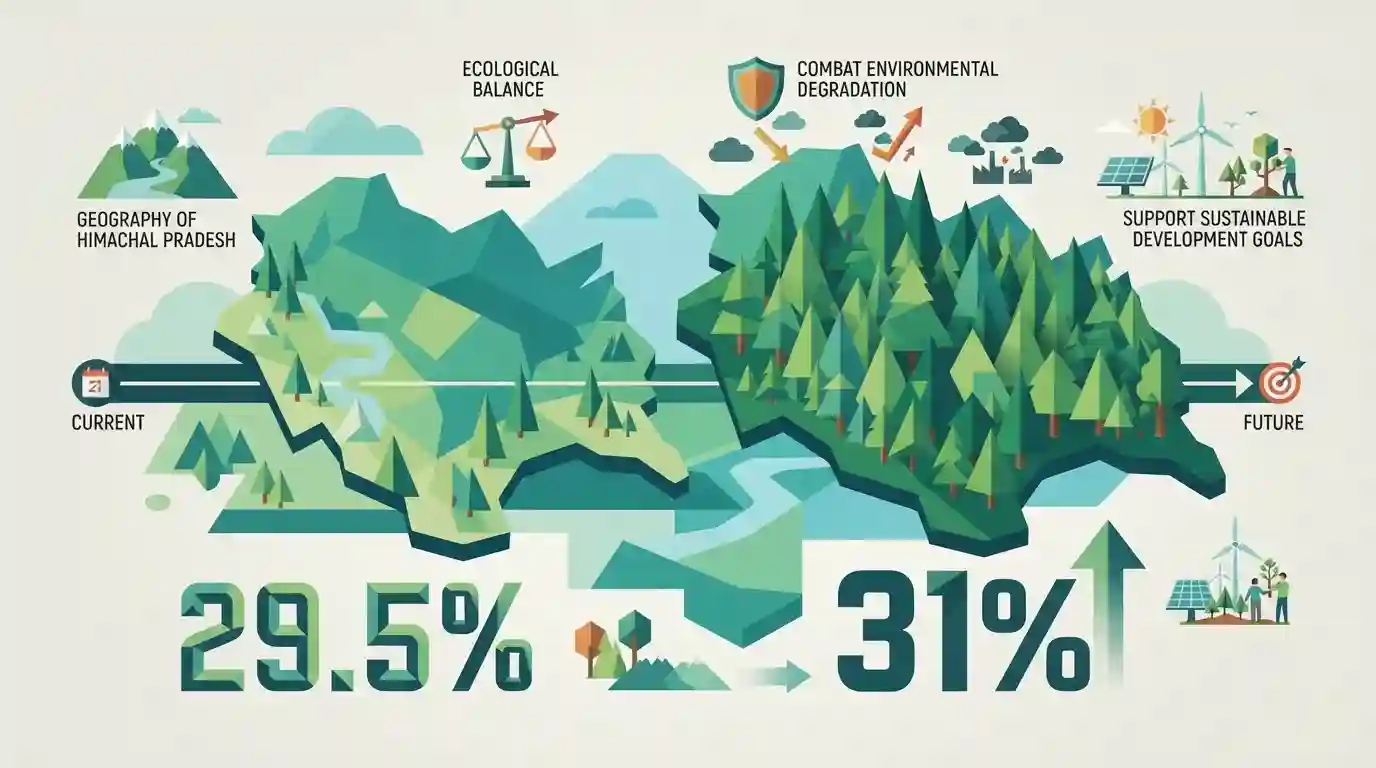
The Himachal Pradesh government has announced plans to increase the state's forest cover from 29.5% to 31% to strengthen ecological balance, combat environmental degradation, and support sustainable development goals in the Himalayan region.
Key Points
- The Himachal Pradesh government aims to increase the state's forest cover from the current 29.5% to 31%.
- The initiative focuses on boosting ecological sustainability, afforestation drives, and expanding green cover across the hilly terrain.
- State policy initiatives align with environmental targets to combat climate change and enhance biodiversity.
Important Terms
Himachal Pradesh Forest Department

The nodal administrative body responsible for the conservation, management, and scientific planning of forests, wildlife habitats, and ecological restoration across Himachal Pradesh.
UPSC context
HPAS Paper II / Prelims (Geography & Environment): Evaluates institutional frameworks for state afforestation, wildlife protection, and green growth targets.
Rajiv Gandhi Van Samvardhan Yojana
A community-centric afforestation scheme launched by Himachal Pradesh to increase green cover by engaging local groups like Mahila Mandals and SHGs in planting fruit-bearing trees.
UPSC context
HPAS Prelims (State Schemes & Current Affairs): Tests awareness of recent government initiatives targeting sustainable forestry and rural livelihood integration.
Prelims Trap
State forest cover target of 31% is often mistaken as the National Forest Policy target of 33% or confused with India's overall forest cover percentage.
Aspirants often confuse recorded forest area with actual tree/forest cover percentage, or mix up state-specific targets with national goals (like the 33% National Forest Policy target).
Static Concepts Connected
What is the difference between Recorded Forest Area and Forest Cover as per ISFR?
- Recorded Area:: Legal status refers to the geographical area recorded as forest in government records (Reserved, Protected, or Unclassed forests).
- Forest Cover:: Canopy cover refers to the actual tree canopy density observed aerially/satellite-wise, irrespective of legal ownership or notification status.
- Publication:: India State of Forest Report (ISFR) is published biennially by the Forest Survey of India (FSI).
Cross-Topic Patterns
State afforestation targets + India's Paris NDCs
HP's afforestation targets feed directly into national commitments under India's Nationally Determined Contributions (NDCs) to create an additional carbon sink of 2.5 to 3 billion tonnes of CO2 equivalent.
Himalayan ecology + Disaster management frameworks
Himalayan state forest policies must balance fragile mountain ecology with infrastructure needs, connecting environment protection with disaster management and landslide mitigation strategies.

HPAS often tests exact forest cover percentages or ISFR data; expect a statement on current vs target forest cover in prelims.
Linked PYQs · 2
Linked PYQs · 2
- 2024HPAS_PRELIMSGS1
Match the forest cover area/type with their total area in Himachal Pradesh (2021) : | List I (Density/Total Forest Cover) | List II (Area in sq. kms.) | |---|---| | (a) Very dense forest above 70 percent | (i) 7,100 | | (b) Moderate dense forest 40 to 70 percent | (ii) 5,180 | | (c) Open forest 10 percent to 40 percent | (iii) 15,443 | | (d) Total forest cover | (iv) 3,163 | Choose the correct options : Code: (a) (b) (c) (d)
- 2022HPAS_PRELIMSGS1
Select the correct statements from the following : (i) Supreme Court of India has allowed the State for silviculture green felling of three species on experimental basis. (ii) Forests in H.P. cover an area of 37947 sq. kms of total geographical area of the state (iii) In H.P. presently 30% of the total geographical areas support forest cover. (iv) The aim of the forest department is to enhance the forest cover in the state to 35% of its geographical area by 2030.
