Himachal Government Plans New Sugar Mill in Nurpur
Source:chinimandi ↗
Why It Matters
This development illustrates the state's strategic approach to integrating agriculture with industry, highlighting efforts to boost rural incomes, create border-area employment, and diversify Himachal Pradesh's industrial base.
Summary
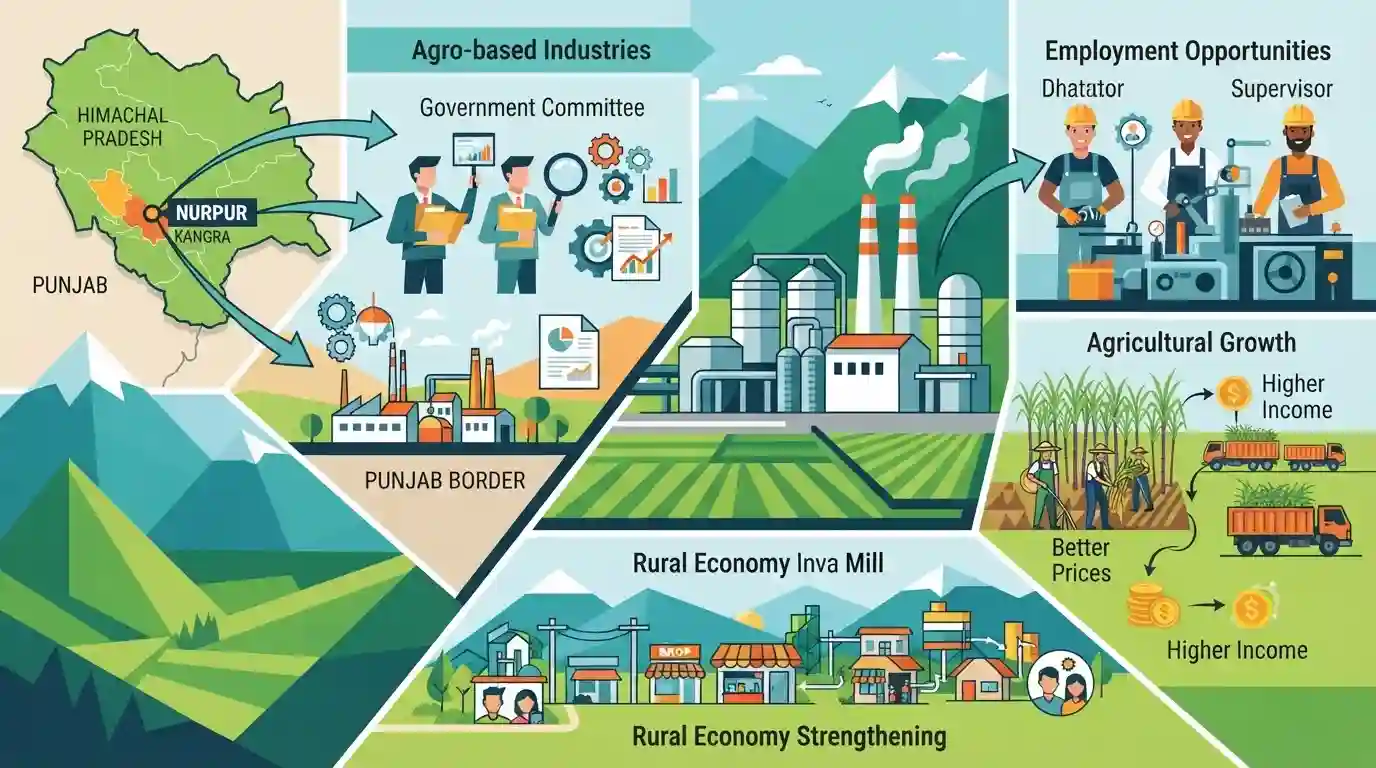
The Himachal Pradesh government is planning to establish a new sugar mill in the Nurpur area of Kangra district to promote agro-industrial growth. A committee has been constituted to evaluate the fair market value of sugar mills near the Punjab border, which will guide the formulation of a balanced industrial policy. The proposed project aims to create local employment opportunities, provide better prices for sugarcane farmers to encourage cultivation, and ultimately strengthen the state's rural economy through industrial diversification.
Key Points
- The Himachal Pradesh government plans to establish a sugar mill in the Nurpur area of Kangra district to boost agro-industrial development.
- A dedicated committee has been formed to assess the fair market value of sugar mills along the Punjab border, aiming to frame a balanced industrial policy.
- The proposed mill is expected to generate new local employment opportunities and ensure better, remunerative prices for sugarcane farmers in the region.
- The initiative is viewed as a strategic step towards strengthening the rural economy, promoting industrial diversification, and supporting the agricultural community in the state.
Important Terms
Agro-based Industry

Enterprises that use agricultural products as primary raw materials to manufacture goods, such as sugar mills processing sugarcane. They play a vital role in linking agricultural output with the manufacturing sector.
UPSC context
GS Paper 3 (Economy). Important for topics on food processing, industrial development, and creating rural employment.
Sugarcane Cultivation
The farming of sugarcane, a high-value, water-intensive tropical cash crop. It takes 10-12 months to harvest and serves as the fundamental raw material for the sugar and ethanol blending industries.
UPSC context
GS Paper 3 (Agriculture). Crucial for understanding major cropping patterns, water usage, and commercial farming in India.
Fair and Remunerative Price (FRP)
The minimum guaranteed price that sugar mills are legally required to pay farmers for sugarcane. It is announced by the Central Government based on the recommendations of the CACP.
UPSC context
GS Paper 3 (Agriculture). Tests knowledge of minimum support prices, agricultural pricing policies, and farmer welfare.
Industrial Policy
A comprehensive government strategy designed to encourage, regulate, and direct the growth of the manufacturing and industrial sectors, ensuring balanced regional development and industrial diversification.
UPSC context
GS Paper 3 (Economic Development). Highly relevant to topics on changes in industrial policy and their effects.
Rural Economy
The economic framework of non-urban areas, primarily driven by agriculture, agro-processing, and allied activities. Strengthening it is essential for reducing poverty, halting urban migration, and ensuring inclusive economic growth.
UPSC context
GS Paper 3 (Inclusive Growth). Central to addressing rural distress, employment generation, and socio-economic development.
Prelims Trap
The Central Government mandates both the Fair and Remunerative Price (FRP) and the State Advised Price (SAP) for sugarcane.
The Central Government only determines the Fair and Remunerative Price (FRP) under the Sugarcane (Control) Order, 1966. State Advised Prices (SAP) are declared independently by individual state governments and are generally higher than the FRP.
Static Concepts Connected
How is Sugarcane Pricing regulated in India (FRP vs SAP)?
- FRP Statutory Basis: FRP is determined under the Sugarcane (Control) Order, 1966, on the recommendations of the Commission for Agricultural Costs and Prices (CACP).
- FRP Authority: The Cabinet Committee on Economic Affairs (CCEA), chaired by the Prime Minister, officially approves and declares the FRP.
- SAP Discretion: SAP is announced by specific state governments (like UP, Punjab, Haryana) and is historically higher than the federally mandated FRP, leading to localized price competition.
What are the ecological and agro-climatic requirements for Sugarcane?
- Climate & Rainfall: Requires a hot and humid climate with temperatures between 21°C to 27°C and rainfall between 75 cm and 150 cm.
- Elevation Limits: While traditionally tropical, sub-tropical regions (like the Shivalik/Low Hills Zone up to 1000m elevation) can cultivate it, though they are highly sensitive to frost.
- Soil & Drainage: Deep, rich loamy soils with good drainage are ideal, as waterlogging severely damages sucrose content and root systems.
Cross-Topic Patterns
SAP vs FRP Federal Friction
Divergent state sugarcane pricing (SAP) along borders (e.g., HP vs Punjab) creates localized supply-chain leakages, pulling raw agricultural inputs away from processing units in lower-paying states.
Irrigation-Induced Cropping Shocks
Infrastructure development like micro-irrigation can counter-intuitively trigger a decline in hardy, long-duration crops (sugarcane) as farmers pivot to high-value, short-duration horticulture.

Multi-statement questions may test the statutory basis of FRP vs SAP alongside the ecological limits of Shivalik-zone cash crops by 2026.
Linked PYQs · 5
Linked PYQs · 5
- 2025HPAS_PRELIMSGS1
Match List I with List II : | List-I (Place) | List-II (Industry) | |---|---| | (a) Phagwara | (i) Silk Textile Industry | | (b) Gokak | (ii) Woollen Textile Industry | | (c) Kullu | (iii) Sugar Industry | | (d) Mandya | (iv) Cotton Textile Industry | Choose the correct answer from the options given below : Code: (a) (b) (c) (d)
- 2024HPAS_PRELIMSGS1
For the year 2022-23, match the Industry sub-sector in Himachal Pradesh with the percentage of workers employed in them : | List I (Industry Sub-sector) | List II (Percentage of workers employed) | |---|---| | (a) Mining and Quarrying | (i) 2 | | (b) Manufacturing | (ii) 41 | | (c) Electricity and Other Utilities | (iii) 50 | | (d) Construction | (iv) 7 | Choose the correct option : Code: (a) (b) (c) (d)
- 2025HPAS_PRELIMSGS1
According to PLFS 2023-24, share of secondary and tertiary sector in total employment in Himachal Pradesh respectively are :
- 2020HPAS_PRELIMSGS1
Consider the given four statements and choose the correct answer from the given options. 1. Jute is used for making decorative items. 2. Sugarcane is a cereal crop. 3. Cotton requires clear sky during flowering stage. 4. Sugarcane is a crop of temperate areas.
- 2024HPAS_PRELIMSGS1
What percent agriculture and its allied industries account for the total Gross State Value Added (GSVA) of Himachal Pradesh ?
