Himachal eases cannabis norms for medical and industrial use
Source:tribuneindia ↗
Why It Matters
The legalization and regulation of cannabis cultivation for non-recreational use presents a major opportunity for rural economic revitalization and revenue generation in Himachal Pradesh. It tests candidates' awareness of state-specific agrarian policies, regulatory frameworks around narcotics, and the economic potential of alternative cash crops.
Summary
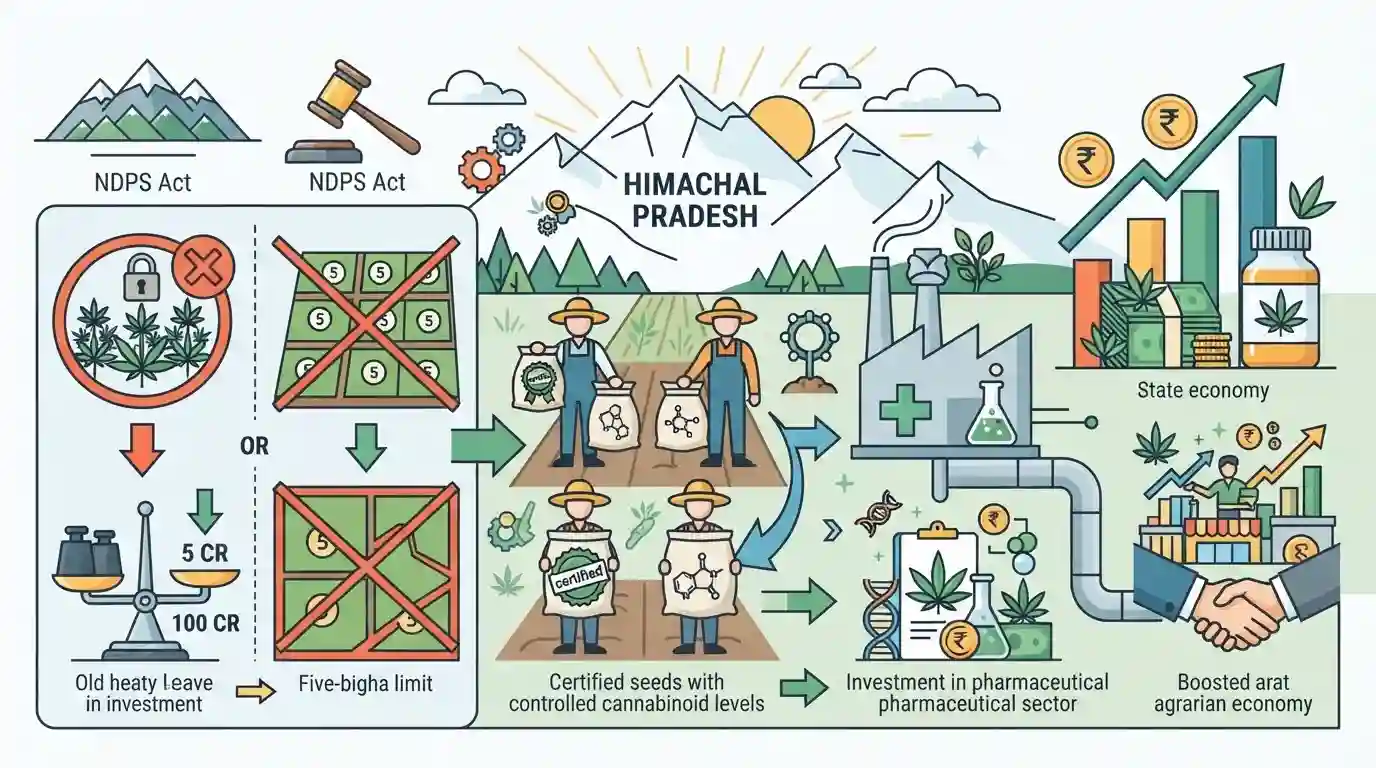
The Himachal Pradesh Government has significantly relaxed norms for the controlled cultivation of cannabis for medicinal, industrial, and scientific purposes by amending the state's Narcotic Drugs and Psychotropic Substances (NDPS) rules. The minimum investment for manufacturing units was reduced from ₹100 crore to ₹5 crore, and the cultivation land limit was revised to five bighas. The policy allows cultivation anywhere in the state, provided farmers use certified seeds with tested cannabinoid concentrations, aiming to boost the agrarian economy and attract investment in the pharmaceutical sector.
Key Points
- Himachal Pradesh amended its NDPS Order to facilitate cannabis cultivation for medical, scientific, and industrial purposes across the state.
- The minimum investment requirement to establish a cannabis manufacturing unit has been drastically reduced from ₹100 crore to ₹5 crore.
- The permitted land limit for controlled cultivation has been revised from three acres to five bighas.
- Cultivators must use authorised seeds with a valid certificate confirming the specified concentration of active cannabinoids (THC and CBD).
- The Agriculture Development Officer (ADO) has been designated as the nodal officer for oversight by the Department of Agriculture.
Important Terms
Himachal Pradesh NDPS (Second Amendment) Rules, 2026

A 2026 policy framework legalising cannabis cultivation for medicinal and industrial purposes in HP. It eases entry barriers by reducing the minimum manufacturing investment to ₹5 crore and cultivation area to five bighas.
UPSC context
Highly relevant for GS Paper 3 (Economy/Agriculture). Tests understanding of HP's alternative cash crop policies and revenue generation strategies.
Narcotic Drugs and Psychotropic Substances (NDPS) Act, 1985
India's central drug control law. Under specific provisions, it grants state governments the authority to permit and regulate the controlled cultivation of cannabis for medicinal, scientific, and industrial use.
UPSC context
Critical for GS Paper 2 (Governance). Tests awareness of the central legislative framework empowering state-level medicinal cannabis policies.
Buy-back Agreement
A mandatory contract under HP's new cannabis rules requiring farmers to secure a guaranteed buyer—such as an authorised pharmaceutical manufacturer—before applying for a commercial cultivation license.
UPSC context
Important for GS Paper 3 (Agriculture). Evaluates understanding of market linkages and risk mitigation strategies for HP farmers.
State Taxes and Excise Department (Himachal Pradesh)
The state authority in Himachal Pradesh responsible for notifying the amended NDPS rules, regulating the medical cannabis industry, and issuing operational licenses to cultivators, processing units, and researchers.
UPSC context
Relevant for HPAS Prelims and GS Paper 2. Tests knowledge of the regulatory bodies governing the state's commercial licensing.
Department of Agriculture (Himachal Pradesh)
The nodal state agency tasked with monitoring on-ground cannabis cultivation. Its Agriculture Development Officers (ADOs) oversee compliance, verify certified seed usage, and track agricultural documentation.
UPSC context
Significant for GS Paper 3 (Agriculture). Tests familiarity with the administrative machinery implementing and supervising agrarian reforms in HP.
Prelims Trap
"The Central Government amended the NDPS Act to legalize cannabis cultivation in Himachal Pradesh."
The Centre did not amend the Act. The Himachal Pradesh government amended its state-level rules utilizing delegated powers under Section 14 of the central NDPS Act.
Static Concepts Connected
What is the regulatory framework for cannabis cultivation in India under the NDPS Act?
- Central Prohibition: The NDPS Act, 1985 generally prohibits the cultivation, production, possession, and sale of cannabis flowers (ganja) and resin (charas).
- State Exemptions: Section 14 empowers state governments to permit and regulate cannabis cultivation exclusively for medical, scientific, and industrial (hemp) purposes.
- THC Limit: For cannabis to be legally classified as non-narcotic industrial hemp, the concentration of the psychoactive compound Tetrahydrocannabinol (THC) must strictly remain below 0.3%.
Cross-Topic Patterns
Medicinal Cannabis + BBN Pharma Hub
The reduced ₹5 crore investment threshold strategically funnels cannabis yields into HP’s established Baddi-Barotiwala-Nalagarh (BBN) pharmaceutical corridor, integrating agrarian output with secondary manufacturing sectors.
NDPS Federalism + Alternative Cash Crops
HP joins Uttarakhand in utilizing Section 14 of the NDPS Act, illustrating how states can leverage federal legislative carve-outs for regional agrarian revitalization and alternative cash crops.

HP's cannabis policy will likely feature in a multi-statement question testing the ₹5cr limit, 5-bigha cap, and Section 14 NDPS exemptions.
Linked PYQs · 2
Linked PYQs · 2
- 2024HPAS_PRELIMSGS1
What percent agriculture and its allied industries account for the total Gross State Value Added (GSVA) of Himachal Pradesh ?
- 2024HPAS_PRELIMSGS1
Consider the following statements : (1) Himachal Pradesh Government approved an outlay of 1200 crore rupees for economic services during 2022-23. (2) Himachal Pradesh Government approved an outlay of 267 crore rupees for rural development during 2022-23. (3) Himachal Pradesh Government approved an outlay of 140 crore rupees for Mahatma Gandhi National Employment Guarantee Scheme during 2022-23. (4) Himachal Pradesh Government approved an outlay of 22 crore rupees for Forestry and Wildlife during 2022-23. Choose the correct answer from the options given below :
