Himachal MLAs face privilege motions over national anthem dispute
Source:dailypioneer ↗
Why It Matters
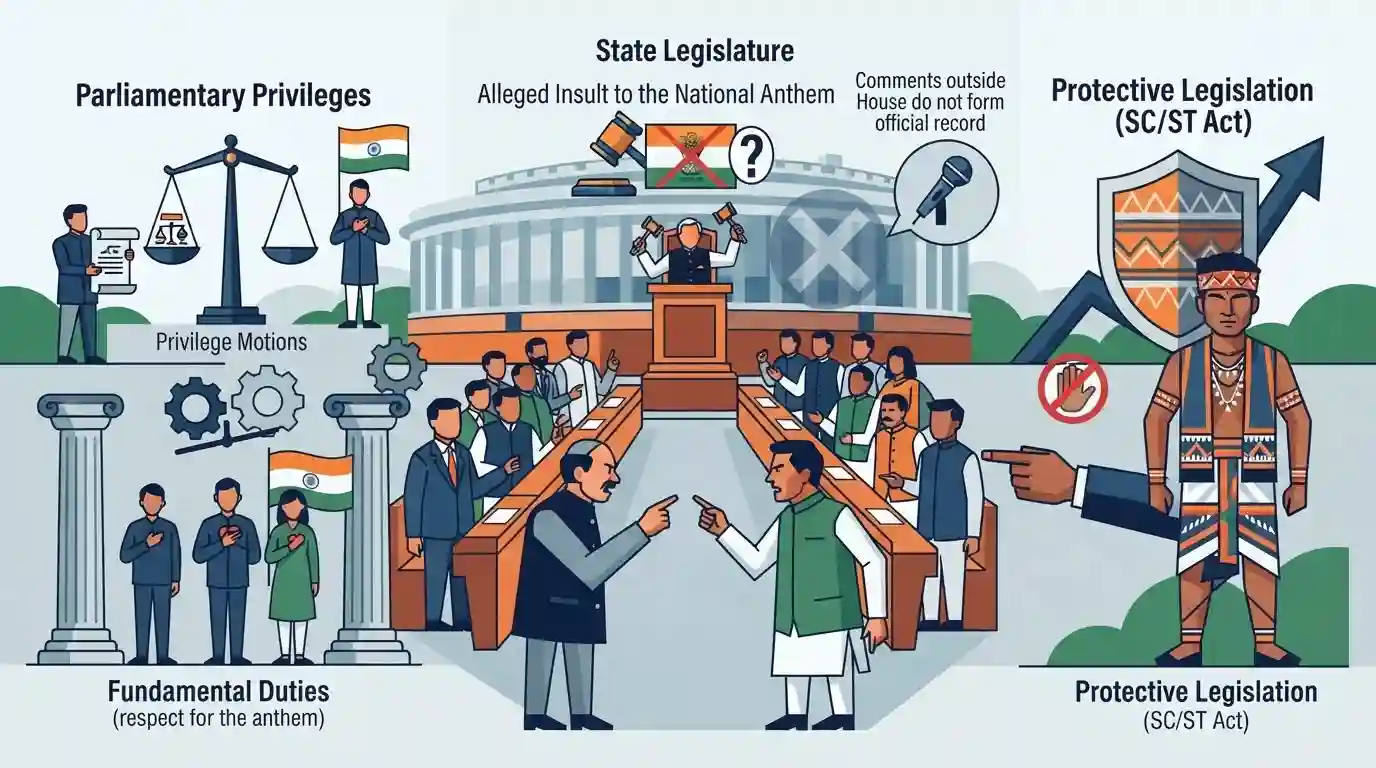
The incident provides a practical context for studying parliamentary privileges (Articles 105/194), the role and rulings of the Speaker in managing assembly records, and the intersection of political disputes with statutory protections like the SC/ST (Prevention of Atrocities) Act. It also touches upon Fundamental Duties (Article 51A(a)) regarding respect for the national anthem.
Summary
A major political dispute has erupted in the Himachal Pradesh Assembly over the alleged insult to the national anthem, prompting both Congress and BJP to declare their intent to move breach of privilege motions against each other. The confrontation involved arguments over comments made outside the House, which the Speaker clarified do not constitute official records, and the invocation of the SC/ST Act by Revenue Minister Jagat Singh Negi regarding remarks against a tribal MLA. This incident highlights critical constitutional themes, including parliamentary privileges, Fundamental Duties, and the enforcement of protective legislation for marginalized communities.
Key Points
- The ruling Congress and opposition BJP in Himachal Pradesh announced they will move breach of privilege motions against each other.
- The row stems from allegations that BJP legislators insulted the national anthem during assembly proceedings.
- Speaker Kuldeep Singh Pathania stated that comments made by the Chief Minister outside the Assembly are not part of official records.
- State Revenue Minister Jagat Singh Negi invoked the SC/ST (Prevention of Atrocities) Act during the dispute over remarks directed at a tribal MLA.
Important Terms
Breach of Privilege Motion

A parliamentary motion introduced when a member feels the privileges, rights, or immunities of the House or its members have been violated. It aims to hold the offender accountable for contempt of the legislature.
UPSC context
GS Paper 2 (Polity). Tests knowledge of parliamentary privileges, functioning of the state legislature, and accountability mechanisms.
SC/ST (Prevention of Atrocities) Act
Enacted in 1989, this special legislation protects Scheduled Castes and Scheduled Tribes from violence and discrimination. It establishes stringent penalties, denies anticipatory bail for specific offenses, and mandates special courts for speedy trials.
UPSC context
GS Paper 2 (Social Justice). Tests understanding of statutory safeguards, protective legislation, and mechanisms addressing historical discrimination.
Fundamental Duties
Civic and moral obligations of Indian citizens enshrined in Article 51A (Part IV-A) of the Constitution. Added by the 42nd Amendment, they include the duty to respect the National Anthem and uphold national ideals.
UPSC context
GS Paper 2 (Polity). Tests knowledge of constitutional provisions, the Swaran Singh Committee, and citizen responsibilities.
Speaker of the Legislative Assembly
The presiding officer of a state's Lower House, elected by its members. The Speaker maintains decorum, interprets rules, manages privilege motions, and serves as the ultimate authority on proceedings within the Assembly.
UPSC context
GS Paper 2 (Polity). Tests the roles, powers, and constitutional position of presiding officers in state legislatures.
Prelims Trap
Legislative privileges under Article 194 grant MLAs complete immunity from criminal proceedings during Assembly sessions.
Privileges only offer immunity from civil arrests (40 days before/after) and shield speech made inside the House. They do not grant immunity from criminal charges.
Static Concepts Connected
What constitutes the powers and limitations of State Legislature privileges?
- Article 194: Grants freedom of speech inside the House and immunity from court proceedings for votes or speeches given therein.
- No Criminal Immunity: Members do not enjoy immunity from criminal cases; protection is limited to civil arrests 40 days before, during, and after a session.
- Outside Remarks: Comments made by ministers or MLAs outside the legislative assembly do not form part of official records or attract absolute privilege.
How is respect for the National Anthem legally enforced in India?
- Fundamental Duty: Article 51A(a) constitutionally mandates citizens to abide by the Constitution and respect its ideals, the National Flag, and the National Anthem.
- Statutory Enforcement: Because Fundamental Duties are inherently non-justiciable, insults to the National Anthem are penalized statutorily under the Prevention of Insults to National Honour Act, 1971.
Cross-Topic Patterns
Privileges vs. Criminal Law
Invoking the SC/ST Act highlights that Article 194 privileges shield lawmakers from civil liabilities and internal speech, but offer no immunity from criminal prosecution.
Duties backed by Statutes
The constitutional duty to respect the National Anthem is routinely tested alongside its enforcement mechanism, the Prevention of Insults to National Honour Act, 1971.

Expect a multi-statement question contrasting MLA privileges (Art 194) against criminal liabilities (SC/ST Act) and outside speech.
Linked PYQs · 3
Linked PYQs · 3
- 2025HPAS_PRELIMSGS1
Who decides the disqualification of members of State Legislative Assembly, for matters other than those in the Tenth Schedule of the Constitution ?
- 2022HPAS_PRELIMSGS1
Who decides the matter of disqualification of MLA for matters other than those given in the Tenth Schedule of the Constitution ?
- 2023HPAS_PRELIMSGS1
Under which Article of the Constitution a Speaker allows any member to speak in Parliament in his/her mother language ?
