Himachal Commissions Indias First Forest Biomass Biochar Plant
Source:bioenergy-times ↗
Why It Matters
Chir pine needles are a major cause of devastating summer forest fires in Himachal Pradesh. Processing them into biochar represents a dual-benefit solution: disaster risk reduction and climate change mitigation, highly relevant for HPAS questions on state-specific environmental initiatives and sustainable technologies.
Summary
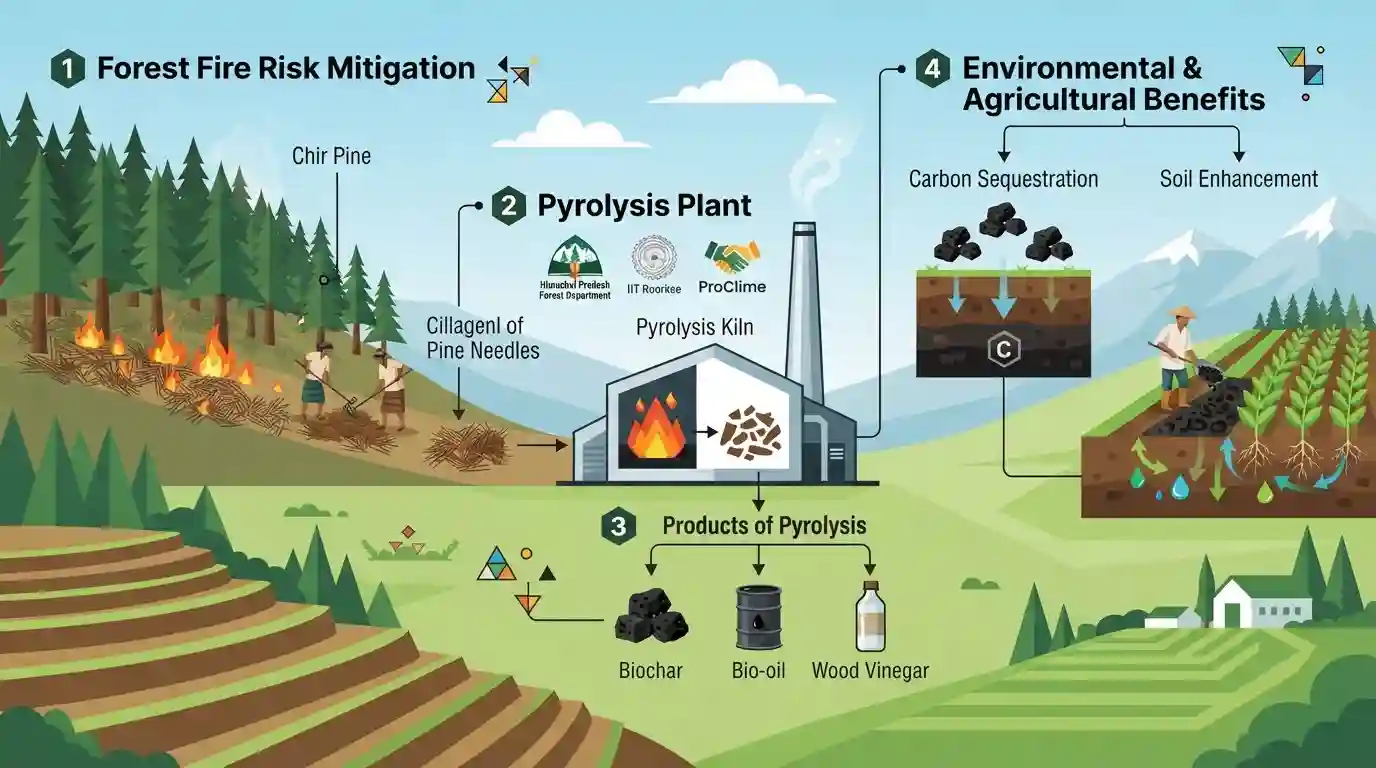
Himachal Pradesh has commissioned India's first indigenous forest biomass biochar plant at the Neri campus of Dr YS Parmar University of Horticulture and Forestry (UHF) in Hamirpur. Developed in collaboration with the state Forest Department, IIT Roorkee, and ProClime, the plant uses pyrolysis to convert highly combustible chir pine needles into biochar, bio-oil, and wood vinegar. This innovative approach addresses the state's severe forest fire problem by removing combustible biomass while producing biochar for carbon sequestration and soil enhancement.
Key Points
- India's first indigenous forest biomass biochar plant has been commissioned at the Neri campus of Dr YS Parmar University of Horticulture and Forestry in Hamirpur, Himachal Pradesh.
- The plant utilizes pyrolysis technology to process highly combustible chir pine needles and other forest residues, mitigating the severe risk of forest fires in the state.
- The process yields biochar as the primary product, which enhances soil health and water retention, along with bio-oil and wood vinegar as valuable by-products.
- The initiative is a collaborative effort between the HP Forest Department, UHF, IIT Roorkee, and climate-tech firm ProClime.
- The project supports climate change mitigation through carbon sequestration, reduces ecological damage from forest fires, and generates local employment opportunities.
Important Terms
Biochar

A carbon-rich, porous charcoal-like material produced by heating organic biomass (like forest and agricultural waste) in an oxygen-depleted environment. It enhances soil quality and sequesters carbon for hundreds of years.
UPSC context
GS Paper III (Environment & Agriculture); tests knowledge of carbon sequestration, soil fertility, and eco-friendly waste management solutions.
Pyrolysis
A thermochemical process that thermally degrades organic materials at elevated temperatures in the absence or controlled limitation of oxygen. It yields biochar, bio-oil, and combustible syngas without actual combustion.
UPSC context
GS Paper III (Science & Technology / Environment); tests understanding of waste-to-energy technologies and sustainable circular economy methods.
Chir Pine (Pinus roxburghii)
A coniferous evergreen tree native to the Himalayas. Its dry, resin-rich needles accumulate on the forest floor, acting as a highly flammable tinderbox that drives catastrophic summer forest fires.
UPSC context
GS Paper III (Environment & Disaster Management); tests understanding of invasive/vulnerable flora, fire ecology, and regional climate risks.
Wood Vinegar
A liquid by-product of biomass pyrolysis. Composed largely of acetic acid and water, it is used in agriculture as a natural pest repellent, plant growth promoter, and soil amendment.
UPSC context
GS Paper III (Agriculture & Environment); tests knowledge of natural farming, eco-friendly pesticides, and waste-to-wealth by-products.
IIT Roorkee
A premier public technical university in India. In this project, it provided the vital technical design and engineering expertise to indigenously develop India's first forest-biomass-dedicated biochar plant.
UPSC context
GS Paper III (Science & Technology); tests awareness of premier Indian institutions driving indigenous technological innovation and climate solutions.
Dr YS Parmar University of Horticulture and Forestry (UHF)
A state agriculture university located in Nauni, Himachal Pradesh. It hosts the newly commissioned biochar plant at its Neri campus, driving scientific research on biochar's horticultural and agricultural applications.
UPSC context
GS Paper III (Agriculture & Science); tests awareness of regional research institutes advancing climate-smart agricultural practices and rural livelihood initiatives.
ProClime
A Chennai-based climate technology firm that co-developed the Hamirpur biochar plant. Under a tripartite agreement, it invests in infrastructure to convert combustible forest biomass into soil amendments, generating verified carbon credits.
UPSC context
GS Paper III (Climate Change / Economy); tests knowledge of private sector roles in carbon markets, green investments, and carbon-negative initiatives.
Prelims Trap
"Pyrolysis converts pine needles into biochar through complete combustion in an oxygen-rich environment."
Pyrolysis is an endothermic process requiring the strict absence (or near-absence) of oxygen to prevent complete combustion, trapping carbon stably.
Static Concepts Connected
What differentiates Pyrolysis from Gasification and Incineration?
- Pyrolysis: Heating biomass in the absence of oxygen at high temperatures to yield solid biochar, bio-oil, and gas.
- Gasification: Heating biomass with limited oxygen or steam to primarily produce combustible syngas (carbon monoxide and hydrogen).
- Incineration: Complete combustion in the presence of excess oxygen, resulting primarily in ash and carbon dioxide emissions.
Why are Chir Pine (Pinus roxburghii) forests highly susceptible to forest fires?
- High resin content: Chir Pine needles and bark contain highly volatile and flammable resins/terpenes, acting as natural fire accelerants.
- Slow decomposition: The needles ('pirul') degrade very slowly, creating a thick, highly combustible litter blanket on the dry forest floor.
- Ecological dominance: Pine thrives on dry, south-facing Himalayan slopes, depleting soil moisture and increasing extreme summer fire vulnerability.
Cross-Topic Patterns
Biochar & Carbon Farming integration
The use of biochar physically traps carbon in the soil, bridging forest waste management directly with 'Carbon Farming'—a regenerative agriculture concept frequently emphasized in recent GS-3 papers.
Forest Fires & Livelihood Economics
Converting highly combustible 'pirul' (pine needles) into commercial biochar shifts Himalayan forest fire management from pure disaster response (NDMA guidelines) to a sustainable, livelihood-generating model.

Expect a multi-statement Prelims question combining pyrolysis conditions, biochar's water-retention role, and pine needle fire ecology.
Linked PYQs · 4
Linked PYQs · 4
- 2022HPAS_PRELIMSGS1
Select the correct statements from the following : (i) Supreme Court of India has allowed the State for silviculture green felling of three species on experimental basis. (ii) Forests in H.P. cover an area of 37947 sq. kms of total geographical area of the state (iii) In H.P. presently 30% of the total geographical areas support forest cover. (iv) The aim of the forest department is to enhance the forest cover in the state to 35% of its geographical area by 2030.
- 2024HPAS_PRELIMSGS1
Match the forest cover area/type with their total area in Himachal Pradesh (2021) : | List I (Density/Total Forest Cover) | List II (Area in sq. kms.) | |---|---| | (a) Very dense forest above 70 percent | (i) 7,100 | | (b) Moderate dense forest 40 to 70 percent | (ii) 5,180 | | (c) Open forest 10 percent to 40 percent | (iii) 15,443 | | (d) Total forest cover | (iv) 3,163 | Choose the correct options : Code: (a) (b) (c) (d)
- 2023HPAS_PRELIMSGS1
Institute of Forest Biodiversity is located at :
- 2024HPAS_PRELIMSGS1
Given below are two statements : Statement I : Directorate of Forest Education is located at Agartala. Statement II : Tropical Forestry Research Institute is located at Jabalpur. In the light of the above statements, choose the most appropriate answer from the options given below :
