Himachal Approves Industrial Hemp Cultivation for Revenue Boost
Source:etvbharat ↗
Why It Matters
The primary sector in Himachal Pradesh employs nearly 54% of its population despite its declining contribution to the GSDP (per the latest HP Economic Survey). Legalizing high-yield, low-water-intensive cash crops like industrial hemp is a major policy shift aimed at bolstering rural incomes, strengthening state finances, and transitioning towards sustainable bio-manufacturing.
Summary
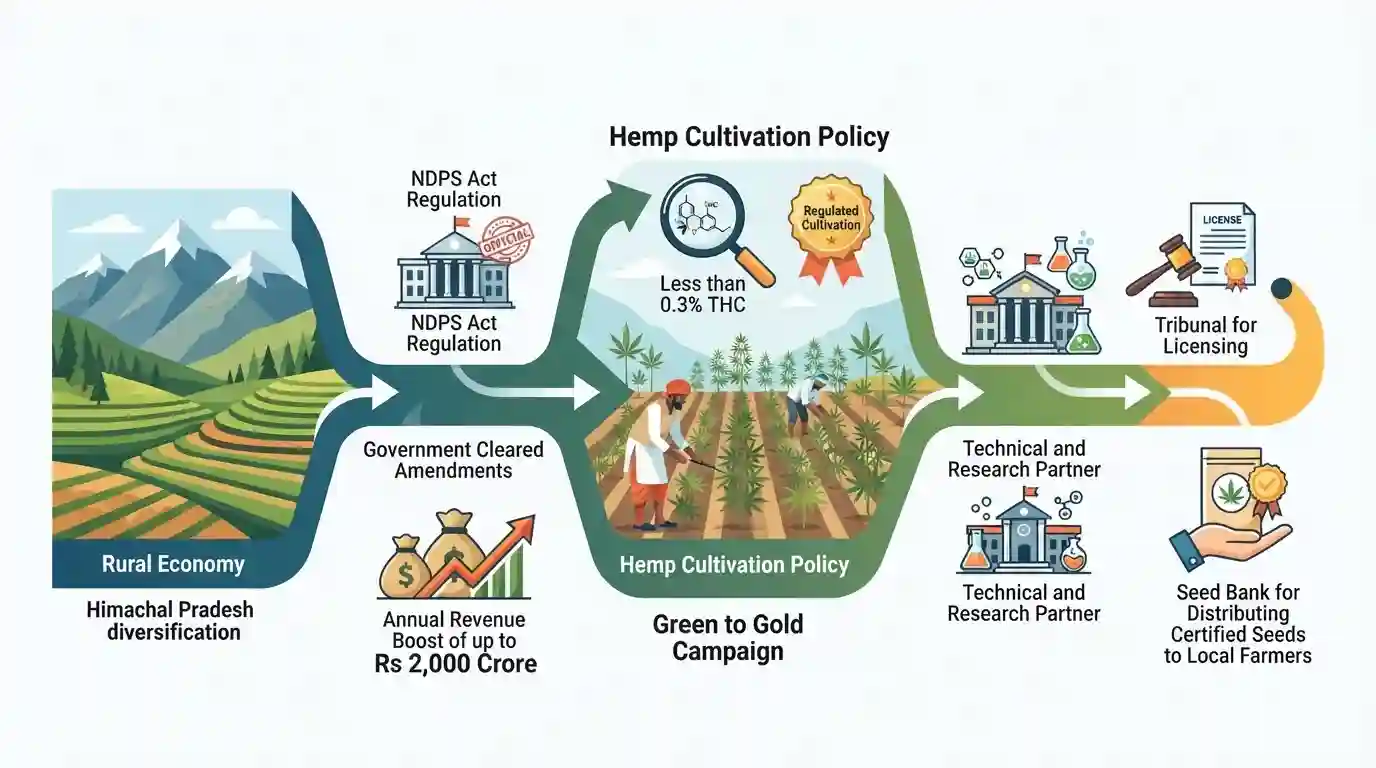
The Himachal Pradesh government has cleared amendments to the NDPS Act to allow regulated industrial and medicinal hemp cultivation, projecting an annual revenue boost of up to Rs 2,000 crore. As part of the 'Green to Gold' campaign, the policy mandates the cultivation of low-THC varieties (less than 0.3% THC) to avert misuse, leveraging Uttarakhand's cultivation model. While CSKHPKV Palampur will serve as the technical and research partner, the state plans to establish a tribunal for licensing and a seed bank for distributing certified seeds to local farmers.
Key Points
- The Himachal Pradesh state cabinet has approved legal amendments to the NDPS Act to permit and regulate the commercial and medicinal cultivation of industrial hemp in the state.
- Dubbed the 'Green to Gold' campaign by CM Sukhvinder Singh Sukhu, the initiative is projected to boost the rural economy and generate between Rs 500 crore to Rs 2,000 crore in annual state revenue.
- A 2023 feasibility committee, chaired by Cabinet Minister Jagat Singh Negi (with members Hans Raj and Janak Raj), recommended the policy after studying existing models in Uttarakhand and Madhya Pradesh.
- The cultivation will strictly target low-THC hemp varieties with a maximum of 0.3% Tetrahydrocannabinol (THC) to prevent psychoactive misuse, with certified seeds to be sourced from Selakui, Uttarakhand.
- Chaudhary Sarwan Kumar Himachal Pradesh Krishi Vishvavidyalaya (CSKHPKV) in Palampur will act as the key research and technical partner.
- The state will set up a state-level tribunal for fast-track cultivation approvals, along with a dedicated seed bank to distribute certified seeds.
- Hemp is highlighted for its diverse uses, including eco-friendly industrial products (textiles, biodegradable bottles, construction) and health benefits (rich in Omega-3 fatty acids, managing chemotherapy side-effects).
Important Terms
Narcotic Drugs and Psychotropic Substances (NDPS) Act

A 1985 Indian law criminalizing the production, trade, and use of narcotics. However, Sections 10 and 14 empower state governments to permit and regulate cannabis cultivation strictly for scientific, medicinal, and industrial applications.
UPSC context
GS-2 (Governance) & GS-3 (Security). Tests understanding of drug regulation, center-state powers, and non-narcotic utilization of prohibited plants.
Green to Gold Campaign
A Himachal Pradesh government initiative aimed at building a sustainable bio-economy by legalizing regulated industrial hemp cultivation. It seeks to replace illicit drug trades with eco-friendly manufacturing, boosting rural livelihoods and generating revenue.
UPSC context
GS-3 (Agriculture & Economy). Relevant for agricultural diversification, rural development strategies, and climate-resilient farming in Himalayan states.
Industrial Hemp
Strains of the cannabis plant grown for industrial and medicinal use, legally mandated to contain less than 0.3% THC (the psychoactive compound). It requires less water and yields versatile materials like textiles, biofuels, and medicines.
UPSC context
GS-3 (Agriculture & Environment). Highlights bio-economy potential, sustainable alternatives to traditional fiber crops, and climate-resilient agriculture.
Hempcrete
An innovative, carbon-negative building material made from industrial hemp and a lime binder. It offers excellent insulation and is a key focus of Himachal Pradesh’s strategy to become a hub for eco-friendly green construction.
UPSC context
GS-3 (Environment & Infrastructure). Tests knowledge of sustainable building materials, climate change mitigation, and carbon-negative technologies.
Chaudhary Sarwan Kumar Himachal Pradesh Krishi Vishvavidyalaya (CSKHPKV)
A premier agricultural university in Palampur providing research and technical guidance for Himachal Pradesh's hemp policy. It leads pilot studies to develop high-yield, low-THC seed varieties tailored specifically for the Himalayan climate.
UPSC context
GS-3 (Agriculture & Science). Illustrates the role of specialized R&D institutions in implementing evidence-based agricultural policy and crop diversification.
Prelims Trap
Only the Central Government has the statutory authority to permit cannabis cultivation in India.
Under Section 10 of the NDPS Act, 1985, State Governments (not the Centre) are explicitly empowered to permit and regulate cannabis cultivation for scientific, medicinal, and industrial purposes.
Static Concepts Connected
How does the NDPS Act, 1985 regulate cannabis cultivation in India?
- State Authority: State governments have the statutory power to permit, regulate, and monitor cannabis cultivation for scientific, medical, and industrial purposes.
- Plant Definition: The Act penalizes the resin (charas) and flowers (ganja), but notably excludes seeds and leaves when not accompanied by fruiting tops.
- THC Threshold: State policies legally distinguish industrial hemp from narcotic cannabis by capping Tetrahydrocannabinol (THC) levels at a maximum of 0.3%.
What are the ecological and agricultural benefits of industrial hemp?
- Resource Efficiency: Hemp requires substantially less water and pesticides than traditional cash crops like cotton, and matures in just 3-4 months.
- Phytoremediation: The crop naturally extracts heavy metals and toxins from contaminated soil, a process known as phytoremediation, restoring degraded lands.
- Carbon Sink: Hemp absorbs significant amounts of atmospheric CO2 and acts as a raw material for carbon-negative construction blocks (hempcrete).
Cross-Topic Patterns
Agri-Diversification in Hilly Terrains
Hemp legalization provides a climate-resilient cash crop for Himalayan states, addressing rural out-migration and complementing traditional horticulture in changing weather patterns.
Biomaterials & Decarbonization Goals
Industrial hemp drives the circular economy through biodegradable plastics, 'hempcrete' for construction, and eco-friendly textiles, subtly aligning with India's net-zero targets.

Expect a 2026 Prelims statement testing the specific exceptions under the NDPS Act (state vs. center powers, seeds vs. flowers).
Linked PYQs · 1
Linked PYQs · 1
- 2025HPAS_PRELIMSGS1
Read the following statements : Statement I : Share of agriculture in total GSDP of Himachal Pradesh has declined from about 75 percent in 1950-51 to little above 20 percent in 2023-24. Statement II : As per economic survey 2024-25 of the state, however, in terms of employment still 54 percent of the state population is engaged in primary sector. In the light of the above statements, choose the most appropriate answer from the options given below :
