Himachal Pradesh Legalizes Medical Cannabis Cultivation
Source:lawstreet ↗
Why It Matters
This development highlights the evolving state-level policy landscape regarding the commercial and medical utility of cannabis in India, showcasing federalism in action under the NDPS Act. It is highly relevant for HPAS Prelims as a major policy decision by the Himachal Pradesh government impacting its agricultural economy and regulatory governance.
Summary
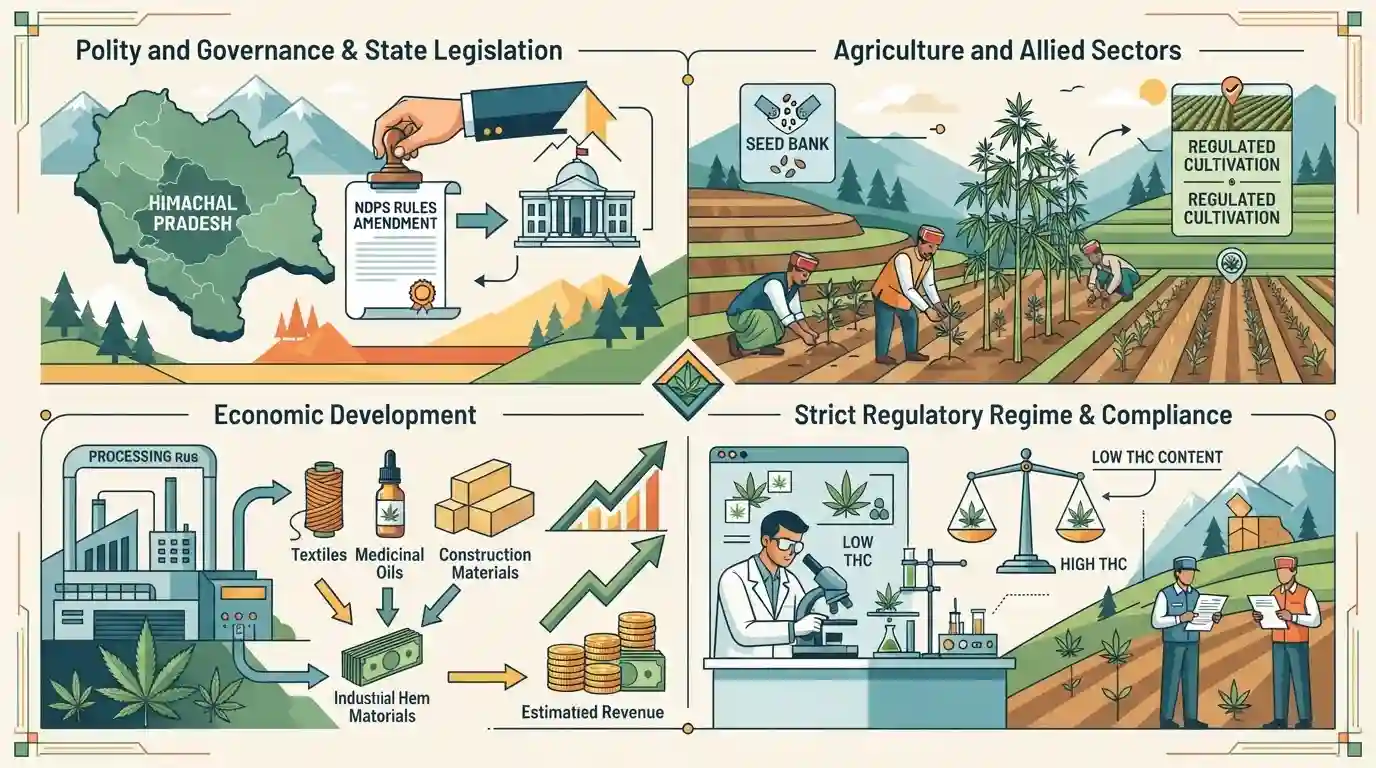
Himachal Pradesh has officially approved the regulated cultivation of cannabis for medical, scientific, and industrial use by amending the state's Narcotic Drugs and Psychotropic Substances (NDPS) Rules of 1989. Following the models of Uttarakhand and Madhya Pradesh, the state aims to generate an estimated Rs 500 crore annually and provide economic benefits to farmers. The legal framework relies on provisions of the central NDPS Act, 1985, which empowers states to permit non-narcotic cannabis cultivation. A strict regulatory regime will oversee operations, including a specific seed bank and caps on THC (tetrahydrocannabinol) content to distinguish industrial hemp from narcotic strains.
Key Points
- The Himachal Pradesh government has amended the HP NDPS Rules, 1989, allowing the regulated cultivation of cannabis for medical, scientific, and industrial purposes.
- The state aims to boost its economy with an estimated annual revenue of Rs 500 crore from the cannabis sector.
- Under the NDPS Act, 1985 (Section 14), states have the authority to permit and regulate cannabis cultivation for horticultural and industrial purposes, provided it is non-narcotic.
- A strict regulatory framework will be established involving special Standard Operating Procedures (SOPs), a dedicated seed bank, and restrictions on THC (tetrahydrocannabinol) content to ensure compliance.
- Himachal Pradesh joins Uttarakhand, Madhya Pradesh, and Jammu & Kashmir in exploring the legal cultivation of hemp and cannabis for non-recreational purposes.
Important Terms
Narcotic Drugs and Psychotropic Substances (NDPS) Act, 1985

A central Indian legislation that prohibits and regulates the manufacture, transport, sale, and use of narcotic drugs, while allowing state-regulated cannabis cultivation for scientific, industrial, and medicinal purposes.
UPSC context
GS Paper II (Government Policies) and GS III (Internal Security). Tests understanding of drug control frameworks and federal legislative divisions.
Himachal Pradesh Narcotic Drugs and Psychotropic Substances (NDPS) Rules, 1989
State-specific rules under the central NDPS Act, recently amended to establish a comprehensive legal and regulatory framework for controlled cannabis cultivation, storage, and processing within Himachal Pradesh.
UPSC context
GS Paper II (State Legislation and Executive Rules). Tests knowledge of state-level implementation of central laws to balance revenue and regulation.
Panchayati Raj Institutions (PRIs)
Rural local self-governing bodies in India. Under the NDPS framework, PRI representatives serve as key stakeholders for local consensus-building, monitoring, and reporting illegal cultivation to prevent drug abuse.
UPSC context
GS Paper II (Local Governance and Decentralisation). Tests understanding of PRIs' role in public policy implementation, community surveillance, and socio-economic changes.
Agriculture, Horticulture, and Universities departments
State administrative and academic bodies tasked with research, licensing, and setting standard operating procedures for developing low-THC seed varieties and monitoring legal hemp cultivation.
UPSC context
GS Paper III (Agriculture and Technology). Tests understanding of institutional mechanisms, scientific research, and academic collaboration in regulating modern cash crops.
Himachal Pradesh Legislative Assembly
The unicameral state legislature of Himachal Pradesh, which adopted resolutions and enabled policy reforms to legalize regulated cannabis cultivation, aiming to boost the regional rural economy.
UPSC context
GS Paper II (State Legislature Structure and Functioning). Tests knowledge of legislative mechanisms to pass resolution-based state policy changes.
Prelims Trap
State governments require special permission from the Parliament to legalize cannabis cultivation for industrial use.
The NDPS Act, 1985 already delegates power to state governments (under Section 14) to permit and regulate non-narcotic cannabis cultivation independently.
Static Concepts Connected
How does the NDPS Act, 1985 divide jurisdiction over cannabis?
- Central Prohibition: Production, trade, and sale of cannabis resin (charas) and flowering tops (ganja) are strictly banned at the national level.
- Exempted Parts: Cannabis leaves and seeds, traditionally used for bhang, are exempt from the national prohibition.
- State Delegation: Under Sections 10 and 14, State governments possess delegated authority to frame rules for medicinal, scientific, and industrial cultivation.
What makes industrial hemp a viable bio-economy crop?
- Low Psychoactivity: Hemp is bred to have strictly capped THC content (usually below 0.3%), eliminating narcotic misuse while allowing industrial applications.
- Ecological Footprint: It is drought-tolerant, requires minimal pesticides, and serves as an excellent carbon sink compared to conventional crops like cotton.
- Industrial Versatility: Yields raw materials for sustainable textiles, biofuels, biodegradable plastics, and seed oils rich in Omega-3 fatty acids.
Cross-Topic Patterns
Delegated Legislation in Federalism
The NDPS Act exemplifies how central statutes use delegated legislation, allowing states like Himachal Pradesh and Uttarakhand to tailor bio-economic policies to local agrarian realities.
Climate-Resilient Hill Agriculture
As traditional horticulture faces climate stress, introducing industrial hemp provides Himalayan states with a low-water, high-yield cash crop to boost farmer incomes and prevent migration.

Expect a 2026 Prelims statement testing the specific exemptions for seeds/leaves under the NDPS Act alongside State powers to permit hemp.
Linked PYQs · 2
Linked PYQs · 2
- 2023HPAS_PRELIMSGS1
Consider the following Acts and Policy : (1) Water (Prevention and Control of Pollution) Act (2) Water Cess Act (3) The National Water Policy (4) Air (Prevention and Control of Pollution) Act With reference to the Acts and Policy mentioned above, in terms of their starting year, which one of the following is the correct ascending order? Choose the correct answer from the options given below :
- 2020HPAS_PRELIMSGS1
'National Mission for Sustainable Agriculture' has been launched to:
