Himachal Pradesh notifies rules to regulate industrial hemp
Source:the-news-himachal ↗
Why It Matters
It represents a major policy shift in Himachal Pradesh regarding the commercialization of hemp, relevant for HP-specific economic and agricultural schemes. It also intersects with environmental sustainability and the regulatory boundary between industrial cash crops and narcotics under state jurisdiction.
Summary
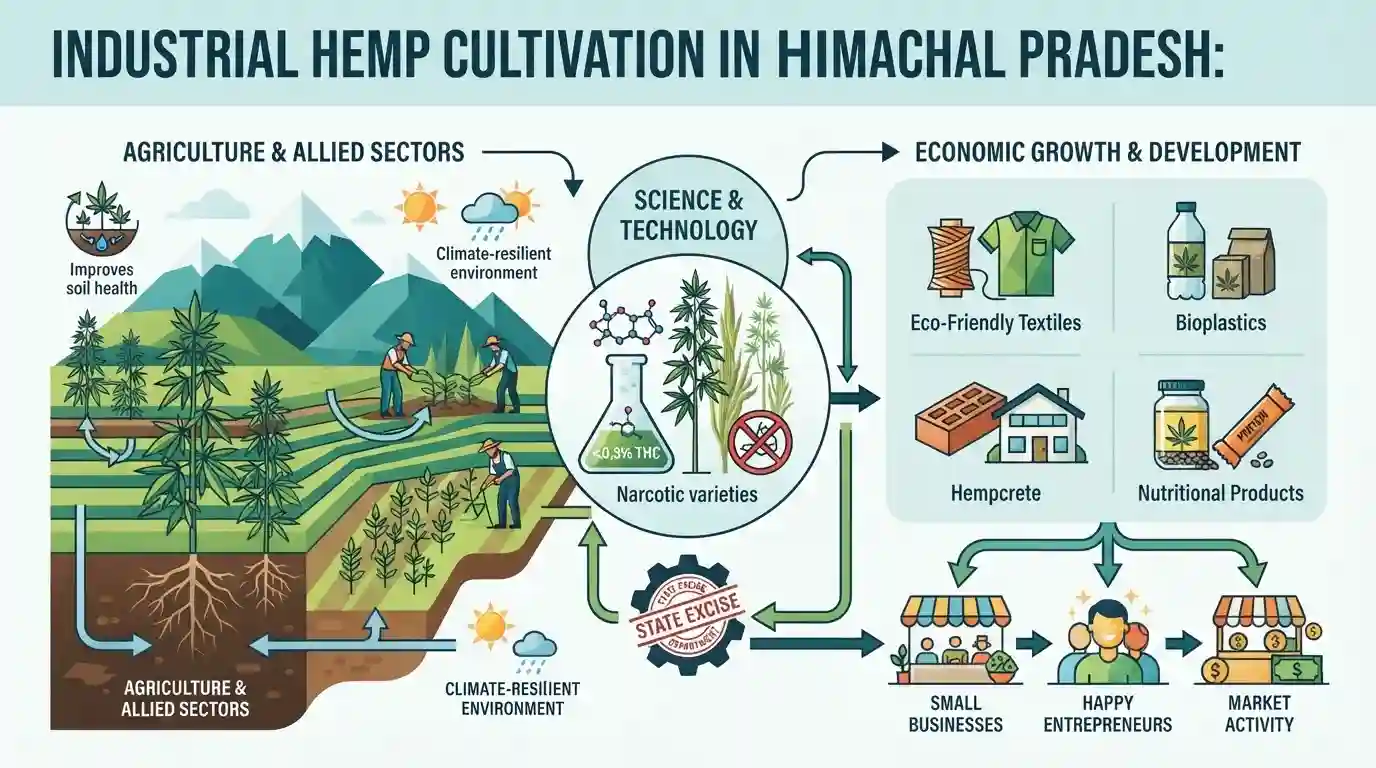
The Himachal Pradesh government has formally notified rules to regulate the cultivation and processing of industrial hemp, aiming to create a sustainable agricultural and manufacturing economy in the state. By capping the psychoactive compound THC at below 0.3%, the framework clearly distinguishes industrial hemp from narcotic marijuana. Under the oversight of the State Excise Department, the initiative opens up commercial opportunities in eco-friendly textiles, bioplastics, hempcrete, and nutritional products. The move acts as a key driver for agrarian diversification and rural entrepreneurship, capitalizing on hemp's climate-resilient and soil-improving properties.
Key Points
- Himachal Pradesh has notified the Industrial Hemp Rules, 2026, establishing a comprehensive licensing framework for cultivating, processing, researching, and transporting industrial hemp.
- The State Excise Department will serve as the nodal agency to oversee compliance and prevent the conflation of industrial hemp with illicit narcotics.
- Industrial hemp is distinguished from narcotic cannabis by having less than 0.3% THC (tetrahydrocannabinol), eliminating psychoactive effects.
- The policy is expected to drive economic diversification, generating rural employment through the production of textiles, biodegradable packaging, CBD oils, and 'hempcrete'.
- Hemp cultivation promotes climate-resilient agriculture, as it requires minimal water, reduces pesticide use, and helps in soil phytoremediation.
Important Terms
Himachal Pradesh Narcotic Drugs and Psychotropic Substances (Amendment) Rules, 2026

State-notified rules establishing a comprehensive legal framework for the controlled cultivation, storage, processing, and transportation of cannabis exclusively for medicinal, scientific, and industrial purposes under strict regulatory oversight.
UPSC context
GS Paper II (Government Policies) and GS Paper III (Agriculture); tests regulatory frameworks for narcotic crops and crop diversification.
Industrial Hemp
Non-psychoactive cannabis varieties containing less than 0.3% tetrahydrocannabinol (THC), legally cultivated for eco-friendly commercial applications like textiles, bioplastics, and building materials (hempcrete).
UPSC context
GS Paper III (Agriculture, Economy, & Environment); tests knowledge of sustainable crops, climate-resilient farming, and agrarian diversification.
Department of State Taxes and Excise
The state administration body in Himachal Pradesh responsible for issuing licenses, setting fee structures, and maintaining strict regulatory enforcement and oversight over the industrial hemp and medicinal cannabis supply chain.
UPSC context
GS Paper II (Administrative Structure) and GS Paper III (Resource Mobilization); tests executive regulation of controlled substances and revenue management.
Narcotic Drugs and Psychotropic Substances (NDPS) Act, 1985
India's central legislation that criminalizes recreational cannabis use but explicitly empowers state governments to permit and regulate the cultivation of cannabis for industrial, scientific, and horticultural purposes.
UPSC context
GS Paper II (Government Acts) and GS Paper III (Internal Security); tests legislative balance between narcotic control and industrial/medical utilization.
Atmanirbhar Bharat
A national flagship policy aimed at making India self-reliant by promoting local manufacturing, boosting rural entrepreneurship, fostering innovation, and reducing dependency on imports across diverse economic sectors.
UPSC context
GS Paper III (Indian Economy & Industrial Policy); tests strategies for economic self-reliance, indigenous production, and structural growth.
Prelims Trap
The NDPS Act completely bans cannabis cultivation and only the Central Government can grant exemptions.
Under Section 14 of the NDPS Act, State Governments are specifically empowered to permit and regulate cannabis cultivation for industrial (fiber and seed) or medicinal purposes.
Static Concepts Connected
How does the NDPS Act, 1985 regulate cannabis and what powers do states hold?
- Narrow definition: The Act strictly defines cannabis as charas (resin) and ganja (fruiting tops), specifically excluding detached leaves and seeds.
- State licensing: Section 14 legally empowers state governments to frame rules permitting cannabis cultivation for industrial (fiber/seed) or horticultural purposes.
- Bhang legality: Because detached leaves are excluded from the central NDPS definition, the regulation and sale of bhang falls under state excise laws.
What distinguishes industrial hemp from narcotic cannabis, and what is its ecological utility?
- Chemical threshold: Industrial hemp contains less than 0.3% of the psychoactive compound THC (Tetrahydrocannabinol), distinguishing it from recreational marijuana.
- Phytoremediation: Hemp acts as a hyperaccumulator, effectively drawing heavy metals and toxins out of degraded soils, improving land health.
- Resource efficiency: It requires vastly less water and chemical pesticides compared to conventional fiber crops like cotton, aiding climate resilience.
Cross-Topic Patterns
Climate-Smart Agriculture & Bioplastics
Hemp's low water footprint and utility in biodegradable packaging connects directly to India's circular economy goals and urgent need for crop diversification away from water-guzzling cotton or paddy.
NDPS licensing vs FSSAI food standards
Cultivation is licensed by states under NDPS, but processing hemp seeds into commercial food falls under FSSAI, which strictly caps THC limits in food products, creating a dual-regulatory framework.

Expect a Prelims question blending the NDPS Act's definition of cannabis, State licensing powers, and the 0.3% THC scientific threshold.
Linked PYQs · 2
Linked PYQs · 2
- 2024HPAS_PRELIMSGS1
What percent agriculture and its allied industries account for the total Gross State Value Added (GSVA) of Himachal Pradesh ?
- 2024HPAS_PRELIMSGS1
For the year 2022-23, match the Industry sub-sector in Himachal Pradesh with the percentage of workers employed in them : | List I (Industry Sub-sector) | List II (Percentage of workers employed) | |---|---| | (a) Mining and Quarrying | (i) 2 | | (b) Manufacturing | (ii) 41 | | (c) Electricity and Other Utilities | (iii) 50 | | (d) Construction | (iv) 7 | Choose the correct option : Code: (a) (b) (c) (d)
