Himachal Plans Climate Resilient Roads to Mitigate Disasters
Source:thenewshimachal ↗
Why It Matters
Essential for understanding Himachal Pradesh's state policies on infrastructure planning, climate change adaptation, and disaster mitigation in fragile Himalayan terrains.
Summary
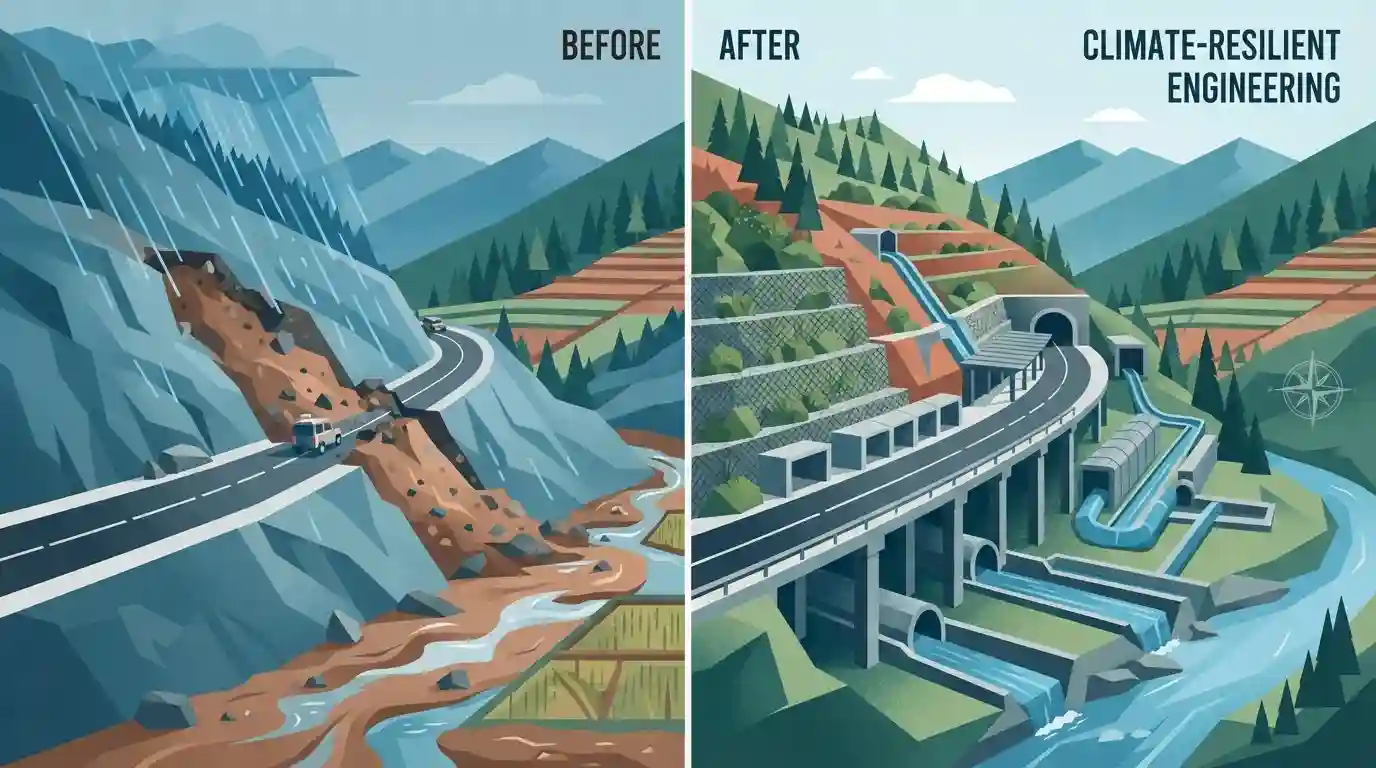
Himachal Pradesh is shifting its road infrastructure development strategy toward climate-resilient engineering to protect state highways and rural roads from heavy monsoon rains, landslides, and cloudbursts.
Key Points
- Himachal Pradesh is planning climate-resilient road infrastructure to withstand heavy rainfall, cloudbursts, and frequent natural disasters.
- The initiative focuses on upgrading construction standards, improving drainage systems, and incorporating modern slope stabilization techniques across vulnerable hill roads.
- Frequent disruptions to connectivity during monsoons have prompted the state government to shift towards long-term disaster-resilient engineering rather than temporary post-disaster repairs.
Important Terms
Road Drainage Policy

A strategic policy introduced by Himachal Pradesh to govern road drainage design using hydrological and climate data rather than standardized templates, mitigating severe monsoon damage and slope destabilization.
UPSC context
HPAS Paper III (Disaster Management & Infrastructure): Evaluates state-level policy interventions and institutional mechanisms for climate adaptation and disaster mitigation.
Himachal Pradesh State Roads Transformation Project
An $82 million World Bank-backed project signed in 2020 to strengthen Himachal's road safety institutions, build climate-resilient roads, and improve horticultural logistics and tourism corridors.
UPSC context
HPAS Paper II & III: Important for questions on international financial institutions, multilateral assistance, and infrastructural development in hill states.
Public Works Department Himachal Pradesh
The nodal state agency responsible for planning, designing, constructing, and maintaining public roads, bridges, and state highways across Himachal Pradesh.
UPSC context
HPAS Paper III (Infrastructure & Governance): Tests knowledge of state-level executing bodies managing public assets and disaster response.
Prelims Trap
Bitumen is the sole approved material for state highway paving in Himachal Pradesh.
Aspirants often assume bitumen roads are standard everywhere, missing that Himachal is actively experimenting with cement-concrete and plastic-mixed paving to combat heavy monsoon waterlogging.
Static Concepts Connected
What are the key bio-engineering techniques used for slope stabilization in hill states like Himachal Pradesh?
- Live Vegetation: Using deep-rooted live plants and shrubs to mechanically anchor loose soil and reduce runoff velocity.
- Geotextiles: Employing biodegradable materials like coir and jute geotextiles to protect slopes from rain splash erosion while vegetation establishes.
- Hybrid Structures: Constructing retaining structures combined with soil bioengineering to stabilize vulnerable landslide zones along state highways.
Cross-Topic Patterns
Disaster Mitigation & World Bank Funding in HP
Infrastructure initiatives like HP-READY and World Bank-backed road projects directly intersect with HPAS GS Paper III disaster management and public finance syllabus.

HPAS GS-3 disaster management questions may test specific engineering interventions like bio-engineering and geotextiles for hill roads.
Linked PYQs · 2
Linked PYQs · 2
- 2020HPAS_PRELIMSGS1
Consider the given four statements and choose the correct answer from the given options. Select the true statements from the following: 1. Chamba, Kullu and Kinnaur are considered the most susceptible of landslide threat. 2. Una, Bilaspur, Sirmaur, Shimla and Solan are considered as low vulnerable of disaster threats. 3. Hum valley of Una district has hardly any natural drinking water source. 4. As per the study of central water board, Kala Amb valley in Sirmaur district has exploited the least underground water.
- 2024HPAS_PRELIMSGS1
Arrange the following climatic zones of Himachal Pradesh according to rainfall amount from lowest to highest : (1) Frigid aridic zone (2) Wet temperate zone (3) Humid sub-tropical zone (4) Sub-humid sub-tropical zone Choose the correct answer from the options given below :
