Pangi valley declared Himachal first natural farming sub division
Source:ommcomnews ↗
Why It Matters
The article showcases sustainable agricultural models, demographic statistics, and targeted welfare initiatives for tribal areas in Himachal Pradesh, which are highly relevant for the HPAS Prelims geography, economy, and social welfare segments.
Summary
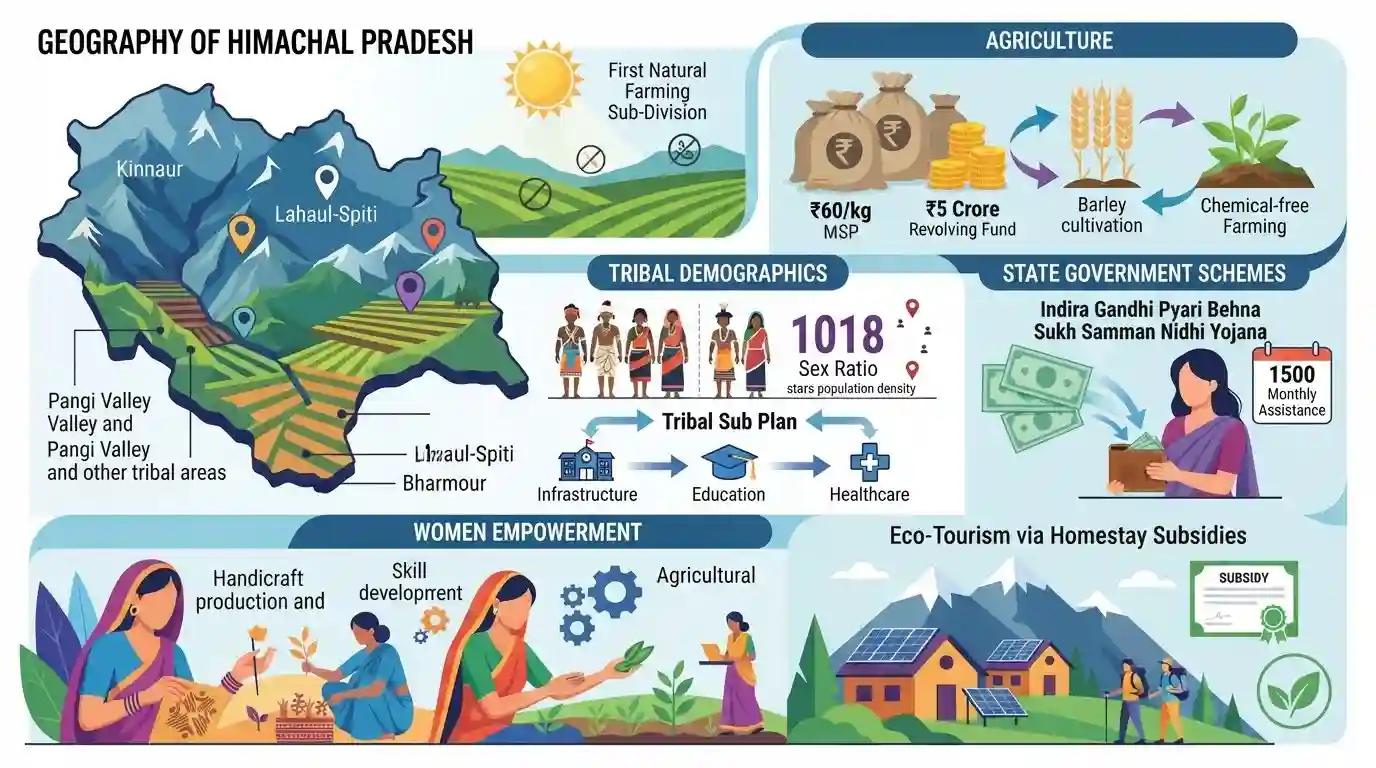
The Pangi Valley in Himachal Pradesh has been declared the state's first natural farming sub-division, marking a significant step towards chemical-free, climate-resilient agriculture in tribal regions. The initiative is backed by an assured Minimum Support Price (MSP) of Rs 60 per kg for naturally grown barley and a Rs 5 crore revolving fund. This development highlights the state government's broader focus on empowering the tribal belts (including Kinnaur, Lahaul-Spiti, and Bharmour) which boast a favorable sex ratio of 1018 despite their sparse population density. Alongside agriculture, the government is driving socio-economic upliftment through the Tribal Sub Plan, Rs 1500 monthly assistance to women under the Indira Gandhi Pyari Behna Sukh Samman Nidhi Yojana, and promoting eco-tourism via homestay subsidies.
Key Points
- Pangi Valley in Chamba district has been declared Himachal Pradesh's first natural farming sub-division, promoting chemical-free agriculture.
- The state government instituted an MSP of Rs 60 per kg for naturally grown barley and a Rs 5 crore revolving fund to boost sustainable agriculture.
- Tribal areas account for 42.49% of the state's land area but hold only 5.71% of the population, boasting a high sex ratio of 1018 compared to the state average of 972.
- Socio-economic empowerment is driven by schemes like the Indira Gandhi Pyari Behna Sukh Samman Nidhi Yojana (Rs 1500 monthly) and the creation of over 3,200 Lakhpati Didis in tribal belts.
- The government is fostering eco-tourism and entrepreneurship in these remote regions through a 5% interest subvention on homestay investments.
Important Terms
Pangi Valley

A high-altitude, remote tribal subdivision in Chamba district of Himachal Pradesh, declared as the state's first natural farming subdivision under the Participatory Guarantee Scheme (PGS).
UPSC context
GS Paper I (Geography of India) and GS Paper III (Agriculture and sustainable farming in mountainous/tribal regions).
Indira Gandhi Pyari Behna Sukh Samman Nidhi Yojana
A Himachal Pradesh state welfare scheme providing Rs 1,500 monthly financial assistance to eligible women aged 18 to 59 years from families earning less than Rs 2 lakh annually.
UPSC context
GS Paper II (Welfare schemes for vulnerable sections of the population and women empowerment initiatives).
Prakritik Kheti Khushhal Kisan Yojana (PK3Y)
A flagship scheme launched by the Government of Himachal Pradesh in 2018-19 to promote climate-resilient, chemical-free natural farming (Zero Budget Natural Farming) and improve soil health.
UPSC context
GS Paper III (Sustainable Agriculture, technology missions, and environmental conservation).
Tribal Sub-Plan (TSP)
A multi-sectoral planning and budgeting strategy introduced during the Fifth Five-Year Plan (1974-75) to ensure proportionate developmental resources and welfare benefits flow directly to Scheduled Tribes.
UPSC context
GS Paper II (Welfare schemes for STs, administrative mechanisms, and constitutional safeguards under Article 46).
Lakhpati Didi Initiative
A national flagship campaign under the Deendayal Antyodaya Yojana-National Rural Livelihoods Mission (DAY-NRLM) aimed at enabling rural Self-Help Group (SHG) women to earn a sustainable annual income of at least ₹1 lakh.
UPSC context
GS Paper II (Welfare Schemes) and GS Paper III (Inclusive growth, rural livelihoods, and women entrepreneurship).
Prelims Trap
The Central Government has declared a dedicated MSP for naturally grown barley.
This is a State-level initiative by Himachal Pradesh. The central CACP recommends MSP for standard barley, not distinctively for 'naturally grown' variants.
Static Concepts Connected
What are the core differences between Natural and Organic farming?
- External inputs: Organic farming permits off-farm bio-fertilizers and organic manure. Natural farming uses strictly zero external inputs, relying on local microbial formulations like Jivamrita.
- Tillage and weeding: Organic farming involves standard plowing and weeding. Natural farming often advocates no-till practices and views multi-cropping and weeds as part of the ecosystem.
- Cost profile: Natural farming aims to be virtually zero-budget (ZBNF), whereas organic farming can require expensive bulk organic amendments.
What is the geographical course of the Chandrabhaga (Chenab) river?
- Origin: Formed by the confluence of the Chandra and Bhaga rivers at Tandi in the Lahaul-Spiti district of Himachal Pradesh.
- Pangi Valley route: It flows north-westward through the remote Pangi valley in Chamba district before exiting Himachal and entering the Kishtwar region of J&K.
- Indus System: It is the largest tributary of the Indus river by volume of water.
Cross-Topic Patterns
Tribal regions + Zero-Budget Farming
Tribal belts largely missed the Green Revolution's chemical fertilizers. This makes their transition to official 'natural farming' hubs much faster, as their baseline traditional practices are already chemical-free.
Lakhpati Didi + Rural Eco-tourism
The DAY-NRLM targets are evolving. Combining homestay subsidies with SHG structures shifts women’s empowerment from primary agriculture into service-sector rural entrepreneurship.

Expect 2026 Prelims to link natural farming initiatives with tribal geography (Chenab basin) and SHG schemes like Lakhpati Didi.
Linked PYQs · 5
Linked PYQs · 5
- 2023HPAS_PRELIMSGS1
Match List I with List II : | List-I (District) | List-II (Wildlife Sanctuary) | |---|---| | (a) Kinnaur | (i) Rupi Bhaba | | (b) Chamba | (ii) Sechu Tuan Nala | | (c) Mandi | (iii) Kibber | | (d) Lahaul and Spiti | (iv) Nargu | Choose the correct answer from the options given below : Code: (a) (b) (c) (d)
- 2025HPAS_PRELIMSGS1
Given below are two statements : Statement I : The Gujjars of Himachal Pradesh are both Hindus and Muslims. Statement II : Lahaulis and Spitianis have Mongoloid features. In the light of the above statements, choose the most appropriate answer from the options given below :
- 2014HPAS_PRELIMSGS1
Which one of the following agricultural practices is eco-friendly ?
- 2020HPAS_PRELIMSGS1
'National Mission for Sustainable Agriculture' has been launched to:
- 2020HPAS_PRELIMSGS1
Consider the given four statements and choose the correct answer from the given options. Which of the following statement(s) is / are not correct about the Social Welfare programs of Government of Himachal Pradesh? 1. e-Udyan portal: Where farmers can avail Horticulture farming service benefits while sitting in their home. 2. Vishesh Mahila Uthan Yojna: Scheme formulated for rehabilitation of physically and sexually abused women through technical and vocational training. 3. Medha Protsahan Yojna: Rupees one lakh is provided to the meritorious students to provide guidance at coaching centers. 4. Mukhya Mantri Ek Bigha Scheme: State Government will empower rural women by helping them become self-sufficient and get employment under MGNREGS.
