Himachal Pradesh BPL Identification and Rural Development Focus
Source:Indian Express ↗
Why It Matters
Provides a practical case study for GS2 (Social Justice and Governance) on how state governments define and update poverty criteria to better target welfare schemes. It also touches upon GS3 (Economy) by demonstrating how states find innovative revenue streams (like a cess on hydropower) when central revenue deficit grants are reduced or discontinued.
Summary
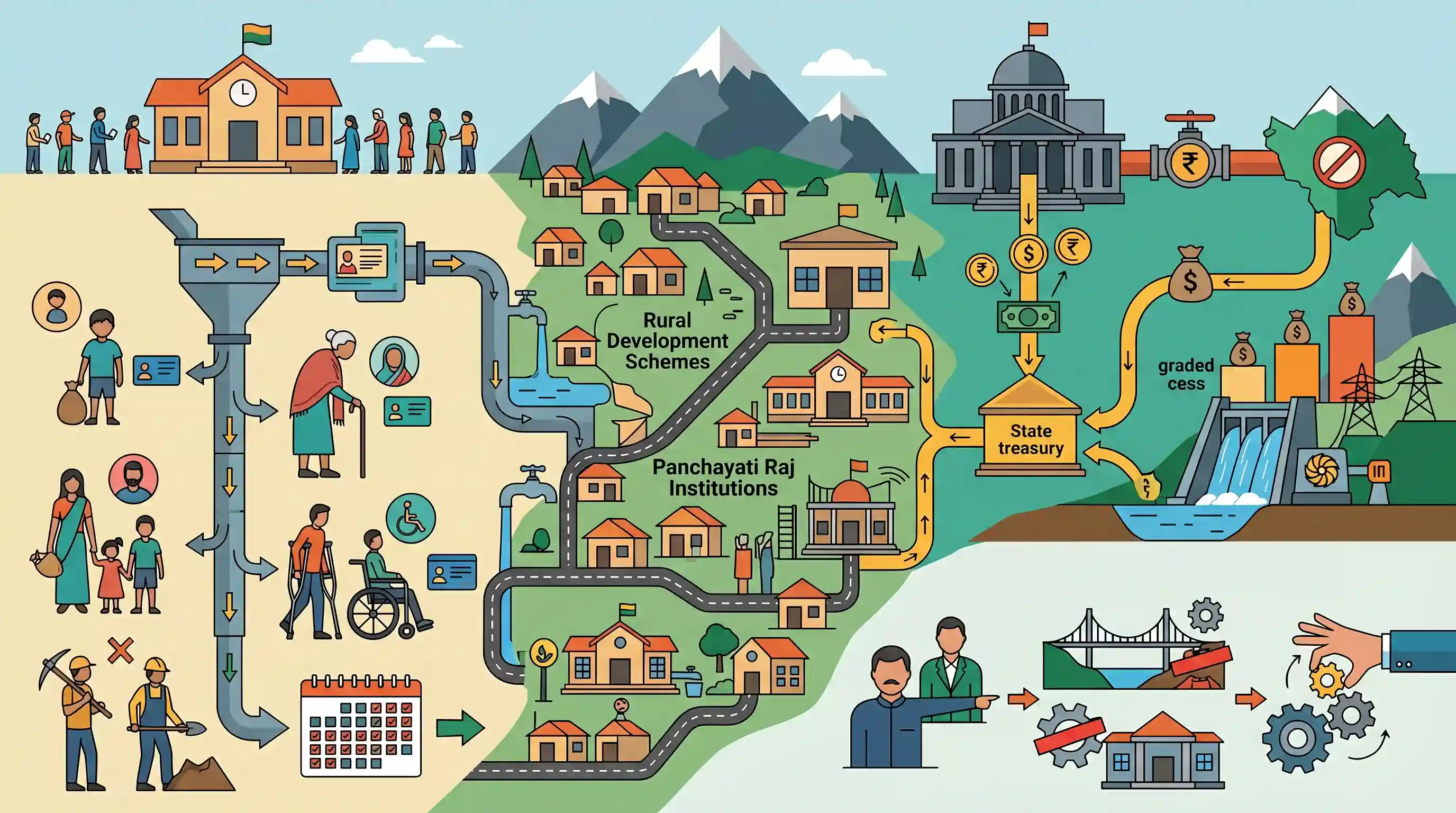
Ahead of panchayat polls, the Himachal Pradesh government has intensified its focus on rural development by initiating a new phase of Below Poverty Line (BPL) identification. The updated criteria aim for better targeting by including vulnerable groups such as orphans, female-headed households, the elderly, the disabled, and those completing 100 days of MGNREGA work. Concurrently, the state is addressing fiscal challenges—stemming from the Centre's discontinuation of revenue deficit grants—by imposing a graded land revenue cess on hydropower projects. The government is also addressing administrative bottlenecks causing delays in local development schemes like MPLADs and Vidhayak Kshetra Vikas Nidhi Yojana.
Key Points
- The Himachal Pradesh government, led by CM Sukhvinder Singh Sukhu, is increasing its focus on rural areas ahead of the upcoming panchayat elections.
- The state has initiated the fourth phase of the Below Poverty Line (BPL) identification survey, introducing new inclusion criteria to target vulnerable groups.
- New BPL criteria include orphans up to 27 years old, households with elderly members (>59), families with disabled members, female-headed households without adult males, and families completing 100 days of MGNREGA work.
- To address revenue shortfalls after the Centre discontinued the revenue deficit grant, Himachal Pradesh imposed a graded annual land revenue cess of up to 2% on hydropower projects to raise approximately ₹1,800 crore.
- The CM raised concerns over significant delays in the execution of local development funds, including MPLAD, Vidhayak Kshetra Vikas Nidhi Yojana, and Mukhya Mantri Gram Path Yojana.
Important Terms
Post Devolution Revenue Deficit Grant (PDRDG)

Grants recommended by the Finance Commission under Article 275 to bridge the revenue gap of specific states after the devolution of central taxes.
UPSC context
GS Paper II/III: Fiscal Federalism. Tests understanding of Centre-State financial relations and the Finance Commission's role in addressing vertical fiscal imbalances.
MPLADS (Member of Parliament Local Area Development Scheme)
A Central Sector Scheme enabling MPs to recommend durable community asset projects (like schools or roads) worth ₹5 crore annually in their constituencies.
UPSC context
GS Paper II: Governance/Parliament. Tests knowledge of legislative oversight, separation of powers, and mechanisms for local-level developmental planning.
MGNREGA (Mahatma Gandhi National Rural Employment Guarantee Act)
A rights-based social security scheme providing a legal guarantee of 100 days of unskilled manual work annually to every rural household.
UPSC context
GS Paper II/III: Social Justice/Economy. Tests understanding of poverty alleviation, rural employment, and the efficacy of rights-based welfare legislation.
Below Poverty Line (BPL) Identification
An economic benchmark used by the government to identify households requiring priority welfare assistance based on income and vulnerability criteria.
UPSC context
GS Paper II: Welfare Schemes. Tests knowledge of poverty estimation, targeting mechanisms, and social safety nets for vulnerable populations.
Vidhayak Kshetra Vikas Nidhi Yojana
A state-funded scheme (MLALADS) allowing Members of the Legislative Assembly to recommend local development works within their respective assembly constituencies.
UPSC context
GS Paper II: State Governance. Tests understanding of the role of state legislators in local development and decentralised funding.
Panchayati Raj Institutions (PRIs)
Constitutional bodies established under the 73rd Amendment Act to facilitate rural self-governance and ensure bottom-up developmental planning.
UPSC context
GS Paper II: Local Governance. Tests knowledge of the 73rd Amendment, democratic decentralisation, and the functioning of local rural bodies.
Prelims Trap
"BPL identification across India is conducted by NITI Aayog using uniform national criteria."
NITI Aayog estimates national and state poverty lines. However, the actual identification of specific BPL households for welfare targeting is executed by State governments through local bodies.
Static Concepts Connected
What is the constitutional dispute over states taxing hydropower?
- State's Argument: States invoke Entry 45 (land revenue) and Entry 49 (taxes on lands and buildings) of the State List to impose a cess on hydropower projects.
- Union's Objection: The Centre contends that taxing electricity generation violates Article 288, which exempts water and electricity from state taxation in specific inter-state or central operations.
What are the core features of the MPLAD Scheme?
- Central Sector Scheme: A Central Sector Scheme fully funded by the GoI, providing each MP an annual, non-lapsable entitlement of ₹5 crore.
- District Implementation: MPs only recommend projects; District Authorities are solely responsible for examining project eligibility, sanctioning funds, and executing the physical works.
- Demographic Quotas: MPs are mandated to recommend at least 15% of outlays for SC-inhabited areas and 7.5% for ST-inhabited areas to ensure inclusive development.
Cross-Topic Patterns
State Cess on Hydropower vs Union
States like HP levying land/water cess on hydropower projects conflicts with the Centre's stance that taxing water for electricity generation violates Article 288 and the Union List.
MGNREGA as a Welfare Targeting Tool
Using the completion of 100 days of MGNREGA work as a criterion for BPL inclusion creates a data-driven linkage between rural employment guarantees and targeted welfare distribution.

Centre-State friction over states levying land/water cess on hydropower generation is a high-probability GS2 Mains question for 2026.
Linked PYQs · 5
Linked PYQs · 5
- 2020PrelimsGS1
With reference to the funds under Members of Parliament Local Area Development Scheme (MPLADS), which of the following statements are correct? 1. MPLADS funds must be used to create durable assets like physical infrastructure for health, education, etc. 2. A specified portion of each MP's fund must benefit SC/ST populations. 3. MPLADS funds are sanctioned on yearly basis and the unused funds cannot be carried forward to the next year. 4. The district authority must inspect at least 10% of all works under implementation every year. Select the correct answer using the code given below:
- 2018PrelimsGS1
With reference to the provisions made under the National Food Security Act, 2013, consider the following statements : 1. The families coming under the category of 'below poverty line (BPL)' only are eligible to receive subsidised food grains. 2. The eldest woman in a household, of age 18 years or above, shall be the head of the household for the purpose of issuance of a ration card. 3. Pregnant women and lactating mothers are entitled to a 'take-home ration' of 1600 calories per day during pregnancy and for six months thereafter. Which of the statements given above is/are correct?
- 2011PrelimsGS1
Among the following who are eligible to benefit from the “Mahatma Gandhi National Rural Employment Guarantee Act”?
- 2020MainsGS2
The incedence and intensity of poverty are more important in determining poverty based on income alone". In this context analyse the latest United Nations Multidimensional Poverty Index Report.
- 2015MainsGS2
Though there have been several different estimates of poverty in India, all indicate reduction in poverty levels over time. Do you agree? Critically examine with reference to urban and rural poverty indicators.
