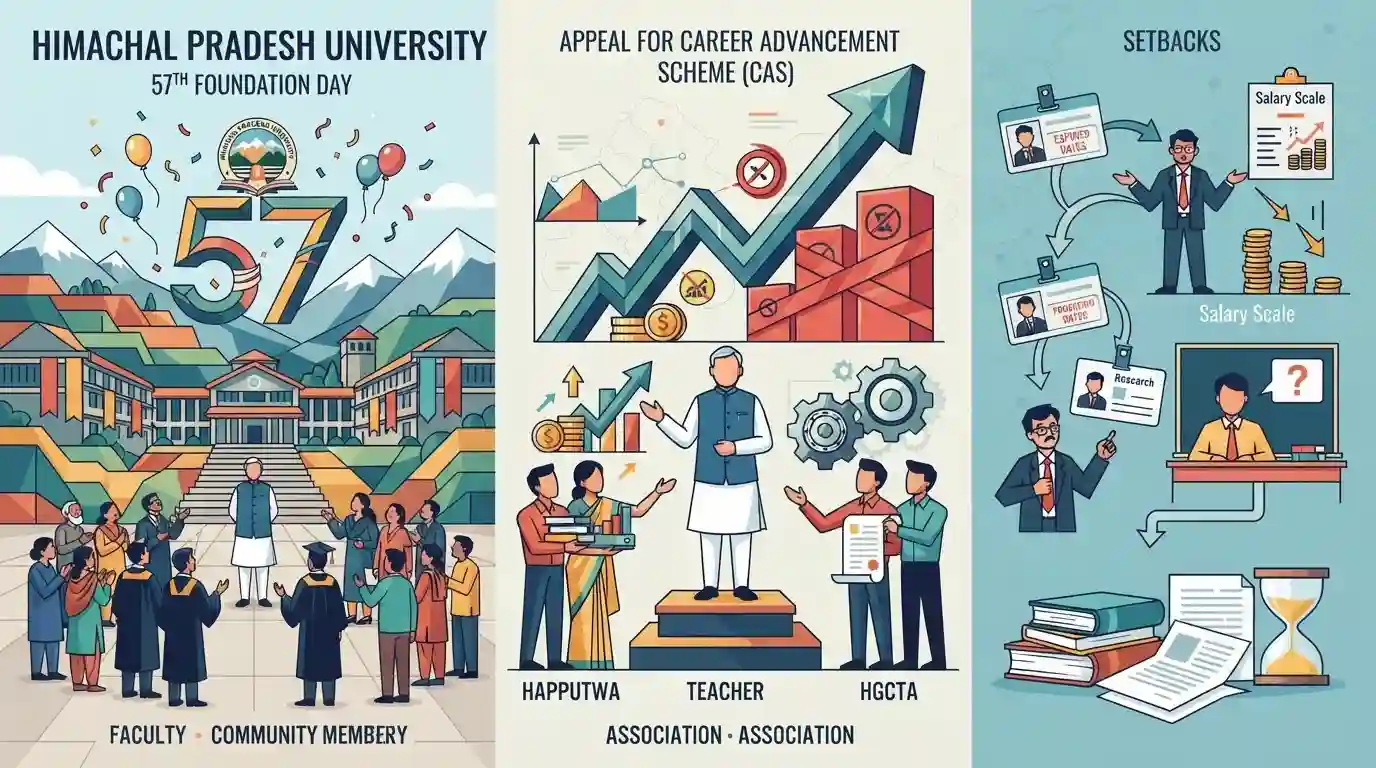
HPU Foundation Day faculty protest urges CAS promotion restoration
Source:lokmattimes ↗
Why It Matters
The article sheds light on the administrative challenges in state-funded higher education institutions. The implementation of UGC regulations like the Career Advancement Scheme (CAS) directly affects faculty quality and motivation, which are critical to improving Gross Enrolment Ratios (GER) and educational outcomes under national frameworks like RUSA and NEP.
Summary
On the occasion of Himachal Pradesh University's 57th Foundation Day, state teachers' associations, including HAPPUTWA and HGCTA, appealed to Chief Minister Sukhvinder Singh Sukhu to reinstate the Career Advancement Scheme (CAS). The delay in processing CAS promotions under UGC guidelines has reportedly led to severe academic and financial setbacks for university and college faculty members across the state.
Key Points
- Himachal Pradesh University (HPU) celebrated its 57th Foundation Day amidst faculty protests regarding stalled career progressions.
- Two prominent teachers' bodies, HAPPUTWA and HGCTA, jointly urged Chief Minister Sukhvinder Singh Sukhu to immediately restore the Career Advancement Scheme (CAS).
- The associations highlighted that the suspension of CAS promotions is causing significant financial and academic detriment to faculty in state universities and government colleges.
- The protest underscores broader challenges in implementing UGC regulatory guidelines at the state level, impacting the morale and quality of higher education.
Important Terms
Career Advancement Scheme (CAS)

A UGC-mandated framework providing performance-based career promotions to higher education faculty. It assesses qualitative contributions—like research, publications, and teaching innovations—allowing upward mobility to higher academic grades without changing the substantive sanctioned post.
UPSC context
Relates to GS Paper 2 (Education Policy). Essential for understanding faculty welfare, educational governance, and quality maintenance in higher education.
University Grants Commission (UGC)
A statutory body established under the UGC Act of 1956 by the Ministry of Education. It is responsible for coordinating, determining, and maintaining higher education standards, alongside disbursing financial grants to recognized universities.
UPSC context
Crucial for GS Paper 2 (Statutory Bodies, Education). Tests understanding of regulatory frameworks, institutional governance, and quality assurance in India.
Himachal Pradesh University (HPU)
A prominent state public university located in Shimla. It serves as a central institution for higher education in the state, frequently facing localized governance and administrative challenges related to grant-in-aid budgets and faculty promotions.
UPSC context
A practical case study for GS Paper 2 (Issues Relating to Education), illustrating administrative and financial hurdles in state-level university governance.
Himachal Pradesh University Teachers' Welfare Association (HAPPUTWA)
A representative body of university faculty in Himachal Pradesh. It functions as a pressure group advocating for academic reforms, timely salary disbursements, and the implementation of statutory promotion policies like CAS.
UPSC context
Links to GS Paper 2 (Role of Pressure Groups). Demonstrates how academic unions influence state education administration and policy implementation.
Himachal Government College Teachers' Association (HGCTA)
A state-level advocacy group representing government college teachers in Himachal Pradesh. It campaigns against administrative delays, pressing the government for timely departmental promotions, CAS advancements, and the release of pending financial dues.
UPSC context
Relevant to GS Paper 2 (Pressure Groups, Education). Serves as an example of collective bargaining and civil society intervention in public governance.
Prelims Trap
UGC regulations automatically mandate promotions and pay revisions across state universities without state approval.
Education is a Concurrent subject. While UGC sets standards, state governments must officially adopt and notify schemes like CAS for state universities, causing frequent implementation delays.
Static Concepts Connected
How is 'Education' distributed in the 7th Schedule?
- Concurrent List: Moved from the State List to the Concurrent List via the 42nd Constitutional Amendment Act (1976), allowing both Centre and States to legislate.
- Union List Entry 66: Coordination and determination of standards in institutions for higher education or research remains exclusively with the Centre.
What is the mandate of the University Grants Commission (UGC)?
- Statutory Body: Established under the UGC Act, 1956, responsible for coordinating, determining, and maintaining standards of higher education in India.
- Advisory Role: Advises the Central and State governments on measures necessary for the improvement of university education, including faculty promotion schemes.
Cross-Topic Patterns
NEP 2020 + Fiscal Federalism
The financial burden of implementing central regulatory guidelines (like UGC's CAS) often strains state exchequers, leading to stalled promotions and highlighting friction in concurrent subjects.
Faculty Quality + Institutional Rankings
Stalled career advancement schemes directly impact faculty motivation and retention, which in turn degrades a state university's NAAC grading and overall NIRF rankings.

Expect a GS2 Mains question on the friction between UGC mandates (Union List Entry 66) and state-level implementation capacity in education.
Linked PYQs · 2
Linked PYQs · 2
- 2017HPAS_PRELIMSGS1
To improve the Gross Enrolment Ratio (GER) in Higher Education the Government of H.P. has adopted 'Rashtriya Uchtar Shikha Abhiyan' the centrally sponsored scheme in the year :
- 2022HPAS_PRELIMSGS1
Match List I with List II : | List I | List II | |---|---| | (a) Gini coefficient | (i) a measure of the energy intensity of diet composition | | (b) PISA score | (ii) assesses how far students near the end of compulsory education have acquired some of the knowledge and skills that are essential for full participation in society | | (c) Human Trophic Level | (iii) measures the extent to which the distribution of income among individuals or households within an economy deviates from a perfectly equal distribution | | (d) Palma ratio | (iv) The share of all income received by the 10% people with highest disposable income divided by the share of all income received by the 40% people with the lowest disposable income | Choose the correct answer from the options given below : Code: (a) (b) (c) (d)
