Himachal Introduces Scientific Guidelines for Rural Link Roads
Source:thenewshimachal ↗
Why It Matters
This development is highly relevant for HPAS Prelims and Mains, as it addresses a core issue in the state: maintaining safe and durable infrastructure in a fragile, landslide-prone hilly terrain. It represents a significant policy shift from ad-hoc rural road construction to standardized, scientific planning.
Summary
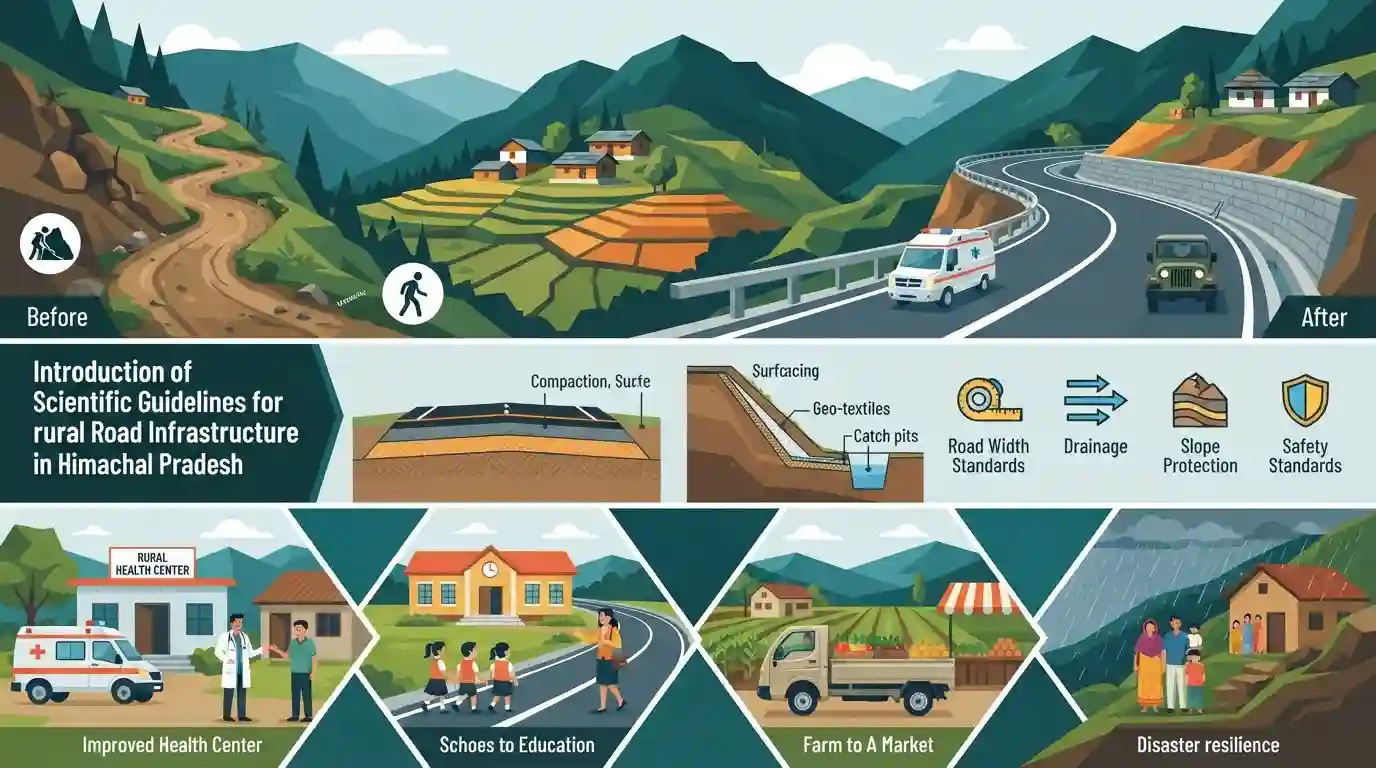
The Himachal Pradesh government has introduced India's first scientific guidelines for the design, construction, and certification of jeepable and ambulance link roads in rural areas. The comprehensive framework sets specific standards for road width, drainage, slope protection, and safety to ensure durable infrastructure in hilly terrains. By mandating the inspection and upgrading of existing roads by the Public Works Department, the initiative aims to improve remote rural connectivity, ensuring better access to healthcare, education, and emergency services while mitigating landslide and structural risks.
Key Points
- The Himachal Pradesh government has notified comprehensive scientific guidelines for the construction and maintenance of jeepable and ambulance link roads in rural areas.
- The initiative is the first of its kind in India to provide a uniform framework for planning, certification, and maintenance of rural roads in hilly terrains.
- The guidelines prescribe specific standards for road width, pavement design, drainage systems, retaining walls, slope protection, and road safety.
- Existing uncertified link roads will undergo inspection, upgrades, and formal certification by the Public Works Department to ensure they meet the new safety standards.
- The primary objective is to enhance access to healthcare, education, and emergency services in remote and rugged areas, promoting inclusive development.
Important Terms
Jeepable and Ambulance Link Roads

Rural mountain roads engineered for light vehicles and emergency transport, now standardized in Himachal Pradesh to ensure structural safety, proper drainage, and slope protection.
UPSC context
Relevant to GS-3 (Infrastructure), illustrating decentralized rural connectivity and disaster-resilient planning in geographically challenging terrains.
Public Works Department (PWD)
The primary state government agency responsible for executing and maintaining public infrastructure projects, such as roads and bridges, and ensuring compliance with engineering standards.
UPSC context
Important for GS-2 (Governance), focusing on institutional capacity, service delivery, and accountability in executing public infrastructure schemes.
Disaster-Resilient Infrastructure
Structural assets designed to withstand natural hazards like landslides and floods, ensuring minimal economic loss and continuous functionality of critical services during crises.
UPSC context
A core GS-3 (Disaster Management) concept, testing knowledge of climate adaptation and sustainable development in vulnerable geographical regions.
Last-Mile Connectivity
The final leg of a transportation or service network that directly links remote or marginalized communities to essential hubs like hospitals, schools, and markets.
UPSC context
Crucial for GS-2 (Social Justice) and GS-3 (Inclusive Growth), highlighting infrastructure's role in public health access and rural economies.
Prelims Trap
Scientific guidelines for jeepable and ambulance link roads are mandated nationwide under PMGSY.
Himachal Pradesh is the first state to notify these specific scientific guidelines; it is a state-level initiative, not a nationwide mandate under PMGSY.
Static Concepts Connected
What are the core features of Pradhan Mantri Gram Sadak Yojana (PMGSY)?
- Centrally Sponsored: Launched in 2000 to provide single all-weather road connectivity to eligible unconnected habitations.
- Target Population: Habitations with a population of 500+ in plains, and 250+ in hill states (like HP), North-East, deserts, and tribal areas.
- Green Technology: PMGSY-III explicitly mandates using green technologies and non-conventional materials like waste plastic or cold mix.
What are the key engineering measures for slope stabilization in hilly terrains?
- Retaining Walls: Rigid structures built on the valley side to hold back soil and prevent downslope movement along cut slopes.
- Catch-water Drains: Surface and sub-surface drains divert runoff, preventing soil saturation that often triggers landslides and flash floods.
- Bio-engineering: Planting deep-rooted vegetation combined with structural methods to bind topsoil and reduce erosion naturally.
Cross-Topic Patterns
Disaster Risk Reduction + Infrastructure
HP's policy aligns with the Sendai Framework's mandate to invest in disaster resilience by integrating structural safety and landslide mitigation into everyday local infrastructure.
Geography-specific planning vs. PMGSY
State-specific standards for hill roads highlight the ecological limitations of applying uniform, national-level PMGSY engineering codes across fragile Himalayan terrains.

Expect a 2026 Mains GS3 question asking to evaluate the need for localized, disaster-resilient infrastructure codes in the Himalayas.
Linked PYQs · 2
Linked PYQs · 2
- 2020HPAS_PRELIMSGS1
Consider the given four statements and choose the correct answer from the given options. Select the true statements from the following: 1. Chamba, Kullu and Kinnaur are considered the most susceptible of landslide threat. 2. Una, Bilaspur, Sirmaur, Shimla and Solan are considered as low vulnerable of disaster threats. 3. Hum valley of Una district has hardly any natural drinking water source. 4. As per the study of central water board, Kala Amb valley in Sirmaur district has exploited the least underground water.
- 2022HPAS_PRELIMSGS1
Select the incorrect statements from the following : (i) H.P. has been assessed second top performer in terms of Human Resource Development and Public Infrastructure among Hill States during 2020-21. (ii) Bilaspur district has been ranked at number one on the basis of District Good Governance Index (DGGI)-2020. (iii) Shimla district ranked fifth in DGGI-2020. (iv) Hamirpur has improved its position to the fourth in terms of Transparency and Accountability Index.
