Himachal Pradesh advances green hydrogen and railway pilot plans
Source:hindustantimes ↗
Why It Matters
The article highlights Himachal Pradesh's strategic push towards renewable green hydrogen utilizing its hydro potential, alongside the critical imperative of climate-resilient disaster governance during extreme monsoon events.
Summary
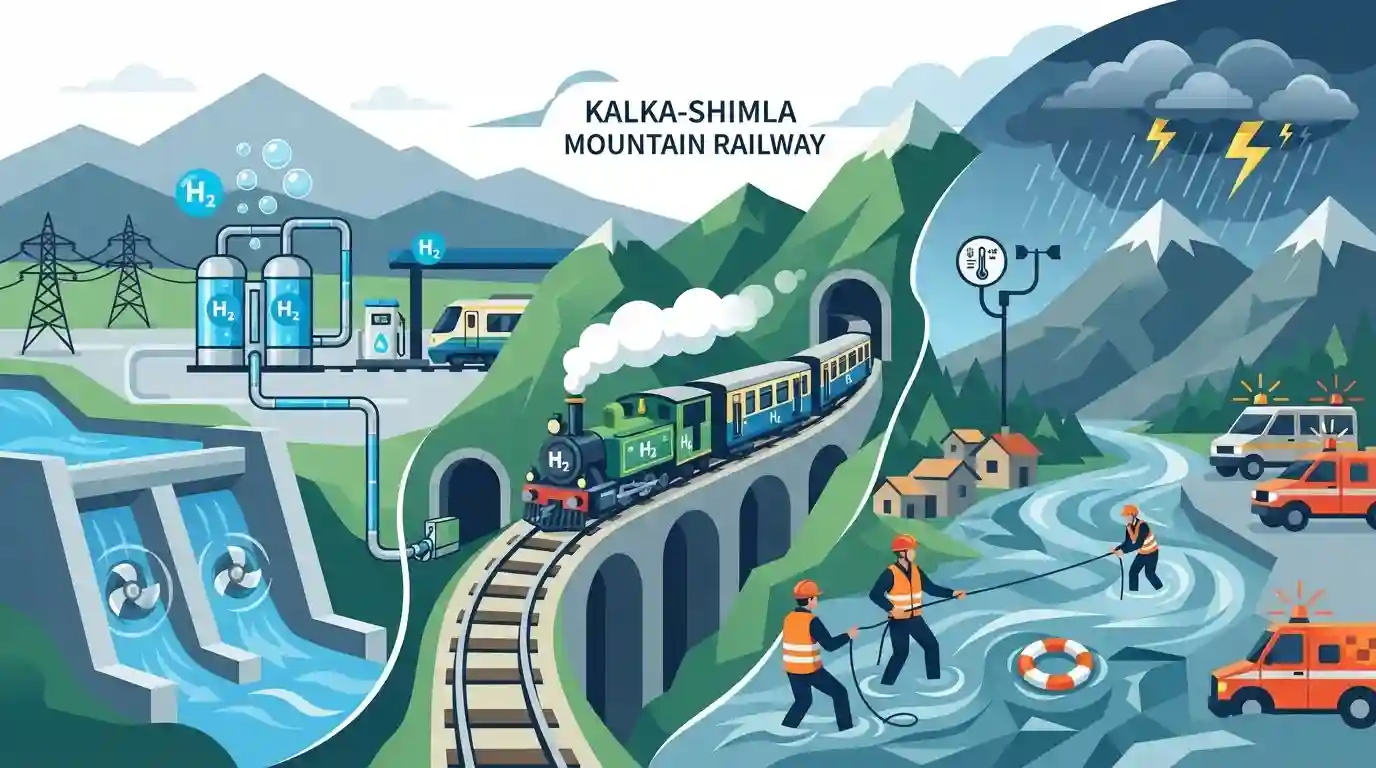
Himachal Pradesh is driving its transition to clean energy by advancing a green hydrogen program powered by its extensive hydropower resources, with plans to pilot hydrogen-powered trains on the Kalka-Shimla heritage line. Concurrently, the state government has placed its disaster management systems on high alert following IMD warnings of heavy rainfall and flash floods.
Key Points
- Himachal Pradesh is accelerating its green hydrogen program to leverage its abundant hydropower resources and position itself as a leader in clean energy.
- The state has submitted pilot proposals to run hydrogen-powered trains on the historic UNESCO World Heritage Kalka-Shimla railway line, following India's first hydrogen train trial in Haryana.
- Due to heavy monsoon rain forecasts by the IMD, the state government has placed its entire disaster management machinery and district administrations on high alert to handle potential flash floods and emergencies.
- The development reflects HP's dual focus on exploiting sustainable energy technologies while preparing for climate-induced seasonal weather disasters.
Important Terms
National Green Hydrogen Mission

An Indian government initiative to establish a global hub for green hydrogen production, use, and export. It targets producing at least 5 million metric tonnes annually by 2030 to decarbonize industries and reduce fossil fuel imports.
UPSC context
Crucial for GS-3 (Environment/Energy) and climate change discussions, focusing on India's Net Zero 2070 goals.
Hydrogen for Heritage
An Indian Railways scheme to deploy green hydrogen-powered trains on historic and ecologically sensitive narrow-gauge lines (like the Kalka-Shimla Railway). It aims to eliminate diesel pollution without installing visually disruptive overhead electric cables.
UPSC context
Relevant to GS-3 (Infrastructure/Environment) and GS-1 (Heritage), testing knowledge of sustainable transport and eco-conservation.
India Meteorological Department (IMD)
The principal government agency under the Ministry of Earth Sciences responsible for meteorological observations, weather forecasting, and seismology. It provides early warnings for weather events like cyclones, floods, and heatwaves.
UPSC context
Essential for GS-1 (Geography) and GS-3 (Disaster Management), frequently tested regarding monsoon prediction and climate alerts.
State Disaster Management Authority (SDMA)
A statutory body established under the Disaster Management Act, 2005. Chaired by the Chief Minister, it coordinates disaster preparedness, formulates state-level policies, and oversees response and recovery efforts during emergencies.
UPSC context
Key for GS-3 (Disaster Management) and GS-2 (Governance), examining institutional frameworks for crisis response.
Prelims Trap
The UNESCO World Heritage serial property 'Mountain Railways of India' includes Darjeeling, Nilgiri, Kalka-Shimla, and Matheran Hill railways.
Only Darjeeling, Nilgiri, and Kalka-Shimla are inscribed under this serial World Heritage property. Matheran Hill Railway and Kangra Valley Railway are not part of the UNESCO inscription.
Static Concepts Connected
How do Proton Exchange Membrane (PEM) Fuel Cells generate electricity?
- Electrochemical Reaction: Combines hydrogen and atmospheric oxygen electrochemically, bypassing mechanical combustion to generate direct current electricity.
- Proton Permeability: Employs a solid polymer membrane that allows only positively charged protons to pass, forcing electrons through an external circuit to generate power.
- Clean Byproducts: The process produces only electricity, water vapor, and waste heat, maintaining zero tailpipe carbon emissions.
Which routes constitute the UNESCO 'Mountain Railways of India'?
- Inscribed Triad: It is a serial World Heritage site consisting of Darjeeling Himalayan (1999), Nilgiri Mountain (2005), and Kalka-Shimla (2008).
- Gauge Variations: Features narrow gauges (2-ft/610mm for Darjeeling, 2-ft-6-in/762mm for Kalka-Shimla) and metre gauge (1000mm rack-and-pinion for Nilgiri).
Cross-Topic Patterns
Green Tech vs Himalayan Fragility
HP's dual focus highlights the paradox of building capital-intensive green hydrogen/hydropower infrastructure in ecologically fragile, disaster-prone seismic zones.
Heritage Integrity vs Decarbonisation
Running modern hydrogen-powered trains on historic narrow-gauge tracks demonstrates the tension between preserving physical heritage integrity and deploying clean-energy upgrades.

2026 Prelims may test PEM fuel cell chemistry (anode/cathode inputs) integrated with geographic profiles of UNESCO Mountain Railways.
Linked PYQs · 4
Linked PYQs · 4
- 2017HPAS_PRELIMSGS1
Renewable source of energy is :
- 2014HPAS_PRELIMSGS1
Which of the following is not a renewable source of energy ?
- 2024HPAS_PRELIMSGS1
Arrange the following climatic zones of Himachal Pradesh according to rainfall amount from lowest to highest : (1) Frigid aridic zone (2) Wet temperate zone (3) Humid sub-tropical zone (4) Sub-humid sub-tropical zone Choose the correct answer from the options given below :
- 2023HPAS_PRELIMSGS1
Consider the following statements : (1) The rainiest district in Himachal Pradesh is Kangra. (2) Rainfall in the Alpine region of Himachal Pradesh varies between 300-600 mm. (3) Winter season in Himachal Pradesh extends from October to March. (4) Mandi is the hottest place in Himachal Pradesh. Choose the correct answer from the options given below :
