Himachal Monsoon Toll Reaches 183 with Huge Infrastructure Losses
Source:economic-times ↗
Why It Matters
Provides data on the localized impacts of monsoons in Himachal Pradesh, which is highly relevant for state-specific questions on disaster management, geography, and climate vulnerabilities in the HPAS Prelims examination.
Summary
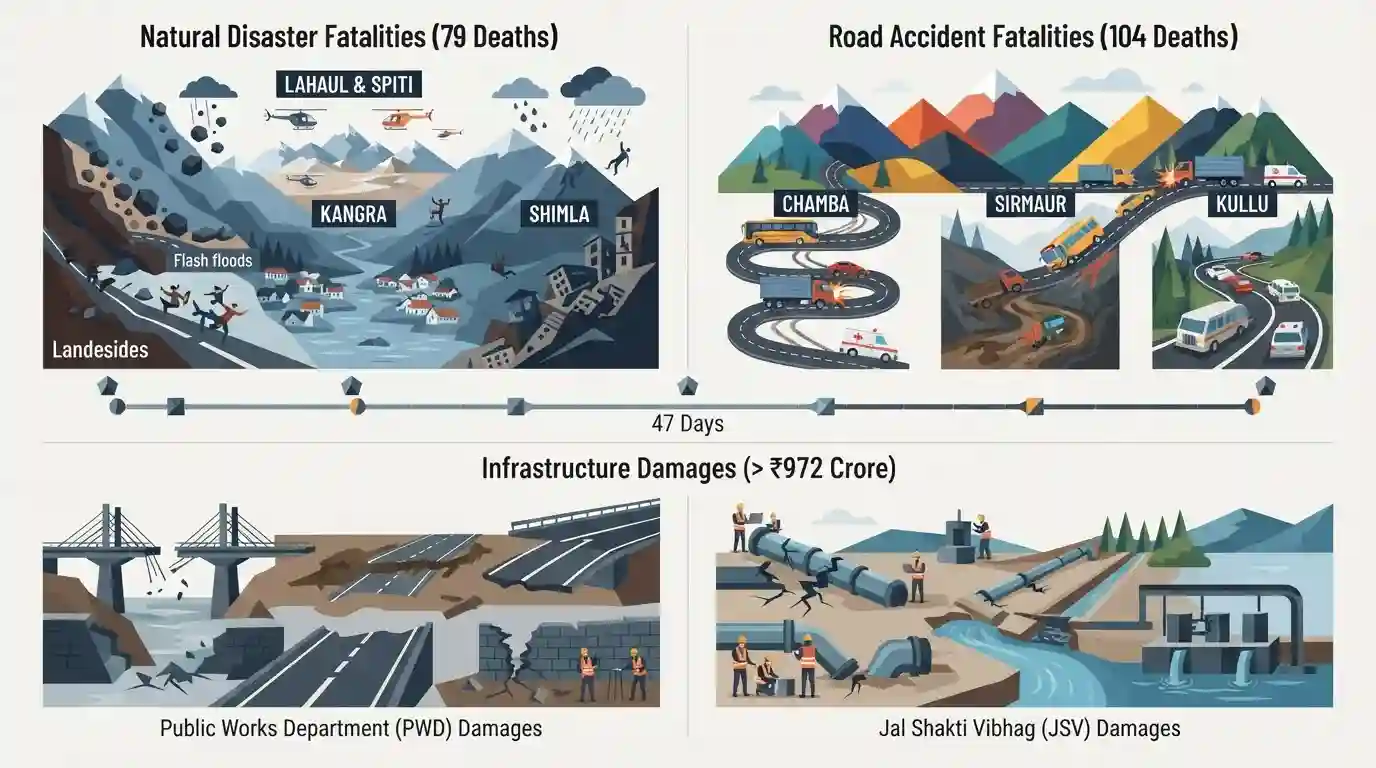
The monsoon season in Himachal Pradesh has resulted in 183 deaths and infrastructure losses exceeding Rs 972 crore within 47 days. Natural disasters like landslides, flash floods, and falls accounted for 79 fatalities, with the highest impact seen in Lahaul and Spiti, Kangra, and Shimla. Additionally, road accidents claimed 104 lives, heavily affecting districts like Chamba, Sirmaur, and Kullu. Massive infrastructural damages were incurred by the Public Works Department and the Jal Shakti Vibhag, highlighting the state's extreme vulnerability to monsoonal hazards.
Key Points
- 183 fatalities reported in Himachal Pradesh over 47 days during the monsoon season due to natural hazards and road accidents.
- Total infrastructure losses have crossed Rs 972 crore, with PWD reporting losses of Rs 733.9 crore and Jal Shakti Vibhag Rs 216.4 crore.
- Of the total deaths, 79 were caused by natural hazards like landslides, falls, and flash floods, while 104 were due to road accidents.
- Lahaul and Spiti, Kangra, and Shimla recorded the highest number of deaths due to natural disasters.
- Chamba, Sirmaur, and Kullu reported the most fatalities from road accidents.
Important Terms
Public Works Department (PWD)

The primary government agency in Himachal Pradesh responsible for the planning, construction, and maintenance of public infrastructure, including roads, bridges, and state buildings.
UPSC context
Vital for GS Paper III (Infrastructure and Disaster Management) to understand road vulnerability and post-disaster reconstruction challenges in hilly terrains.
Jal Shakti Vibhag
The state department in Himachal Pradesh tasked with managing water resources, encompassing drinking water supply, sewerage, irrigation, and flood protection infrastructure.
UPSC context
Relevant to GS Paper III (Water Resources & Disaster Management), illustrating the severe impact of monsoon hazards on essential state water systems.
Lahaul and Spiti
A high-altitude district in Himachal Pradesh known for its fragile ecology, which has recently experienced high vulnerability and fatalities due to extreme monsoonal hazards.
UPSC context
Crucial for GS Paper I (Geography of HP) and GS III (Environment), highlighting shifting weather patterns and disaster vulnerability in trans-Himalayan regions.
Prelims Trap
"The majority of monsoon fatalities in Himachal Pradesh were caused directly by flash floods, cloudbursts, and landslides."
Data shows road accidents (104 deaths) caused more fatalities than direct natural hazards (79 deaths) during this monsoon, though weather heavily exacerbates these accidents.
Static Concepts Connected
What are the primary disaster vulnerability profiles of Himachal Pradesh districts?
- Seismic Zones: HP falls completely in Zone IV and V (high to very high risk), making districts like Kangra, Mandi, and Chamba highly vulnerable to earthquakes.
- Landslide Susceptibility: Steep, geologically young Himalayan slopes in Shimla, Kinnaur, and Chamba make them highly susceptible to heavy monsoon-triggered soil saturation and slope failures.
- GLOFs and Cloudbursts: Higher elevation districts like Lahaul-Spiti and Kinnaur face immense risks from Glacial Lake Outburst Floods (GLOFs) and sudden cloudbursts.
How do geographic rainfall zones in HP correlate with hazard types?
- Kangra (High Rainfall): As the state's rainiest district, it is structurally susceptible to intense riverine and flash floods during the southwest monsoon peaks.
- Lahaul-Spiti (Cold Desert): Traditionally a dry, frigid aridic zone, this trans-Himalayan region is increasingly devastated by flash floods due to shifting monsoon patterns and low vegetative cover.
Cross-Topic Patterns
Infrastructure expansion vs. Ecological Fragility
Massive PWD and Jal Shakti losses frequently link HPAS questions on unchecked infrastructure expansion (road widening, hydropower tunneling) to increased landslide and flood susceptibility.
Cold Desert Climate Anomalies
High natural disaster fatalities in Lahaul-Spiti, despite being a dry aridic zone, reflect broader themes of climate change shifting extreme precipitation events into trans-Himalayan regions.

Expect multi-statement questions contrasting Lahaul-Spiti's arid cold-desert classification with its rising vulnerability to flash floods.
Linked PYQs · 2
Linked PYQs · 2
- 2024HPAS_PRELIMSGS1
Arrange the following climatic zones of Himachal Pradesh according to rainfall amount from lowest to highest : (1) Frigid aridic zone (2) Wet temperate zone (3) Humid sub-tropical zone (4) Sub-humid sub-tropical zone Choose the correct answer from the options given below :
- 2023HPAS_PRELIMSGS1
Consider the following statements : (1) The rainiest district in Himachal Pradesh is Kangra. (2) Rainfall in the Alpine region of Himachal Pradesh varies between 300-600 mm. (3) Winter season in Himachal Pradesh extends from October to March. (4) Mandi is the hottest place in Himachal Pradesh. Choose the correct answer from the options given below :
