Himachal monsoon damage crosses Rs 1550 crore, threatens apple economy
Source:global-agriculture ↗
Why It Matters
Monsoon disasters and threats to the apple economy directly impact Himachal Pradesh's state domestic product, agricultural employment, and disaster management preparedness, making it a high-yield area for HPAS Prelims geography and economy questions.
Summary
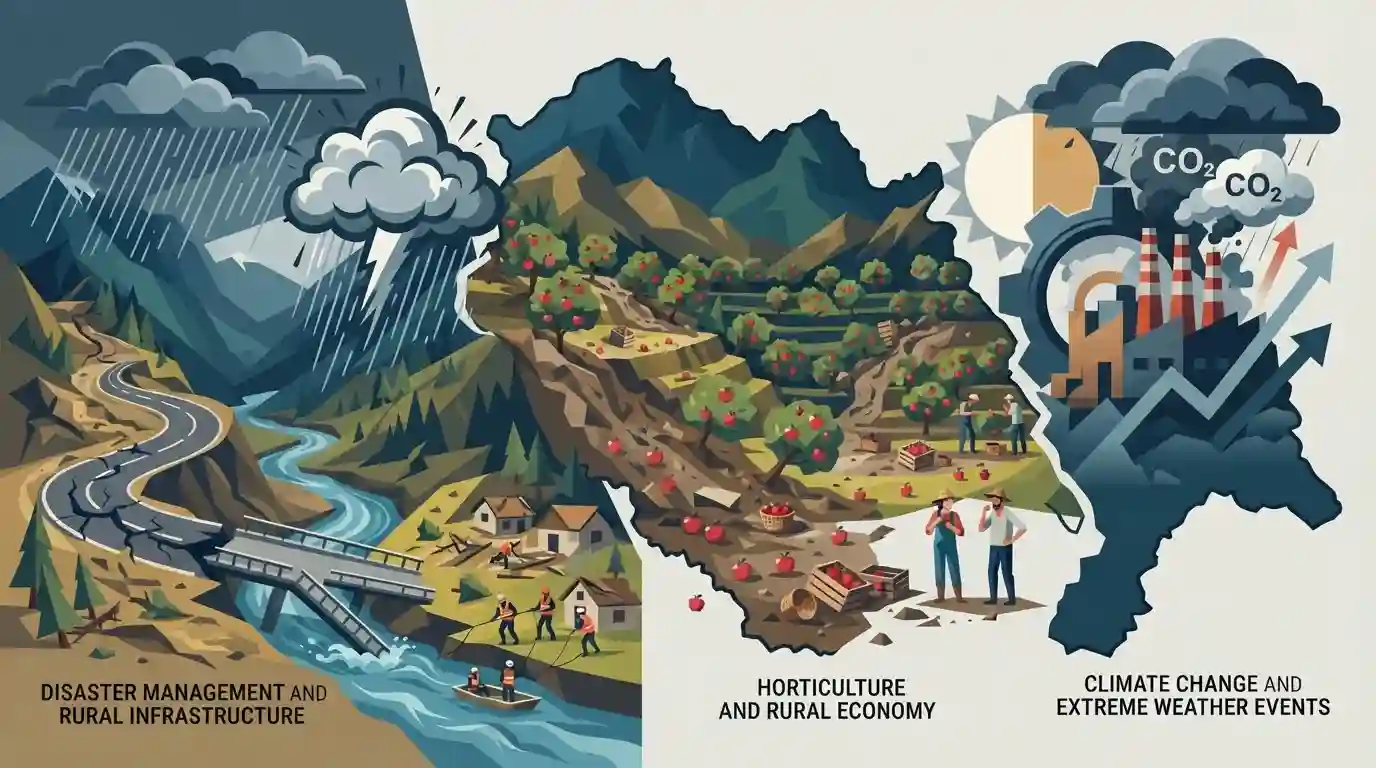
Heavy monsoon rains and cloudburst incidents across Himachal Pradesh have pushed cumulative damage past Rs 1,550 crore, severely disrupting rural infrastructure and threatening the state's crucial apple harvest.
Key Points
- Monsoon rains and cloudbursts in Himachal Pradesh have caused extensive infrastructural and agricultural damage exceeding Rs 1,550 crore.
- The ongoing heavy rainfall threatens the state's signature apple harvest, impacting fruit quality, transit logistics, and market access.
- Horticulture forms a vital pillar of Himachal Pradesh’s rural economy, making crop damage a critical socio-economic challenge for the state.
Important Terms
State Government of Himachal Pradesh

The apex political and executive authority of Himachal Pradesh, responsible for formulating policies, executing disaster response, and managing public finances, infrastructure repairs, and relief distribution during extreme weather events.
UPSC context
Important for HPAS GS Paper II (State Administration, Polity, and Governance) and GS Paper III (Disaster Management and Rural Economy).
Static Concepts Connected
What are the major structural vulnerabilities and economic dimensions of Himachal Pradesh's apple industry?
- Economic Weight: Apples constitute roughly 85% of Himachal's fruit production, powering a Rs 4,000–5,500 crore rural economy.
- Logistical Fragility: Heavy reliance on road transit makes the apple economy extremely vulnerable to monsoon washouts and landslides.
- Market Dependency: Market access depends heavily on functional APMC yards, cold chain infrastructure, and timely scab/pest management.
What institutional frameworks govern cloudburst forecasting and disaster management in Himachal Pradesh?
- Early Warning: Doppler weather radars and automated rain gauge networks managed by IMD provide localized nowcasting for extreme rainfall.
- Statutory Authority: State Disaster Management Authority (SDMA) operates under the Disaster Management Act, 2005, coordinating post-cloudburst rescue and relief.
- Topographical Challenge: Himalayan topography creates localized micro-climates, making cloudburst prediction exceptionally difficult compared to plains.
Cross-Topic Patterns
Horticulture Shock + Rural Credit Risk
Apple economy disruption in Himachal Pradesh links climate resilience with rural credit defaults, cooperative market structures, and National Horticulture Board interventions.
Himalayan Cloudbursts + Eco-Fragility Mapping
Cloudburst frequency in the fragile Himalayan ecosystem connects extreme weather events with sub-watershed vulnerability and unscientific hill-cutting.

Expect a Mains GS3 question on the socio-economic impact of cloudbursts on HP horticulture and mitigation strategies for rural transit.
Linked PYQs · 4
Linked PYQs · 4
- 2025HPAS_PRELIMSGS1
Mountain Soil Zone in Himachal Pradesh is found between :
- 2024HPAS_PRELIMSGS1
Arrange the following climatic zones of Himachal Pradesh according to rainfall amount from lowest to highest : (1) Frigid aridic zone (2) Wet temperate zone (3) Humid sub-tropical zone (4) Sub-humid sub-tropical zone Choose the correct answer from the options given below :
- 2020HPAS_PRELIMSGS1
Which of the following statement(s) is / are correct? 1. As per 2011 census, Himachal Pradesh is only state in the country where 89.96 % population lives in rural areas. 2. Agriculture / Horticulture provide direct employment to about 70 percent of total workers of the state. 3. About 15.72 percent of the total GSDP comes from Agriculture and its allied sectors. 4. Out of total geographical area of the state, the area of operational holdings is about 29.44 lakh hectares.
- 2023HPAS_PRELIMSGS1
Consider the following statements : (1) The rainiest district in Himachal Pradesh is Kangra. (2) Rainfall in the Alpine region of Himachal Pradesh varies between 300-600 mm. (3) Winter season in Himachal Pradesh extends from October to March. (4) Mandi is the hottest place in Himachal Pradesh. Choose the correct answer from the options given below :
