Himachal engineer succeeds in horticulture funded mushroom enterprise
Source:etvbharat ↗
Why It Matters
It provides a practical example of the impact of government horticulture schemes (like MIDH) on rural entrepreneurship, self-employment, and reverse migration among the youth in Himachal Pradesh. It can be cited in Mains answers regarding agriculture allied sectors and rural development.
Summary
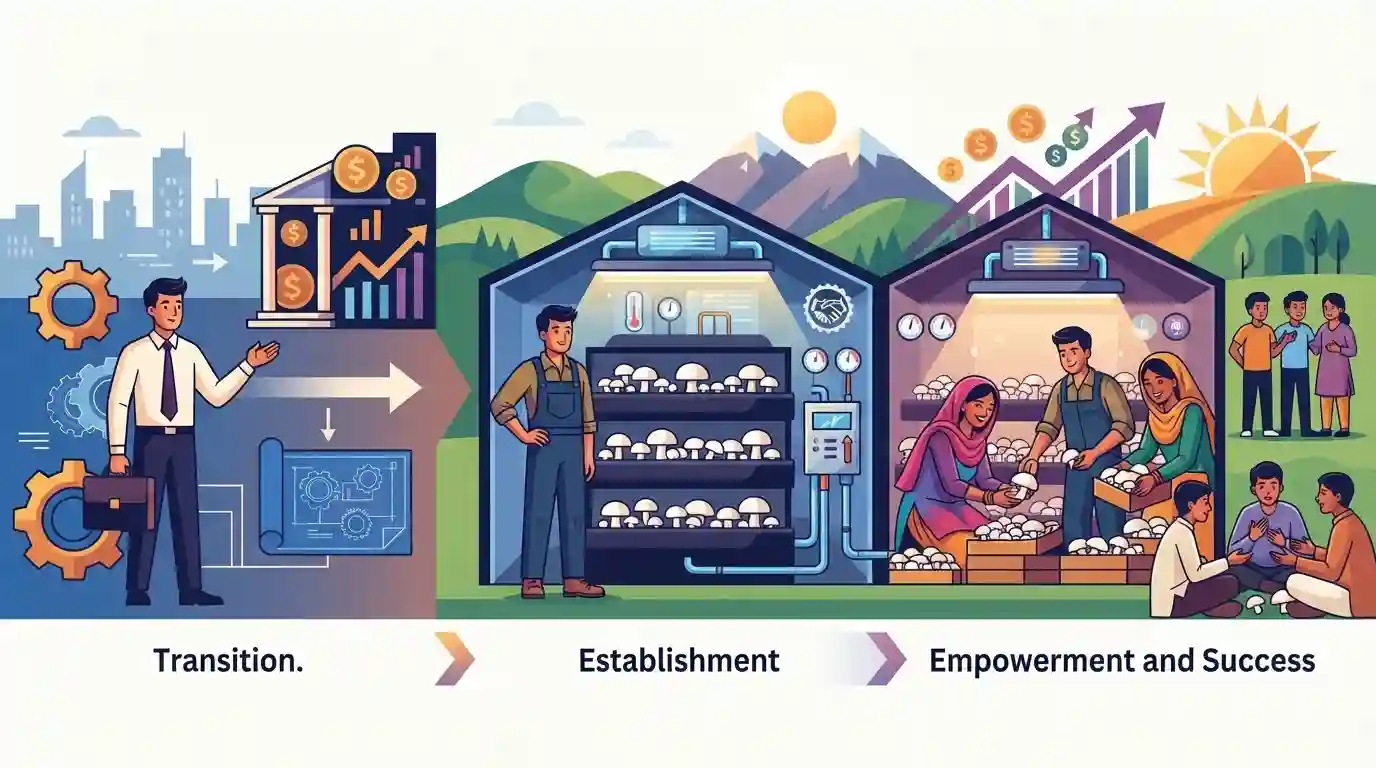
A mechanical engineer in Himachal Pradesh's Kangra district has successfully established a highly profitable, climate-controlled mushroom farm by leveraging the Mission for Integrated Development of Horticulture (MIDH). His transition from the banking sector to agri-entrepreneurship is not only generating significant revenue but also creating employment opportunities for local women, serving as an encouraging model for youth to utilize state horticulture schemes for self-reliance.
Key Points
- Pranav Dhar, a mechanical engineer, left his banking job to establish a climate-controlled mushroom farm in Samloti village, Kangra.
- He received Rs 15 lakh financial assistance from the HP Horticulture Department under the Mission for Integrated Development of Horticulture (MIDH).
- The farm produces 300-400 kg of button mushrooms daily, earning around Rs 40 lakh revenue in six months.
- The initiative has created local employment, specifically for rural women, demonstrating successful rural entrepreneurship.
- The Himachal Pradesh government offers subsidies up to Rs 1 lakh for small units and supports larger commercial units through schemes like MIDH.
Important Terms
Mission for Integrated Development of Horticulture (MIDH)

A centrally sponsored scheme for the holistic growth of India's horticulture sector, providing financial and technical assistance to farmers for crops like mushrooms, fruits, and vegetables to enhance crop quality and market access.
UPSC context
Relevant for HPAS GS Paper-III (Agriculture). Tests knowledge of central government schemes promoting agri-entrepreneurship, crop diversification, and the rural economy.
Himachal Vikas Yojana
A state-level initiative administered by the Himachal Pradesh government providing financial subsidies—such as up to Rs 1 lakh for small-scale mushroom production units—to encourage local agricultural entrepreneurship and horticulture projects.
UPSC context
Crucial for HPAS GS Paper-III (Economy of HP). Evaluates awareness of state-specific economic empowerment, horticultural incentives, and rural employment schemes.
Himachal Pradesh Horticulture Department
The state's nodal agency responsible for implementing central and state horticulture programs. It provides financial subsidies, technical training, and infrastructural support to help local farmers transition to commercial and climate-controlled farming.
UPSC context
Relevant to HPAS GS Paper-II (Governance) and Paper-III. Tests understanding of the state institutional frameworks driving rural development and agricultural modernization.
Prelims Trap
MIDH is a 100% Central Sector Scheme implemented uniformly across all states.
MIDH is a Centrally Sponsored Scheme. For North-Eastern and Himalayan states like Himachal Pradesh, the funding ratio is 90:10 (Centre:State), not 100% central funding.
Static Concepts Connected
What are the key milestones of mushroom cultivation in Himachal Pradesh?
- UNDP Collaboration: Established a dedicated mushroom center at Solan in 1970 to popularize white button mushroom cultivation.
- Mushroom City: Solan pioneered commercial cultivation on scientific lines in 1977, officially earning the title 'Mushroom City of India'.
- Indo-Dutch Project: Launched in Palampur (Kangra) in 1985 to introduce modern Dutch technology for large-scale mushroom production.
What are the core features of the Mission for Integrated Development of Horticulture (MIDH)?
- Scope: A Centrally Sponsored Scheme for the holistic growth of the horticulture sector encompassing fruits, vegetables, root & tuber crops, mushrooms, and spices.
- Funding Pattern: The pattern is 60:40 for general states, but 90:10 (Centre:State) for North Eastern and Himalayan states like Himachal Pradesh.
- Sub-schemes: Incorporates sub-schemes like the National Horticulture Mission (NHM) and Horticulture Mission for North East & Himalayan States (HMNEH).
Cross-Topic Patterns
Foreign Funding in HP Horticulture
Historic collaborations like the UNDP (Solan) and Indo-Dutch (Palampur) set the stage for modern multi-lateral funded projects like ADB-backed HP SHIVA for sub-tropical horticulture.
Youth Agri-Entrepreneurship and MMSY
Transitions from corporate jobs to tech-driven farming tie directly into the state's push for self-employment and reverse migration through schemes like Mukhya Mantri Swavalamban Yojana (MMSY).

A multi-statement Prelims question will likely combine MIDH funding ratios (90:10 for HP) with historical facts like Solan's UNDP origins.
Linked PYQs · 2
Linked PYQs · 2
- 2025HPAS_PRELIMSGS1
Match List I with List II : | List-I (Scheme) | List-II (Launch Year) | |---|---| | (a) Mukhya Mantri Roshni Yojana | (i) 2015 | | (b) Himachal Pradesh Horticulture Development Project | (ii) 2019 | | (c) Mukhya Mantri Gram Path Yojana | (iii) 2009 | | (d) Swavalamban Yojana | (iv) 2020 | Choose the correct answer from the options given below : Code: (a) (b) (c) (d)
- 2023HPAS_PRELIMSGS1
Match List I with List II : | List-I | List-II | |---|---| | (a) Himachal Pradesh Skill Development Project | (i) 2018 | | (b) Himachal Pradesh Kaushal Vikas Nigam | (ii) 2017 | | (c) Mukhya Mantri Yuva Ajivika Yojana | (iii) 2014 | | (d) Himachal Grhini Suvidha Yojana | (iv) 2019 | Choose the correct answer from the options given below : Code: (a) (b) (c) (d)
