Himachal Pradesh adopts AI and advanced tech for disaster management
Source:thenewshimachal ↗
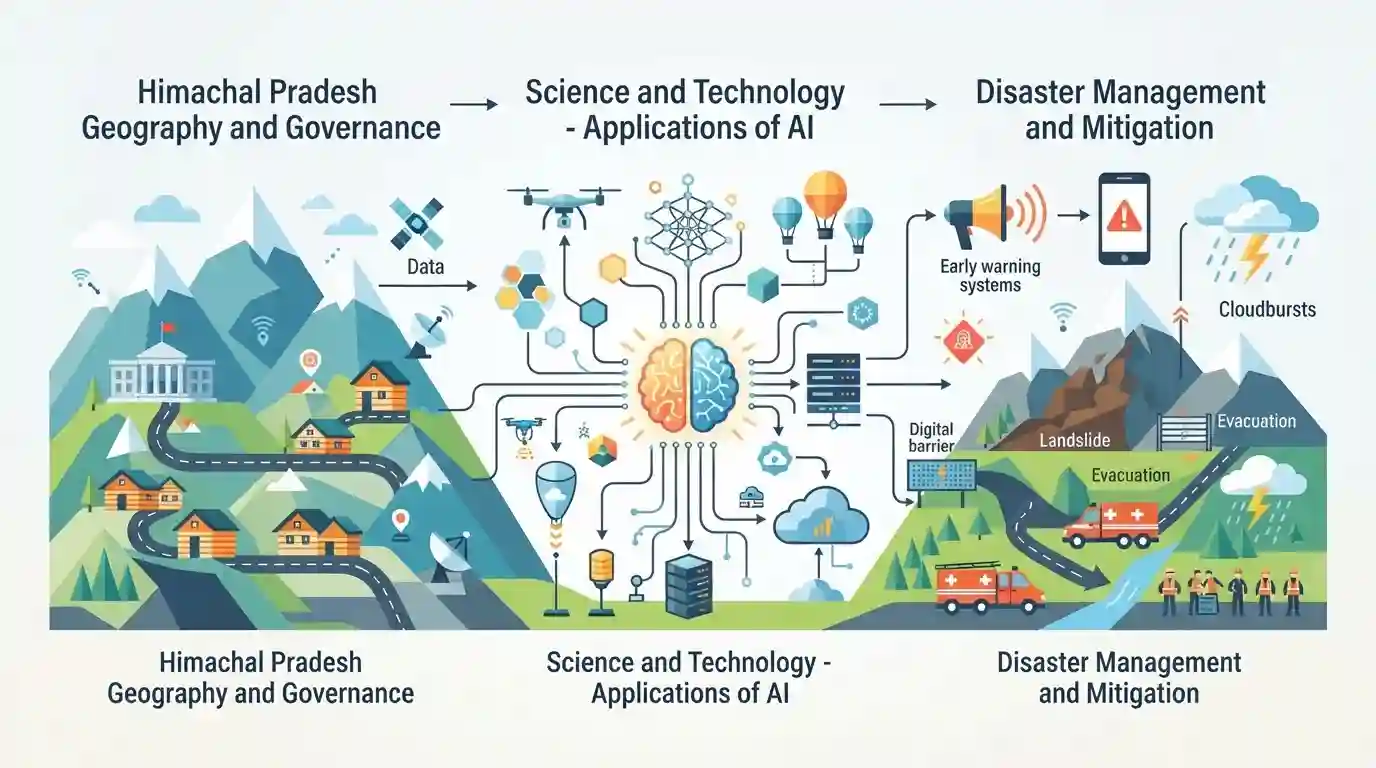
Why It Matters
Crucial for understanding how hill states like Himachal Pradesh leverage emerging technologies (AI/IoT) for disaster risk reduction and climate resilience.
Summary
The Himachal Pradesh government is adopting Artificial Intelligence and advanced technologies to strengthen its disaster management systems, focusing on early warnings and mitigating climate-induced hazards like landslides and cloudbursts in the fragile Himalayan terrain.
Key Points
- Himachal Pradesh is integrating Artificial Intelligence (AI) and advanced technologies into its disaster management framework.
- The initiative aims to improve early warning systems, landslide prediction, and real-time monitoring of vulnerable geographic zones in the mountainous state.
- Given Himachal Pradesh's fragile Himalayan topography, recurring cloudbursts, and landslides, advanced tech integration addresses critical gaps in disaster preparedness and mitigation.
Important Terms
Artificial Intelligence in Disaster Management

The integration of machine learning and predictive data models to monitor geological and weather indicators, enabling proactive evacuation alerts and risk mitigation in fragile mountainous regions.
UPSC context
Relevant to GS Paper III (Science & Tech applications, Disaster Management). Tests knowledge of emerging technologies mitigating natural hazards.
Cloudbursts
Sudden, highly localized, intense rainstorms common in the Himalayas that trigger severe flash floods, landslides, and infrastructure damage across fragile terrains.
UPSC context
Relevant to GS Paper I (Geography - Himalayan hazards) and GS Paper III (Disaster Management). Tests understanding of extreme weather phenomena.
Landslides
Mass movements of earth and rock down steep slopes, frequently induced by heavy monsoon rains, unscientific excavation, or earthquakes in the Himalayan belt.
UPSC context
Relevant to GS Paper I (Physical Geography) and GS Paper III (Disaster vulnerability and mitigation strategies in hill states).
Himachal Pradesh Government
The administrative apparatus of Himachal Pradesh implementing proactive policies, technological frameworks, and early-warning networks to protect local lives and infrastructure from natural calamities.
UPSC context
Relevant to HPAS General Studies papers, focusing on regional governance, state-level policy responses, and administrative handling of ecological vulnerabilities.
Static Concepts Connected
What are the key seismic zones and disaster vulnerabilities specific to Himachal Pradesh's geography?
- Seismic Zones: Seismic Vulnerability: HP lies primarily within Seismic Zones IV (Severe) and V (Very Severe), making it prone to high-intensity earthquakes along tectonic faults.
- Terrain Risk: Himalayan Fragility: Young fold mountains, fragile strata, and steep slopes cause frequent landslides, mass wasting, and debris avalanches.
- Cloudbursts: Hydrometeorological Threats: Monsoonal cloudbursts trigger flash floods in narrow river valleys, heavily impacting hydel projects and settlements.
Cross-Topic Patterns
AI Disaster Management + Western Himalayan Fragility
Integrating IoT and AI into high-altitude terrains bridges HP state governance with national disaster management frameworks like NDMA guidelines on landslide mitigation.

AI-driven early warning systems in fragile Himalayan terrains like HP's Seismic Zones IV/V will feature in Mains GS-3 Disaster Management.
Linked PYQs · 2
Linked PYQs · 2
- 2025HPAS_PRELIMSGS1
Mountain Soil Zone in Himachal Pradesh is found between :
- 2018HPAS_PRELIMSGS1
Which are the projects selected by World Economic Forum to be launched as Centre for Fourth Industrial Revolution in India ?
