Dalhousie Bakrota land use change and High Court environmental ruling
Source:Indian Express ↗
Why It Matters
This ruling is significant for HPAS aspirants as it deals with environmental jurisprudence, urban planning, and land use regulations in the ecologically fragile hill stations of Himachal Pradesh.
Summary
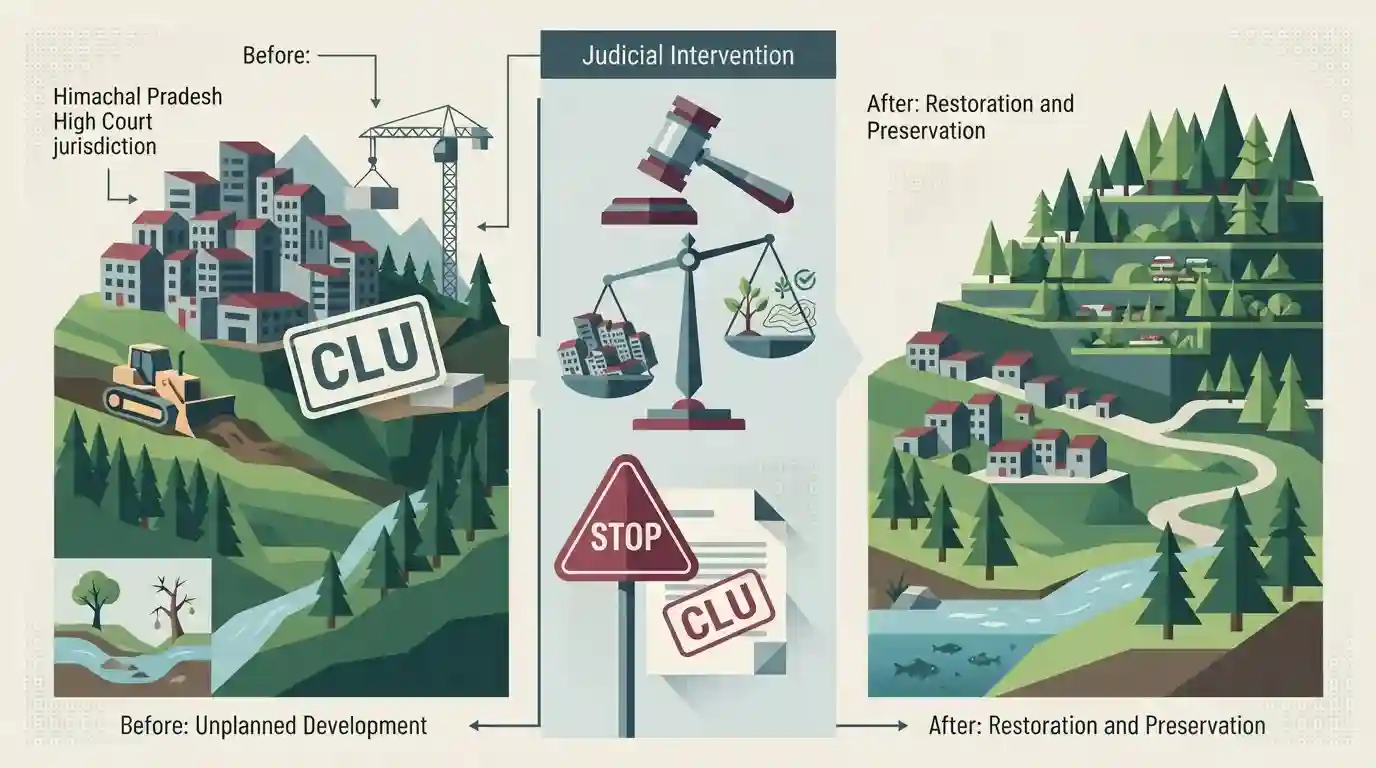
The Himachal Pradesh High Court has quashed the Change of Land Use (CLU) permission granted for commercialisation in the Bakrota area of Dalhousie, reinforcing judicial oversight on environmental preservation and urban planning regulations in ecologically fragile hill regions of the state.
Key Points
- The Himachal Pradesh High Court quashed Change of Land Use (CLU) permission granted for commercialisation in the Bakrota area of Dalhousie.
- The ruling highlights judicial scrutiny over environmental degradation, urban congestion, and unregulated commercial development in ecologically sensitive hill stations of Himachal Pradesh.
- Emphasizes strict adherence to town and country planning laws and environmental safeguards in fragile Himalayan ecosystems.
Important Terms
Himachal Pradesh High Court

The highest judicial body in Himachal Pradesh, exercising constitutional and appellate jurisdiction, including environmental public interest litigations to protect ecologically fragile hill areas.
UPSC context
HPAS Paper II (Polity & Governance): Important constitutional role, judicial review, and interventions in environmental protection and urban planning.
Himachal Pradesh Town and Country Planning Act
The primary state legislation regulating land use, urban planning, and development plans to prevent haphazard construction in hilly areas.
UPSC context
HPAS Paper III (Environment & Economy): Core statutory framework for state land management, urban growth regulations, and hill ecology protection.
Prelims Trap
Change of Land Use (CLU) permissions granted by state appellate authorities in restricted ecological zones are legally final and immune to judicial review.
Aspirants might assume that the State Executive or Town and Country Planning Ministry holds absolute discretionary power to alter land use in restricted zones, missing the strict judicial oversight enforced by the High Court.
Static Concepts Connected
What are the key provisions and regulatory bodies under the HP Town and Country Planning (TCP) Act?
- TCP Authority: Statutory Board regulates planned urban development, land use, and zoning restrictions across designated planning areas in Himachal Pradesh.
- Land Use Control: Prohibits unauthorized construction and commercialisation in designated 'Restricted Areas' or fragile green belts to prevent environmental degradation.
- CLU Mandate: Change of Land Use (CLU) requires rigorous environmental impact assessment and statutory compliance before any commercial conversion is approved.
Cross-Topic Patterns
CLU Quashing + Himalayan Disaster Management
Unregulated commercialisation in hill stations directly triggers urban landslides and flash floods, linking town planning violations to broader Himalayan disaster management concerns.

Himalayan urban ecology, TCP Act violations, and PIL jurisdiction are prime candidates for HPAS Mains GS3 (Environment) questions.
Linked PYQs · 2
Linked PYQs · 2
- 2020HPAS_PRELIMSGS1
Which of the following is / are correct about the Himachal Pradesh Town | Country Planning Act-1977? 1. It has been enforced in 55 Planning areas. 2. Planning area constitutes to 1.60 % of the total geographical area of the state. 3. The above act is enforced in 35 special areas of Himachal Pradesh. 4. 2.06% area of the total geographical area of the state comes under special area.
- 2022HPAS_PRELIMSGS1
Select the correct statements from the following : (i) Supreme Court of India has allowed the State for silviculture green felling of three species on experimental basis. (ii) Forests in H.P. cover an area of 37947 sq. kms of total geographical area of the state (iii) In H.P. presently 30% of the total geographical areas support forest cover. (iv) The aim of the forest department is to enhance the forest cover in the state to 35% of its geographical area by 2030.
