Kullu District Officials Transferred Following High Court Order
Source:aninews.in ↗
Why It Matters
This article illustrates the practical application of judicial mechanisms holding civil servants accountable for dereliction of duty (similar in spirit to writs like Mandamus) and highlights the ongoing socio-economic and security challenges of drug tourism in Himachal Pradesh's Parvati Valley.
Summary
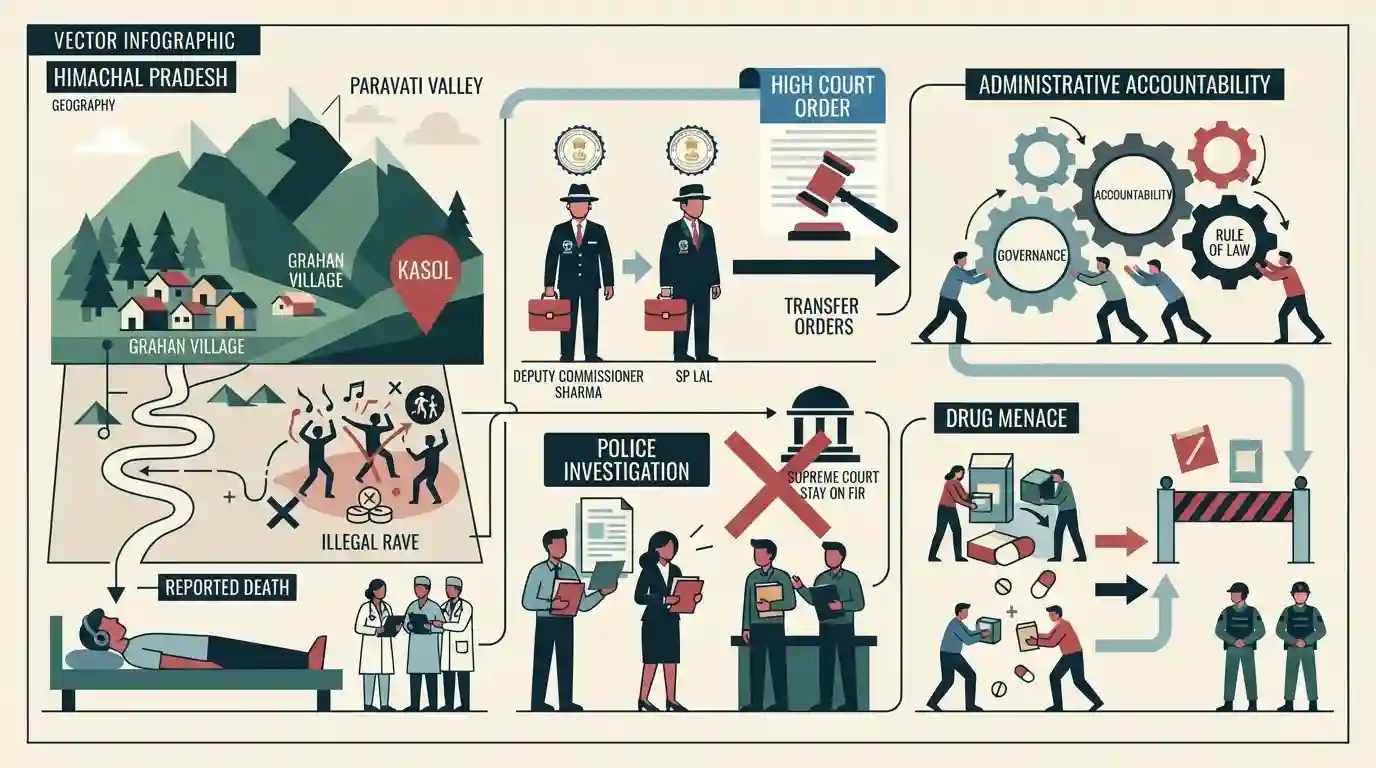
The Himachal Pradesh government has transferred Kullu Deputy Commissioner Anurag Chander Sharma and Superintendent of Police Madan Lal following a High Court order. The officials faced judicial scrutiny for their failure to stop a major illegal rave party in Grahan village near Kasol in the Parvati Valley, where rampant drug abuse led to the death of a Russian DJ. While the High Court ordered an FIR and an SIT probe against the officers for dereliction of duty, the Supreme Court stayed the FIR but allowed the transfers to proceed. The case highlights significant concerns over drug tourism and administrative accountability in the region.
Key Points
- The Himachal Pradesh High Court directed action against the Kullu DC and SP for failing to prevent a large-scale illegal rave party in Grahan village, Kasol.
- The illegal party in Parvati Valley was marked by rampant substance abuse, including cocaine and LSD, and resulted in the suspected drug overdose death of a Russian DJ.
- The High Court ordered an SIT probe and an FIR against the top district officials for dereliction of duty.
- The Supreme Court intervened by staying the FIR against the officers but allowed the state government to proceed with their administrative transfers.
- The incident underscores the severe challenges of drug tourism in the Parvati Valley and highlights the role of judicial oversight over executive negligence.
Important Terms
Narcotic Drugs and Psychotropic Substances Act (NDPS Act)

A 1985 central legislation that prohibits the production, cultivation, sale, purchase, transport, and consumption of narcotic drugs and psychotropic substances, prescribing graded punishments based on seized quantities.
UPSC context
Crucial for GS Paper 3 (Internal Security) and GS 2 (Governance) to address the drug menace and law enforcement challenges.
Special Investigation Team (SIT)
An ad-hoc, specialized law enforcement group formed by a government or constitutional court to impartially investigate complex, high-profile, or sensitive cases where standard policing is deemed insufficient.
UPSC context
Relates to GS Paper 2 (Judiciary/Governance), testing mechanisms of administrative accountability and judicial oversight of the executive.
Dereliction of Duty
The willful failure or gross negligence of a public servant to execute their legally mandated responsibilities, potentially leading to administrative action or criminal liability under the IPC.
UPSC context
Tests GS Paper 4 (Probity in Governance) and GS Paper 2 (Role of Civil Services), emphasizing official accountability and ethics.
Parvati Valley
A river valley in Himachal Pradesh's Kullu district. Known for scenic tourism, it also faces severe governance challenges due to illegal rave parties, cannabis cultivation, and synthetic drug trafficking.
UPSC context
Relevant to GS Paper 1 (Geography) and GS Paper 3 (Internal Security), illustrating the nexus between tourism and organized crime.
Supreme Court of India
India’s apex judicial authority. Under its appellate jurisdiction, it can review, modify, or stay orders from High Courts, ensuring judicial directives adhere to procedural fairness and constitutional boundaries.
UPSC context
Important for GS Paper 2 (Judiciary); tests understanding of appellate jurisdiction, stay orders, and inter-court dynamics.
Prelims Trap
The Supreme Court invoked its Original Jurisdiction under Article 131 to stay the High Court's FIR order against state officials.
Article 131 deals strictly with federal disputes (Centre vs. States). Appeals against High Court orders, such as staying an FIR against officials, fall under the discretionary appellate power via Special Leave Petitions (Article 136).
Static Concepts Connected
What is the geographical profile of the Parvati River?
- Origin: Originates from the Man Talai Glacier below the Pin Parbati pass in Himachal Pradesh.
- River Basin: Acts as a major eastern tributary of the Beas River, merging with it at Bhuntar.
- Key Features: Forms the Parvati Valley (Kasol, Manikaran) known for geothermal springs and ecologically sensitive alpine forests.
Which writ applies when public officials fail to prevent illegal activities?
- Writ of Mandamus: Issued by the SC (Art 32) or HC (Art 226) commanding a public official to perform statutory duties they have failed or refused to perform.
- Exceptions: Cannot be issued against private individuals, the President of India, or State Governors.
Cross-Topic Patterns
Drug Tourism & Internal Security
The rise of synthetic drug hubs (LSD/Cocaine) in Himalayan valleys shifts focus from traditional border smuggling to inland 'drug tourism,' complicating NDPS Act enforcement and internal security frameworks.
Judicial Activism vs Executive Domain
Courts ordering FIRs against DMs/SPs bridges GS2 (Judicial Review) and GS4 (Civil Service Accountability), raising debates on judicial overreach versus necessary intervention when the executive fails.

Expect a Prelims question mixing Beas river tributaries (Parvati) with the Supreme Court's SLP (Art 136) and Mandamus writ powers.
Linked PYQs · 2
Linked PYQs · 2
- 2022HPAS_PRELIMSGS1
Select the incorrect combination from the following : (i) Bahadurpur and Bandla ranges : Demi valley (ii) Markanda and Dharti ranges : Dun and Sproon valleys (iii) Chandertal lake : Kunzam range (iv) Source of Parvati river : Mantilai lake
- 2022HPAS_PRELIMSGS1
When any official does not perform his duty, High Court/Supreme Court can issue which writ ?
