State government to upgrade six institutions into model day schools
Source:theprint ↗
Why It Matters
State-specific schemes and government interventions form a crucial portion of HPAS Prelims. The Rajiv Gandhi Government Model Day-Boarding Schools scheme highlights the state's strategic shift to improve public education infrastructure and counter private school enrollment. Awareness of such flagship initiatives is vital for solving match-the-following or statement-based questions on state welfare policies.
Summary
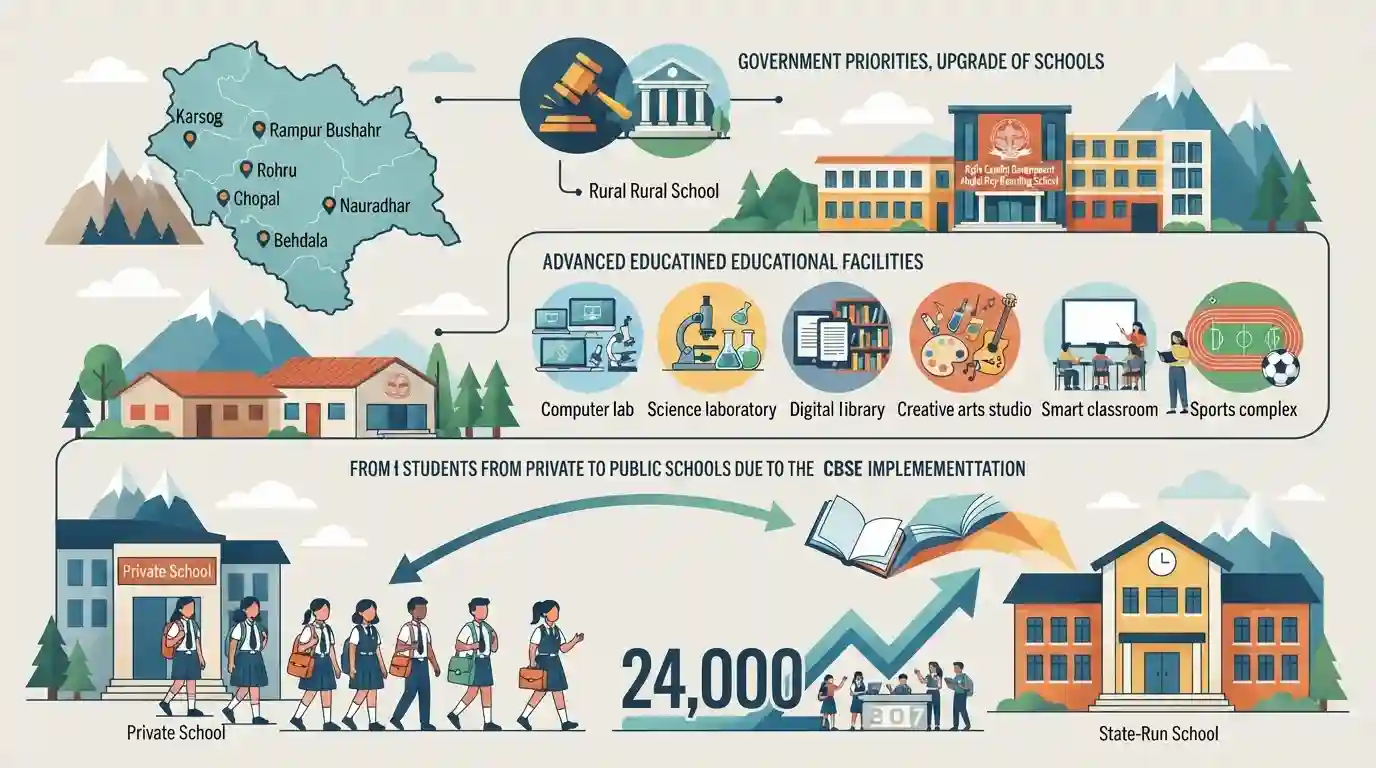
The Himachal Pradesh government, emphasizing education and healthcare as its top priorities, is upgrading six government schools into Rajiv Gandhi Government Model Day-Boarding Schools. Located across Karsog, Rampur Bushahr, Rohru, Chopal, Nauradhar, and Behdala, these institutions aim to provide advanced educational facilities and better infrastructure, particularly to rural students. The Chief Minister also highlighted the success of implementing CBSE-based education in public schools, which prompted 24,000 students to transition from private institutions to state-run schools.
Key Points
- The Himachal Pradesh government has decided to upgrade six existing government schools to Rajiv Gandhi Government Model Day-Boarding Schools.
- These upgrades aim to provide modern educational facilities and better infrastructure, specifically benefiting students from rural areas.
- The selected schools are located in Karsog, Rampur Bushahr, Rohru, Chopal, Nauradhar, and Behdala.
- The introduction of CBSE-based education in government schools has been successful, encouraging approximately 24,000 students to migrate from private to state-run schools.
Important Terms
Rajiv Gandhi Government Model Day-Boarding Schools

A Himachal Pradesh government initiative establishing modern schools in every assembly constituency. They offer holistic education from pre-primary to class 12, featuring state-of-the-art facilities like smart classrooms and sports infrastructure to bridge rural-urban education gaps.
UPSC context
Relevant for GS Paper 2 (Education, Government Policies). Tests knowledge of state-level educational reforms and rural development.
Central Board of Secondary Education (CBSE)
A national-level education board for public and private schools, managed by the Union Government. It sets uniform curricula and conducts standardized exams, providing a recognized educational benchmark often utilized for competitive exam preparation.
UPSC context
GS Paper 2 (Issues relating to Education). Tests understanding of national education bodies, curricula standards, and educational governance.
Himachal Pradesh Government
The state administrative authority currently spearheading significant social sector reforms. Its recent initiatives prioritize healthcare and education, notably upgrading rural school infrastructure and integrating the CBSE curriculum to improve public education quality.
UPSC context
Relevant for GS Paper 2 (State Governance, Social Sectors). Illustrates state-level interventions and resource allocation for human capital development.
Prelims Trap
"Rajiv Gandhi Model Day-Boarding Schools are being upgraded across India under the PM SHRI scheme."
This is purely a State Sector scheme by the Himachal Pradesh government, not to be confused with the Centrally Sponsored PM SHRI scheme.
Static Concepts Connected
What is the PM SHRI Scheme for public education?
- Nature of Scheme: A Centrally Sponsored Scheme to upgrade and develop more than 14,500 schools across India.
- NEP 2020 Exemplars: Schools will act as exemplars for the National Education Policy (NEP) 2020, offering mentorship to other schools in their vicinity.
- Green Schools focus: Incorporate environment-friendly aspects like solar panels, LED lights, and nutrition gardens, alongside climate change education.
What does "Reverse Migration" in education signify in recent macroeconomic reports?
- Definition: The shifting of student enrollments from private, fee-charging schools back into government-run schools.
- Key Drivers: Initially triggered by post-COVID economic distress, but sustained by improved public school infrastructure, free textbooks, and curriculum upgrades.
- Data Sources: Captured systematically by the Annual Status of Education Report (ASER) and the government's UDISE+ database.
Cross-Topic Patterns
ASER trends & Reverse Migration
The shift of 24,000 students to HP government schools mirrors the national "reverse migration" trend in K-12 education, a phenomenon heavily tracked by ASER and recent Economic Surveys.
Competitive Federalism in Education
Himachal's shift to CBSE and day-boarding models reflects competitive federalism in human capital, mirroring initiatives like Delhi's SOE (Schools of Excellence) and the Union's PM SHRI.

Expect a Mains GS2 question evaluating 'reverse migration' in K-12 education and the role of State-led infrastructure upgrades vs PM SHRI.
Linked PYQs · 3
Linked PYQs · 3
- 2017HPAS_PRELIMSGS1
To improve the Gross Enrolment Ratio (GER) in Higher Education the Government of H.P. has adopted 'Rashtriya Uchtar Shikha Abhiyan' the centrally sponsored scheme in the year :
- 2020HPAS_PRELIMSGS1
Consider the given four statements and choose the correct answer from the given options. Which of the following statement(s) is / are not correct about the Social Welfare programs of Government of Himachal Pradesh? 1. e-Udyan portal: Where farmers can avail Horticulture farming service benefits while sitting in their home. 2. Vishesh Mahila Uthan Yojna: Scheme formulated for rehabilitation of physically and sexually abused women through technical and vocational training. 3. Medha Protsahan Yojna: Rupees one lakh is provided to the meritorious students to provide guidance at coaching centers. 4. Mukhya Mantri Ek Bigha Scheme: State Government will empower rural women by helping them become self-sufficient and get employment under MGNREGS.
- 2023HPAS_PRELIMSGS1
Match List I with List II : | List-I | List-II | |---|---| | (a) Himachal Pradesh Skill Development Project | (i) 2018 | | (b) Himachal Pradesh Kaushal Vikas Nigam | (ii) 2017 | | (c) Mukhya Mantri Yuva Ajivika Yojana | (iii) 2014 | | (d) Himachal Grhini Suvidha Yojana | (iv) 2019 | Choose the correct answer from the options given below : Code: (a) (b) (c) (d)
