Himachal government plans to develop 50 new eco-tourism sites
Source:hindustantimes ↗
Why It Matters
Important for HPAS Prelims regarding state government tourism initiatives, economic development policies, and environmental sustainability efforts in Himachal Pradesh.
Summary
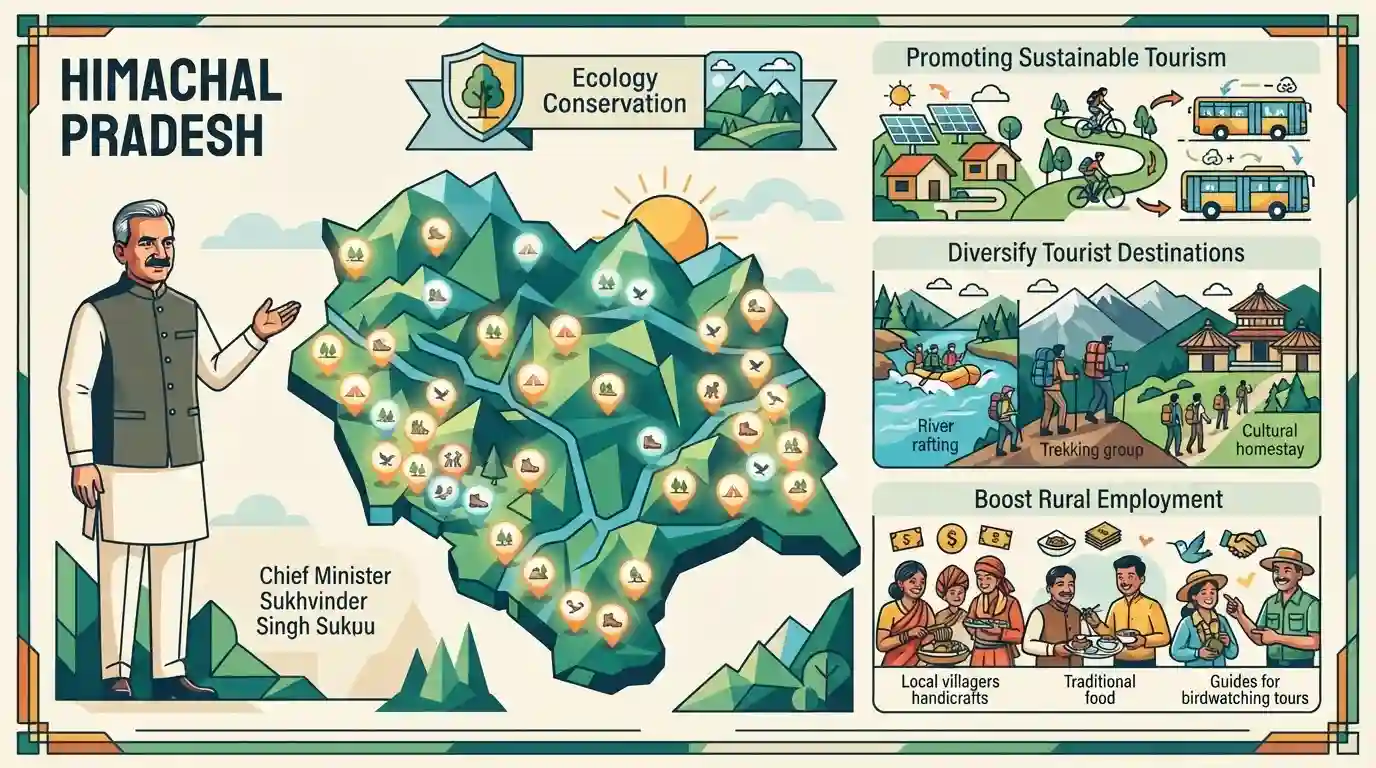
The Himachal Pradesh government has announced plans to develop 50 new eco-tourism sites across the state under the leadership of Chief Minister Sukhvinder Singh Sukhu, aiming to promote sustainable tourism, diversify tourist destinations, and boost rural employment while preserving the state's natural ecology.
Key Points
- Himachal Pradesh government plans to develop 50 new eco-tourism sites across the state to boost sustainable tourism and generate employment.
- Chief Minister Sukhvinder Singh Sukhu emphasized blending environmental conservation with economic growth through eco-tourism initiatives.
- The initiative aims to diversify tourist destinations beyond conventional hotspots, bringing economic benefits to rural and forested areas.
Important Terms
Himachal Pradesh Government

The executive authority of Himachal Pradesh responsible for formulating state policies, administering governance, and implementing development programs like eco-tourism expansion under the Chief Minister.
UPSC context
HPAS Paper II & III: Tests understanding of state administrative framework, policy execution, and regional development strategies.
Eco-Tourism
A model of sustainable travel focused on experiencing natural areas without harming the environment, supporting local rural economies, and conserving biodiversity.
UPSC context
HPAS Paper III (Environment & Economy): Important for questions on sustainable development, tourism policy, and rural employment in hill states.
Prelims Trap
Eco-tourism sites can be developed across any forested tract in Himachal Pradesh without prior central environmental clearances.
Aspirants often assume eco-tourism sites are permitted unfettered commercial construction under forest land, ignoring stringent Central Forest Conservation Act and Wild Life Protection Act clearances.
Static Concepts Connected
What are the key policy guidelines governing eco-tourism and forest conservation in Himachal Pradesh?
- Sustainable Balance: Policy framework balances sustainable rural livelihoods with strict protection of flora, fauna, and fragile Himalayan watersheds.
- Community Participation: Requires mandatory environmental impact assessments and community involvement through Eco-Development Committees (EDCs).
- Regulatory Limits: Restricts commercial construction and high-impact tourism infrastructure in designated wildlife sanctuaries and core forest areas.
Cross-Topic Patterns
Eco-Tourism vs. Forest Conservation Act Linkages
Eco-tourism expansion in fragile Himalayan ecosystems directly intersects with state disaster management frameworks and forest conservation acts restricting non-forestry activities.
Sustainable Tourism & Rural Livelihoods
Decentralizing tourism from overcrowded hubs (Shimla/Manali) to rural areas tests the efficacy of Himachal's rural livelihood and homestay promotion schemes.

HPAS Mains GS3 (Environment/Economy) may ask about balancing eco-tourism revenue generation with ecological carrying capacity in the Himalayas.
Linked PYQs · 3
Linked PYQs · 3
- 2024HPAS_PRELIMSGS1
Match the forest cover area/type with their total area in Himachal Pradesh (2021) : | List I (Density/Total Forest Cover) | List II (Area in sq. kms.) | |---|---| | (a) Very dense forest above 70 percent | (i) 7,100 | | (b) Moderate dense forest 40 to 70 percent | (ii) 5,180 | | (c) Open forest 10 percent to 40 percent | (iii) 15,443 | | (d) Total forest cover | (iv) 3,163 | Choose the correct options : Code: (a) (b) (c) (d)
- 2024HPAS_PRELIMSGS1
Arrange the following years based on the number of foreign tourist arrivals in Himachal Pradesh in descending order : (1) 2020 (2) 2021 (3) 2022 (4) 2023 (up to December 2023) Choose the correct option :
- 2025HPAS_PRELIMSGS1
Consider the following statements : (1) Kibbar is the largest wildlife sanctuary in Himachal Pradesh. (2) Kheerganga National Park was established in 1994 in Himachal Pradesh. (3) Tarla wildlife sanctuary of Himachal Pradesh has an area of 46.4 km². (4) Chail wildlife sanctuary of Himachal Pradesh was established in 1962. Choose the correct answer from the options given below :
